
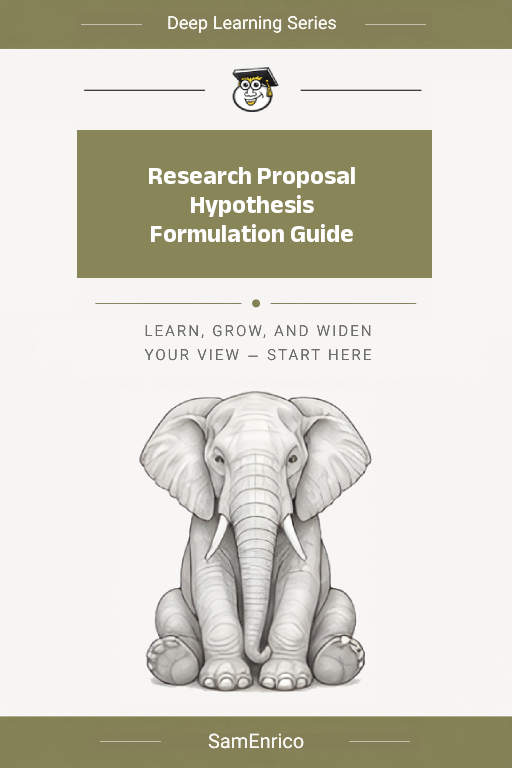
Research Proposal Hypothesis Formulation Guide eBook
Write testable directional or null hypotheses that
by Durr Glynda
Write testable directional or null hypotheses that connect directly to your methodology and analysis plan.
Formats
Free sample
Chapter 1: The Rejection Letter...--–- You have just spent six months writing a research proposal. You have read three hundred papers. You have refined your research question until it shone like a polished stone. You have described your methodology with painstaking precision. You have even anticipated potential limitations and addressed them preemptively, because you are thorough, because you care, because this proposal—this project—matters to you.Then the email arrives.The subject line reads: "Decision on Your Proposal."Your heart does something unpleasant in your chest.
You open it. You skim past the polite salutations, past the "thank you for your submission," past the generic praise that everyone receives. You land on the section that matters: the reviewer comments.And there it is."The hypothesis is not clearly stated.""This reads more as a research question than a testable prediction.""I do not see how you would statistically evaluate the stated hypothesis given the proposed methods.""The direction of the hypothesized effect is not specified.""The null hypothesis is missing or incorrectly framed."Your proposal has been rejected. Or, if you are fortunate, it has been returned for "major revisions"—academic code for "we are giving you one more chance to fix this before we say no."You read the comments again. And again.
And you realize something that makes your stomach tighten: you are not entirely sure what you did wrong.The reviewer used words like "falsifiable" and "operationalized" and "directional" and "null." You have heard these words before, in methods classes, in conversations with advisors, in the margins of statistics textbooks. But somehow, when you tried to apply them to your own work, the result came out wrong. Your hypothesis—the sentence you wrote with such confidence—failed.This chapter is about why that happens. More importantly, this chapter is about how to make sure it never happens to you again.The Anatomy of a Proposal Rejection Before we can fix broken hypotheses, we must understand how they break. Over fifteen years of reviewing proposals for graduate committees, grant agencies, and journals, I have read thousands of hypotheses.
I have also written my own share of terrible ones—hypotheses so vague, so untestable, so utterly disconnected from their accompanying methods that I now cringe to remember them. But failure teaches. And what I have learned is that hypothesis-related rejections fall into a small number of predictable patterns.Let me show you three real examples. The identifying details have been removed, but the fatal flaws remain intact.Case 1: The Vague Prediction"We hypothesize that mindfulness training will improve student well-being."The reviewer wrote: "What does 'improve' mean? In what direction?
How will you measure well-being? A hypothesis that cannot be disconfirmed is not a hypothesis; it is a hope dressed in academic language."Case 2: The Question Masquerading as a Hypothesis"We hypothesize that there is a relationship between social media use and adolescent anxiety."The reviewer wrote: "This is a research question ('Is there a relationship?') restated as a declarative sentence. A hypothesis must predict the nature of the relationship—positive, negative, curvilinear—not merely assert that something exists."Case 3: The Methodless Prediction"We hypothesize that the intervention will reduce symptoms."The reviewer wrote: "Reduce by how much? Compared to what? Using which statistical test?
A hypothesis without an attached analysis plan is a wish, not a testable claim. The reviewer cannot evaluate feasibility because the hypothesis does not specify what 'reduce' means operationally or how reduction will be assessed."Each of these proposals was otherwise strong. The literature reviews were thorough. The research questions were interesting. The writing was clear.
But in each case, the hypothesis—that single, seemingly simple sentence—brought the entire proposal down.Why? Because the hypothesis is the engine of your proposal. If the engine is broken, no one cares how beautiful the body of the car is. Reviewers know that a weak hypothesis predicts a weak study. They will reject your proposal not because they are cruel, but because they are acting as gatekeepers for scientific rigor.
A study with a flawed hypothesis cannot produce interpretable results. And uninterpretable results are, from the perspective of science, not results at all.The Research Question vs. The Hypothesis: A Crucial Distinction Before we go any further, we must establish a distinction that will save you from one of the most common proposal killers. A research question and a hypothesis are not the same thing, and treating them as interchangeable is a reliable path to rejection.A research question is open-ended. It asks about the world without committing to a specific answer.
Examples:Does sleep affect academic performance?Is there a relationship between social support and depression?How do first-generation college students experience impostor phenomenon?These are perfectly good research questions. They identify a phenomenon of interest and open an inquiry. But they are not hypotheses. A research question says, "I wonder what I will find." A hypothesis says, "I predict what I will find."A hypothesis is a specific, testable prediction about the relationship between variables or the difference between groups. It commits to an answer before the data are collected.
Examples:Students who sleep seven or more hours per night will have higher mean GPAs than students who sleep fewer than seven hours.Higher perceived social support will predict lower depression scores, controlling for baseline depression.First-generation college students will report impostor phenomenon primarily through avoidance behaviors (e.g., skipping office hours, not asking questions in class) rather than through affective distress.Notice the difference. The research question asks; the hypothesis predicts. The research question is open; the hypothesis is closed. The research question says "maybe"; the hypothesis says "this."Why does this distinction matter? Because science progresses through testing predictions, not through wandering curiosity.
A research question can guide an exploratory study, but a confirmatory study—the kind that grant agencies and journals prefer—requires a hypothesis. Without a hypothesis, you have no clear criterion for success or failure. You cannot say, "My prediction was confirmed" or "My prediction was disconfirmed." You can only say, "Here is what I observed," which is observation, not science.The Three Fatal Errors (And Why They Kill Proposals)Over years of reviewing proposals, I have observed that hypothesis failures cluster into three distinct categories. I call these the three fatal errors because any one of them is sufficient to guarantee rejection. Learn to recognize them in your own writing, and you will have eliminated the majority of reasons reviewers reject hypotheses.Fatal Error #1: Non-Directional Guessing Non-directional guessing occurs when a hypothesis states that something will happen but does not specify what, exactly, will happen.
The hypothesis commits to an effect but not to its nature.Examples:"There will be a difference between the treatment and control groups.""Social media use is related to anxiety.""The intervention will change participant behavior."These statements are not false, exactly. They are simply… empty. A difference in which direction? A relationship of what kind—positive, negative, curvilinear? A change toward what end—improvement, deterioration, sideways drift?A hypothesis that does not specify direction is unfalsifiable in practice because any outcome can be interpreted as consistent with the hypothesis.
If the treatment group scores higher, you say "There was a difference." If they score lower, you say "There was…
This is the end of the free sample. Get the eBook to keep going. Buy now
About this book
Details
- Author
- Durr Glynda
- Publisher
- SamEnrico
- Language
- English
- Genre
- research, Student's Shortcut
- Released
- 2026-06-01
- Pages (approx.)
- 155
- Available as
- eBook, Audiobook

Read better in the ZLOADR app
Your eBooks on your phone or tablet. Sign in with your SamEnrico account and start reading.
More by Durr Glynda
 Senior Housing Tax DeductionsDurr Glynda$11.99
 Parenting Trigger ManagementDurr Glynda$11.99
 Sam Sheppard Death And MysteryDurr Glynda$11.99
 Hookah and Shisha Toxin GuideDurr Glynda$11.99
 Neurotech Investment MapDurr Glynda$11.99
 The Elevator Pitch BlueprintDurr Glynda$11.99
 Tinnitus Hypnosis ScriptsDurr Glynda$11.99
 Theme Days SchedulingDurr Glynda$11.99
 Customer Service AngerDurr Glynda$11.99
 Gold, Guns, and Ghosts: The Cursed 1968 Mexico City OlympicsDurr Glynda$11.99
 Steel and Secrets: The Golden Spike ConspiracyDurr Glynda$11.99
 Quetzalcoatl's Feathers: The Serpent's Divine FlightDurr Glynda$11.99
You may also like
 Scientific Research On TM GuideMartens Nathanial$11.99
 Research Proposal Methodology Section MasteryPauley Debroah$11.99
 Research Proposal Appendix CompilationRaines Tyisha$11.99
 Academic Researcher Distraction GuideFord Virgil$11.99
 TM Research and ScienceCovert Nicki$11.99
 Social Anxiety Research ReviewRoberge Cole$11.99
 Research Proposal Significance Section GuideBock Tory$12.99
 Research Proposal Reviewer PsychologyLugo Tawanda$11.99
 Research Proposal Research Questions DesignLara Robbi$11.99
 Research Proposal References and CitationsPatten Shanice$11.99
 Research Proposal Mixed Methods DesignCameron Omega$11.99
 Research Proposal Data Management PlanAnderson Roberto$12.99