
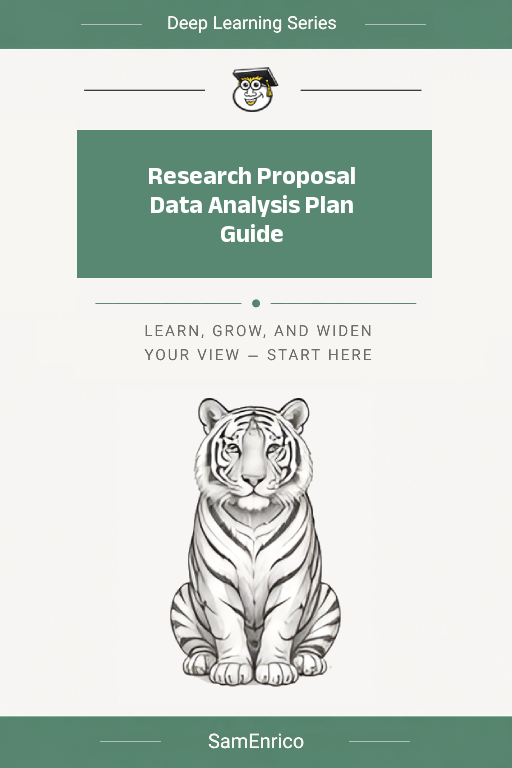
researchStudent's ShortcutData Analysis
Research Proposal Data Analysis Plan Guide Audiobook
Describe appropriate statistical or analytic techn
Describe appropriate statistical or analytic techniques that match your research questions and data types.
Formats
Free sample
Chapter 1: The Graveyard of Vague Plans--Every year, thousands of research proposals die the same quiet death. They are not killed by flawed hypotheses, inadequate budgets, or even poor writing. They are killed by a single, preventable sin: a vague, missing, or mismatched analysis plan.If you are reading this book, you have likely felt the sting of a rejected proposal, or you dread it. You received comments like “the analysis plan is underdeveloped,” “the link between research questions and statistical methods is unclear,” or simply “the methods section is insufficient.” These are not criticisms of your science. They are criticisms of your map.Imagine setting out on a cross-country drive without a GPS, without a paper map, and without having decided whether you will use a car, a bicycle, or a boat.
That is what a research proposal without a coherent analysis plan looks like to a reviewer. They see a journey destined for confusion, p-hacking, or outright failure. This chapter exists to ensure that never happens to you.This chapter opens by reframing the analysis plan not as a technical formality—something to be filled in as an afterthought—but as a persuasive argument for trustworthiness. Grant reviewers, thesis committees, ethics boards, and funding agencies use your analysis plan as a litmus test for your competence. They ask one question as they read it: Does this person know what they are doing, or will they be calling us for help when the data arrive?We will walk through the most common fatal errors observed in rejected proposals: deciding on statistical tests after data collection (a practice that invites p-hacking or HARKing—Hypothesizing After the Results are Known), using a technique that does not match the data type (for example, running a t-test on ordinal Likert items), or omitting the analysis plan entirely.
We will then introduce a simple but powerful alignment model that will serve as the backbone for every chapter in this book: Research Question → Data Type → Analytic Technique → Interpretation. Each arrow in that chain must be justified. If any arrow is broken, your proposal breaks with it.We will conclude by contrasting a weak proposal segment with an exemplary one. Top-funded proposals, you will learn, make their analysis choices feel logically inevitable. The reviewer reads them and thinks, Of course.
Given the question and the data, no other technique would make sense. That is the feeling we are chasing. That…
This is the end of the free sample. Get the Audiobook to keep going. Buy now
About this book
Details
- Author
- Badger Cleotilde
- Publisher
- SamEnrico
- Language
- English
- Genre
- research, Student's Shortcut, Data Analysis
- Released
- 2026-06-01
- Pages (approx.)
- 160
- Available as
- eBook, Audiobook

Listen in the VoxFlicks app
Audiobooks and audio dramas wherever you go. Sign in with your SamEnrico account and press play.
More by Badger Cleotilde
 Number Shape Peg For KidsBadger Cleotilde$11.99
 First Year Widow Survival GuideBadger Cleotilde$11.99
 Crime Scene Reconstruction Court TestimonyBadger Cleotilde$11.99
 Service Animal Rights AdvocateBadger Cleotilde$11.99
 Imposter Procrastination LinkBadger Cleotilde$11.99
 Room Temperature for HypnosisBadger Cleotilde$11.99
 Pomodoro for WritingBadger Cleotilde$11.99
 Justin Timberlake From MickeyBadger Cleotilde$11.99
 Fenrir's Unseen Pup: The Forgotten Howl of the Wolf KingBadger Cleotilde$11.99
 The Lion and the Eagle: Edward III and the Hundred Years' WarBadger Cleotilde$11.99
 Chili Pepper: Harvesting Guide For Fresh, Dried & PowderedBadger Cleotilde$11.99
 How to Produce DrapingBadger Cleotilde$11.99
You may also like
 Scientific Research On TM GuideMartens Nathanial$11.99
 Research Proposal Methodology Section MasteryPauley Debroah$11.99
 Research Proposal Appendix CompilationRaines Tyisha$11.99
 Academic Researcher Distraction GuideFord Virgil$11.99
 TM Research and ScienceCovert Nicki$11.99
 Social Anxiety Research ReviewRoberge Cole$11.99
 Research Proposal Significance Section GuideBock Tory$12.99
 Research Proposal Reviewer PsychologyLugo Tawanda$11.99
 Research Proposal Research Questions DesignLara Robbi$11.99
 Research Proposal References and CitationsPatten Shanice$11.99
 Research Proposal Mixed Methods DesignCameron Omega$11.99
 Research Proposal Data Management PlanAnderson Roberto$12.99