
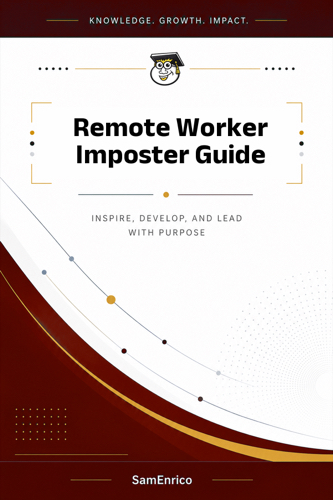
Remote Worker Imposter Guide eBook
Overcoming self doubt when working from home with
Overcoming self doubt when working from home with less feedback and visibility.
Formats
Free sample
Chapter 1: The Feedback Vacuum--You have been staring at the Slack message for eleven minutes.It is three sentences long. You have read it seventeen times. You changed "I think" to "I believe" to "Per my analysis" and then back to "I think." You added an exclamation point, then deleted it, then added it again, then deleted it once more because you worried it looked manic. You considered a thumbs-up emoji but worried that would seem dismissive. You considered no emoji but worried that would seem cold.
Your cursor hovers over the send button. Your chest feels tight. Your cat has walked across your keyboard twice. You have not noticed.You hit send.Then you immediately open the message again. Then you close it.
Then you open it. Then you close it. You imagine your manager reading it. You imagine them frowning. You imagine them forwarding it to someone else with a question mark.
You imagine them thinking, "Why did they phrase it that way?" You imagine them realizing, finally, that you have no idea what you are doing.You check Slack twenty minutes later. No reply. You check again. Still nothing. You check again.
The message has been marked as read. They saw it. They chose not to respond. That means they are angry. That means you are in trouble.
That means the jig is up.You spend the next hour doing absolutely no work because your brain is fully occupied with constructing the elaborate narrative of your own professional demise. You draft a resignation letter in your head. You update your Linked In profile. You calculate how many months of savings you have. All because someone did not reply to a message about a spreadsheet.If you have done this, congratulations.
You are not broken. You are not weak. You are not secretly incompetent. You are experiencing the Feedback Vacuum, and it is the single most predictable, preventable, and pernicious feature of remote work that nobody warned you about.Welcome to the silent workspace.The Death of the Hallway Nod Before the pandemic, before Slack, before Zoom became a verb, work happened in physical spaces. Offices.
Cubicles. Conference rooms with whiteboards and terrible coffee. And in those physical spaces, you received a constant, invisible stream of feedback that you never had to ask for.Let us name what you lost.The hallway nod. You pass your manager near the coffee machine. They look up, see you, nod once, and keep walking.
That is feedback. That nod means "I see you. You belong here. Nothing is on fire." It takes half a second. You do not register it consciously.
But your brain does.The overheard praise. You are walking back from the bathroom and you hear your name. Someone is saying something positive about you to someone else. You were not supposed to hear it. That makes it more credible.
Your brain files it away as evidence: I am valued here.The drive-by compliment. A senior colleague stops at your desk. "Hey, that thing you did yesterday? Saved me an hour. Thanks." They walk away.
The interaction lasts twelve seconds. But your brain releases a small squirt of dopamine. You feel competent. You feel seen.The visual scan. You look around the room and see people working.
Headphones on. Typing. Talking. Thinking. Nobody is pointing at you.
Nobody is whispering about you. The ambient noise of productivity tells your ancient lizard brain: you are safe, you are part of the tribe, you are not being hunted.The post-meeting debrief. You leave a meeting and walk back to your desk with a colleague. "That went well," they say. Or "That was rough." Or "I think you made the right call on the budget thing." This informal, unscripted feedback helps you calibrate.
It tells you what to repeat and what to avoid.All of this is gone now.Remote work did not just change where you sit. It removed the entire invisible architecture of informal feedback that human beings have used for decades to answer the question "How am I doing?" Without that architecture, your brain does not go quiet. It does the opposite. It fills the silence with the loudest story it can find. And the loudest story is always the worst one.The 70 Percent Let us talk about the research, because you need to know that this is not a personal failing.
This is a statistical probability.Imposter syndrome was first identified in 1978 by psychologists Pauline Clance and Suzanne Imes. They studied high-achieving women who were convinced they had somehow fooled everyone into thinking they were smarter than they actually were. These women had doctoral degrees, publications, prestigious jobs. And they lived in constant fear of being "found out."Decades of research have since confirmed that imposter feelings are not limited to women, not limited to early-career professionals, and not limited to any particular industry. Up to 70 percent of high achievers report experiencing imposter syndrome at some point in their careers.
That is seven out of ten people in leadership positions, specialized roles, and competitive fields. The other three are either lying or unusually gifted at self-deception.Here is what the research also tells us. Imposter syndrome is not a clinical diagnosis. It is not a personality disorder. It is a pattern of thinking that is triggered by specific environments.
Change the environment, and you can change the pattern.Remote work is an environment perfectly designed to trigger imposter syndrome. Let us count the ways.First, remote work removes social proof. In an office, you can see other people struggling. You can see them make mistakes, ask questions, admit confusion. That normalizes your own struggles.
Remotely, you see only polished output. You do not see the fifteen drafts. You do not see the frustrated sigh. You do not see the frantic Google search. You see the finished product and assume everyone else produced it effortlessly.Second, remote work removes spontaneous recognition.
In an office, your manager might walk by and say "good job on that report" without any prompting. Remotely, recognition requires effort. Your manager has to remember to send a message. They have to type it out. They have to hit send.
Most managers are too busy, too distracted, or too exhausted to do this consistently. So you hear nothing. And your brain interprets nothing as "you are invisible and probably about to be fired."Third, remote work amplifies asynchronous anxiety. In an office, you ask a question and get an immediate verbal response. You hear the tone.
You see the facial expression. You know within seconds whether you are on the right track. Remotely, you send a message and wait. And wait. And wait.
Every minute of silence is a minute your brain spends constructing worst-case scenarios.Fourth, remote work removes the physical separation between work and home. When your office was a building you left at 5 p.m., your brain had a clear signal: evaluation time is over. Now your office is your living room, your bedroom, your kitchen table. Your brain never leaves evaluation mode. You check Slack at 10 p.m.
You send emails at 6 a.m. You are always on, always available, always being judged. This is not productivity. This…
This is the end of the free sample. Get the eBook to keep going. Buy now
About this book
Details
- Author
- Joyner Cammie
- Publisher
- SamEnrico
- Language
- English
- Genre
- Non-Fiction, Self-Help, Remote Work
- Released
- 2026-06-10
- Pages (approx.)
- 133
- Available as
- eBook, Audiobook

Read better in the ZLOADR app
Your eBooks on your phone or tablet. Sign in with your SamEnrico account and start reading.
More by Joyner Cammie
 TM for Screen AddictionJoyner Cammie$11.99
 Listening Without InterruptingJoyner Cammie$11.99
 Affirmations for ComparisonJoyner Cammie$11.99
 The Sociopath Impulsive CriminalJoyner Cammie$11.99
 The Visionaries of Stone: How Western Architects Shaped DemocracyJoyner Cammie$11.99
 Understanding T-lymphocytopeniaJoyner Cammie$17.99
 How to Become a Dry-house TenderJoyner Cammie$11.99
 Zero Cost Pivot GuideJoyner Cammie$12.99
 Agriculture Invoice FactoringJoyner Cammie$12.99
 SleepingJoyner Cammie$11.99
You may also like
 Remote Work Anger ManagementClay Marlo$11.99
 Weekly Review for Remote WorkersReid Dustin$11.99
 Virtual Networking Success GuideWilloughby Eun$11.99
 Virtual Body Language GuideGilman Marx$11.99
 Virtual Assistant Deployment GuideGossett Kevin$11.99
 Remote Work Self Esteem HandbookTucker Lillie$11.99
 Remote Work Loneliness GuideDennison Karon$11.99
 Remote Work Isolation GuideDurant Shea$11.99
 Remote Work Anger Management GuideCampos Ivey$11.99
 Remote Communication Skills GuideLoomis Billie$11.99
 Breath Awareness For Zoom FatigueParkinson Cassey$11.99
 Virtual Meeting Body Language GuideFeldman Lenna$11.99