
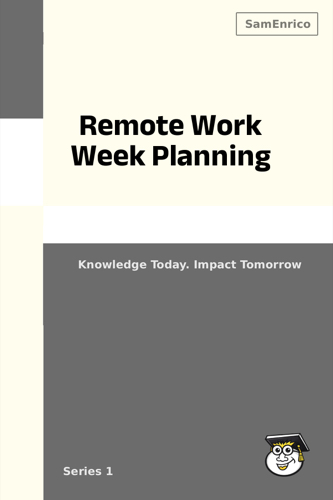
Remote Work Week Planning eBook
undefined
undefined
Formats
Free sample
Chapter 1: The Mirror Test--–- The first time you worked from home, you probably felt a strange mixture of liberation and unease. No commute, no dress code, no one watching you stare blankly at your screen while your coffee cooled. But by the third week, something shifted. You realized that the office, for all its interruptions and fluorescent lighting, had been doing something for you that you never noticed until it was gone. It was hiding your bad habits.This chapter dismantles a foundational myth: that the traditional office workweek was ever truly productive.
It argues that physical presence in an office often masks poor prioritization, because managers and workers alike reward "face time" and visible busyness rather than actual output. When the office disappears, so does that mask. The result is not freedom but exposure—and for many remote workers, that exposure is deeply uncomfortable.The Great Illusion of the 9-to-5Let us begin with an uncomfortable truth. The modern office was not designed for deep thinking. It was designed for supervision.
From the factory floors of the Industrial Revolution to the cubicle farms of the 1990s, the fundamental unit of measurement has always been presence. Could you see the worker? Then the worker was working. This logic persisted long after knowledge work replaced manual labor because it was simple, measurable, and required no trust.The problem is that knowledge work does not operate on presence. It operates on cognition.
And cognition is invisible.When you sit at your desk for eight hours, staring at a spreadsheet, no one knows whether you are analyzing data or mentally planning your grocery list. The office environment therefore creates a perverse incentive: looking busy becomes more important than being productive. This is not a character flaw; it is a rational response to a system that rewards visibility over outcomes.But here is what no one tells you. That system was also protecting you. When you were in the office, the structure of the day—the commute, the fixed lunch hour, the colleagues packing up at 5 PM—provided scaffolding for your attention.
You did not have to decide when to stop working; the building essentially closed. You did not have to negotiate boundaries; the physical separation between work and home was already drawn in miles.Remote work removes that scaffolding. And without it, your unplanned, unarchitected workweek collapses.Why Remote Work Exposes What the Office Hid Consider what happens when you move your work home. The commute vanishes, removing the psychological boundary that once separated "work mode" from "home mode." The environmental cues disappear—no lunch bell, no colleague knocking on your door at quitting time, no manager turning off the lights. The result is what researchers call "boundary blurring," and it is the single greatest source of remote work burnout.But boundary blurring is only half the story.
The other half is prioritization.In the office, poor prioritization was easily masked by activity. You could spend three hours rearranging files, two hours in a meeting that should have been an email, and one hour "networking" by the coffee machine, and still feel like you had a productive day. Your manager saw you at your desk. Your calendar looked full. No one asked the hard question: did any of that actually move the needle?Remote work asks that question constantly.
When you are alone with your screen, there is no one to impress with busyness. The only thing that remains is output. And output requires you to distinguish between tasks that matter and tasks that merely fill time.This distinction is so important that it deserves its own vocabulary.Deep Work Versus Shallow Work: The Essential Distinction The most useful framework for understanding productive work comes from Cal Newport's concept of deep work. Deep work is cognitively demanding, high-value activity that creates real progress. Writing a proposal, analyzing data to find a pattern, coding a new feature, designing a strategy—these are deep work.
They require focus, resist interruption, and produce outcomes that move projects forward.Shallow work is everything else. Answering email, sorting files, scheduling meetings, filling out timesheets, approving routine requests. These tasks are often necessary, but they do not create progress. They maintain the status quo. They fill time without moving the needle.Here is the problem.
The office did not just hide poor prioritization; it actively encouraged shallow work. Open office plans made deep work almost impossible, because every interruption reset your cognitive focus. The constant flow of email, Slack, and drive-by conversations trained you to react rather than to create. Many office workers spent 60 to 70 percent of their day on shallow tasks without ever realizing it, because everyone around them was doing the same thing.Remote work exposes this imbalance. Without the constant interruptions, you suddenly have the opportunity to do deep work.
But opportunity is not the same as ability. Most remote workers find themselves filling the newly quiet hours with the same shallow tasks they did in the office, because those tasks feel safe. Email gives you a dopamine hit. Checking a box feels like progress. But deep work is uncomfortable.
It requires staring at a hard problem without an immediate answer. It requires tolerating confusion. It requires saying no to the small, easy tasks that scream for your attention.This is why most remote workers do not suddenly become more productive when they leave the office. They become more anxious. They work longer hours, because without the boundary of the commute, work bleeds into evening and weekend.
They feel guilty when they step away from their screen, because no one can see them not working. They end up exhausted, burned out, and less effective than they were in the office.The solution is not to replicate the office at home. The solution is to architect your week intentionally.The Business of One: Reframing Your Workweek This book proposes a radical reframing. Instead of thinking of yourself as an employee who works from home, think of yourself as a Business of One. You are a tiny company that delivers outcomes to stakeholders.
Your stakeholders include your manager, your team, your clients, and your future self. The currency of your business is not hours logged; it is results delivered.This reframing shifts the fundamental question of weekly planning. Instead of asking "How many hours will I work this week?" you ask "What three to five results will I produce this week?" Instead of asking "Was I at my desk?" you ask "Did I move the needle?" Instead of asking "Did I answer every email within an hour?" you ask "Did I complete the tasks that only I can do?"The Business of One mindset has three practical implications for weekly planning.First, you must define outcomes, not activities. An activity is "work on the report." An outcome is "submit the completed report to the client by Friday." Activities make you feel busy; outcomes make you effective. When you plan your week, every item on your list should be stated as an outcome.
If you cannot state it as an outcome, it is probably shallow work that does not belong on your weekly plan.Second, you must measure your…
This is the end of the free sample. Get the eBook to keep going. Buy now
About this book
Details
- Author
- Calabrese Augustine
- Publisher
- SamEnrico
- Language
- English
- Genre
- Non-Fiction, Self-Help / Weekly
- Released
- 2026-06-09
- Pages (approx.)
- 132
- Available as
- eBook, Audiobook

Read better in the ZLOADR app
Your eBooks on your phone or tablet. Sign in with your SamEnrico account and start reading.
More by Calabrese Augustine
 Hoffa Disappearance Podcast Investigative GuideCalabrese Augustine$11.99
 Reading People Body Language GuideCalabrese Augustine$11.99
 Housing Market StressCalabrese Augustine$11.99
 Goal Framework ResearchCalabrese Augustine$11.99
 Fitbit Step Count EnvyCalabrese Augustine$11.99
 Recovering From Being Fired GuideCalabrese Augustine$11.99
 Stimulus Control GuideCalabrese Augustine$11.99
 The Battle of the Java Sea: The Pacific's Forgotten Cataclysm (1942)Calabrese Augustine$11.99
 The Iron Poet: Brunel and the Birth of Modern EngineeringCalabrese Augustine$11.99
 How to Produce Textile Machinery PartsCalabrese Augustine$11.99
 AI for Bad Debt Provision CalculationCalabrese Augustine$12.99
 UAE VAT on Financial ServicesCalabrese Augustine$12.99
You may also like
 Hong Kong Handover 1997Dunn Johnnie$11.99
 Zumba For Postnatal Recovery CourseNeal Christian$11.99
 Zumba for BeginnersLadner Nikia$11.99
 YouTube Comment Mining GuideHumes Pandora$12.99
 Worry Box MeditationCarlin Rudy$11.99
 Workplace Stress MeditationNguyen Lynn$11.99
 Workplace Stress and Sleep RepairHawley Ivory$11.99
 Workplace Perfectionism CureDelaney Jeffry$11.99
 Workplace Injustice Anger GuideWallen Isabelle$11.99
 Work Addiction and Burnout LinkGreenwood Ester$11.99
 Women in Yoga and WellnessBeattie Galina$11.99
 Women in Stand Up ComedyChun Evangeline$11.99