
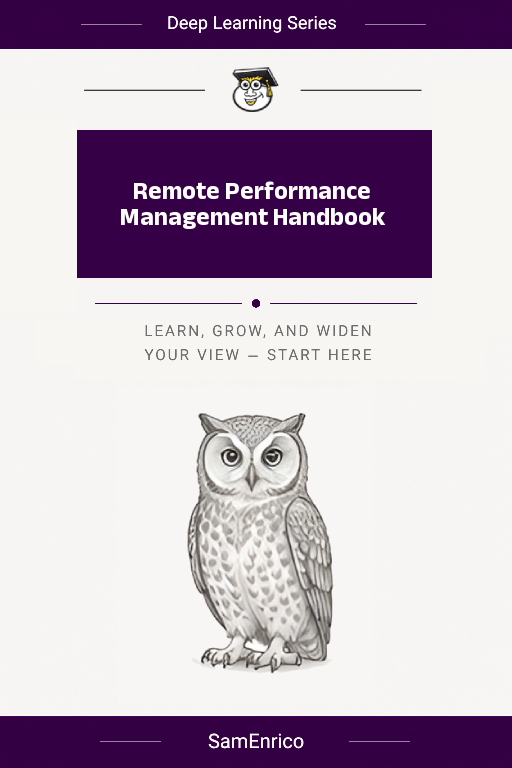
Non-FictionBusiness BriefPerformance
Remote Performance Management Handbook eBook
Track productivity and manage KPIs for distributed
Track productivity and manage KPIs for distributed teams across Kenya, Philippines, and Poland.
Formats
Free sample
Chapter 1: The Trust Battery--–- Every remote manager eventually faces the same sinking feeling. You have sent a polite Slack message to your Polish developer at 9 AM Warsaw time. Three hours pass. Nothing. You check your Filipino customer support lead—her tickets are closed, her CSAT scores are perfect, but she has stopped offering suggestions in team meetings.
Something is off. You look at your Kenyan data analyst’s output—tasks are being completed, but the quality has slipped, and the initiative that made him stand out six months ago has vanished. You have no idea why any of this is happening. Worse, you are not sure how to find out.This is the silent crisis of remote management across three continents. You cannot walk over to a desk.
You cannot read body language over a video call that freezes twice per meeting. You cannot tell the difference between a team member who is struggling quietly and one who has already mentally checked out. The tools you have been given—Slack statuses, Jira tickets, time-tracking software—tell you what is happening at the surface level. They tell you almost nothing about why.The problem is not laziness. The problem is not bad hiring.
The problem is that traditional management assumes physical proximity as the foundation of trust. When that proximity disappears, most managers default to one of two equally bad strategies: surveillance (tracking every click, every minute, every screenshot) or neglect (assuming that if tickets are closing, everything is fine). Surveillance destroys morale. Neglect allows small problems to fester until they become resignations.There is a third way. This chapter introduces the single most important mental model in this book: the Trust Battery.
It is a simple, practical framework for understanding, measuring, and rebuilding the relational capital that makes remote teams function. Without the Trust Battery, every KPI you track, every dashboard you build, and every 1-on-1 you conduct will be surface-level maintenance. With it, you gain the ability to diagnose problems before they become crises, to lead with empathy without losing accountability, and to build a team that does not need you to watch them in order to trust them.But before we get to the solution, we need to understand the problem more deeply. Because the way trust works in Poland is not the way trust works in the Philippines. And the way trust works in the Philippines is not the way trust works in Kenya.
If you try to apply a one-size-fits-all trust model to three radically different cultural contexts, you will fail. And you will not understand why.THE ANATOMY OF REMOTE DISTRUSTLet us start with a truth that most management books dance around: remote work amplifies existing distrust. If you were a manager who worried that your team would slack off when you were not watching, the shift to remote work made that anxiety permanent. If you were a manager who assumed the best of your team until proven otherwise, remote work made that assumption harder to sustain because you lost the daily visual cues that reinforced it.The research is clear on this point. A 2021 study published in the Academy of Management Discoveries found that managers consistently rated remote workers as less productive than in-office workers performing identical tasks, even when objective output data showed no difference.
The cause was not productivity. The cause was what the researchers called the "visibility bias"—the unconscious tendency to equate what you can see with what is real. When you cannot see someone working, your brain fills the gap with suspicion.This bias is not a moral failing. It is a cognitive default. And it becomes dangerous when it drives management behavior.
The typical reaction to visibility bias is to demand more visibility: daily screenshots, time-tracking software, mandatory camera-on policies, random check-ins, and endless status meetings. Each of these interventions signals the same message: I do not trust you. And nothing destroys a remote team faster than that message.But here is the paradox that most managers miss. The team member who responds to surveillance by working harder was never the problem. The team member who responds to surveillance by gaming the system (moving a mouse every few minutes while watching Netflix) was also not the problem—they are just rational actors responding to perverse incentives.
The real problem is the team member who receives your surveillance as a signal of distrust and quietly begins looking for another job. By the time you notice the drop in output, they have already accepted an offer elsewhere.This is why the Trust Battery matters. It gives you a language and a framework for building trust actively, rather than losing it passively through surveillance or neglect.THE TRUST BATTERY: A MENTAL MODEL FOR RELATIONAL CAPITALImagine that every relationship you have with a direct report contains an invisible battery. When the battery is fully charged, the relationship runs smoothly. Feedback is received as intended.
Deadlines are met. Conflicts are resolved quickly. When the battery is low, every interaction becomes friction. A simple request for a status update feels like an accusation. A missed deadline feels like betrayal.
A polite piece of feedback lands as a personal attack.The Trust Battery has three properties that matter for remote management.First, the battery charges and drains through specific behaviors. It does not charge automatically just because time passes. You cannot build trust by simply leaving people alone. You must actively deposit energy into the battery through deliberate actions.Second, the battery drains faster remotely than it does in person. In an office, small deposits happen constantly: a nod of acknowledgement in the hallway, a genuine "good morning," a quick check-in at the coffee machine.
These micro-interactions are the interest payments on trust. Remote work eliminates almost all of them. Without deliberate replacement, the battery slowly drains to zero, and neither party notices until something breaks.Third—and this is where most managers get into trouble—the battery charges differently depending on cultural context. What fills the battery for a Polish software engineer will have no effect on a Filipino customer support agent. What fills the battery for a Kenyan data analyst may actively drain the battery for a Polish team member.
Understanding these differences is not optional. It is the core skill of managing distributed teams across Kenya, the Philippines, and Poland.THE THREE TRUST ARCHITECTURESTo manage across these three locations, you need to understand three fundamentally different trust architectures. Each is internally consistent, culturally reinforced, and completely rational given the historical and social context in which it developed.Poland: The Competence-Based Trust Architecture Polish professionals operate in what anthropologists call a low-context, competence-first trust culture. This is not a personality quirk. It is the product of several generations of economic transformation, from communism to capitalism to EU integration, during which reliability and skill became the only reliable currencies.In the Polish trust architecture, trust is built primarily through demonstrated competence.
You earn trust by doing what you said you would do, when you said you would do it, to the standard you promised. Small talk and personal disclosure are not required and, in excess, can actually reduce trust because they signal that…
This is the end of the free sample. Get the eBook to keep going. Buy now
About this book
Details
- Author
- Armenta Elouise
- Publisher
- SamEnrico
- Language
- English
- Genre
- Non-Fiction, Business Brief, Performance
- Released
- 2026-05-30
- Pages (approx.)
- 148
- Available as
- eBook, Audiobook

Read better in the ZLOADR app
Your eBooks on your phone or tablet. Sign in with your SamEnrico account and start reading.
More by Armenta Elouise
 Acupuncture for Pain ReliefArmenta Elouise$11.99
 OKR For Home ProjectsArmenta Elouise$11.99
 Job Loss EQ GuideArmenta Elouise$11.99
 Diversity Fuel For Group CreativityArmenta Elouise$11.99
 Junk Food VisibilityArmenta Elouise$11.99
 Cortisol and Exercise TimingArmenta Elouise$11.99
 Self Hypnosis for Needle PhobiaArmenta Elouise$11.99
 Massage For Plantar FasciitisArmenta Elouise$11.99
 The Olmec Code: Africa's Mathematical Legacy in MesoamericaArmenta Elouise$11.99
 The Great Western Campaign: The Qing Conquest of the Zunghar Khanate (1755-1759)Armenta Elouise$11.99
 Scorpions: Arachnid FactsArmenta Elouise$11.99
 How to Produce Decorative TapeArmenta Elouise$11.99
You may also like
 Hong Kong Handover 1997Dunn Johnnie$11.99
 Zumba For Postnatal Recovery CourseNeal Christian$11.99
 Zumba for BeginnersLadner Nikia$11.99
 YouTube Comment Mining GuideHumes Pandora$12.99
 Worry Box MeditationCarlin Rudy$11.99
 Workplace Stress MeditationNguyen Lynn$11.99
 Workplace Stress and Sleep RepairHawley Ivory$11.99
 Workplace Perfectionism CureDelaney Jeffry$11.99
 Workplace Injustice Anger GuideWallen Isabelle$11.99
 Work Addiction and Burnout LinkGreenwood Ester$11.99
 Women in Yoga and WellnessBeattie Galina$11.99
 Women in Stand Up ComedyChun Evangeline$11.99