
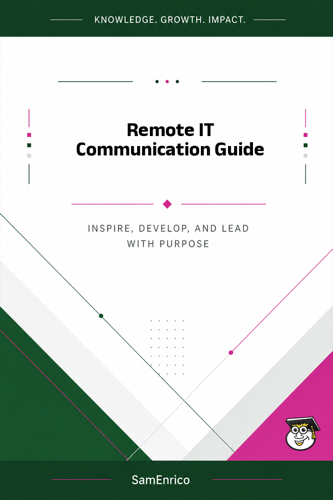
Remote IT Communication Guide eBook
Explains tech issues to non technical users.
by Dudley Telma
Explains tech issues to non technical users.
Formats
Free sample
Chapter 1: The Translation Mandate...--The email arrived at 2:47 PM on a Tuesday. The subject line was innocent enough: "Quick question about the dashboard." The sender was Jessica, the company’s Director of Sales. She was smart, driven, and had closed three million dollars in contracts that quarter. She was also, by her own admission, "not a computer person."The body of the email read: "The new sales dashboard is broken. It's showing the wrong numbers.
My team can't work. Please fix urgently."You, the IT professional, opened the dashboard. You saw nothing wrong. You refreshed the page. Still fine.
You checked the logs. No errors. You queried the database directly. The numbers were mathematically correct. You wrote back: "Hi Jessica, I've checked the dashboard and the underlying data.
Everything is calculating correctly on our end. Could you clear your browser cache and try again? Also, what specific numbers are you comparing against?"Her response, four minutes later: "I don't know what a cache is. The number on the dashboard says 1.2M. My spreadsheet says 1.4M.
This is why IT doesn't listen."And just like that, a simple data discrepancy became a departmental war. Jessica escalated to her VP. The VP emailed your VP. Your VP called you. Suddenly, you were in a meeting with eight people, explaining database replication lag, ETL job schedules, and the difference between real-time and batch processing.
The only thing everyone agreed on was that someone had failed.No one had failed technically. The database was correct. The dashboard was correct. The spreadsheet was correct—for a different time window. The failure was translational.This chapter opens by diagnosing the single greatest barrier between IT professionals and the people they support.
It is not a lack of technical skill. It is not a lack of patience. It is a cognitive bias so pervasive and so invisible that it destroys careers, derails projects, and turns allies into adversaries before anyone even realizes what happened. That barrier is the Curse of Knowledge.The Curse of Knowledge: Why Experts Suffer Most The Curse of Knowledge is a well-documented cognitive bias. Once you know something, you cannot un-know it.
More dangerously, you cannot easily imagine what it is like not to know it. The curse is not that experts are arrogant, though arrogance certainly makes it worse. The curse is that expertise literally rewires your brain to see the world differently. The steps you take for granted—logging in, navigating a file tree, understanding what a "cache" is—become invisible to you. They become oxygen.
And you stop noticing that the person you are talking to is breathing a completely different atmosphere.Consider the email exchange above. When you wrote "clear your browser cache," you were speaking a language that made perfect sense inside your head. You visualized a temporary storage folder, a series of HTTP requests, a simple Ctrl+F5. Jessica heard a foreign phrase that might as well have been in ancient Greek. She did not feel educated.
She felt stupid. And when people feel stupid, they get angry. They do not get curious. They do not ask clarifying questions. They escalate.This is not a minor inconvenience.
In a remote work environment, the Curse of Knowledge is amplified by every missing signal you would normally get in person. In an office, you would see Jessica's confused frown. You would say, "Let me show you," and walk to her desk. You would point at her screen, press the keys yourself, and watch her nod. In a remote environment, you have none of that.
You have text on a screen, flat and cold, stripped of all context. Your perfectly reasonable technical instruction lands as an insult.The research on this is startling. A classic study by Elizabeth Newton at Stanford University illustrated the curse perfectly. She gave people a list of well-known songs—"Happy Birthday," "The Star-Spangled Banner"—and asked them to tap the rhythm with their fingers. The listeners had to guess the song.
The tappers predicted that listeners would guess correctly about 50 percent of the time. The actual success rate was 2.5 percent. The tappers were hearing the song clearly in their own heads. The listeners heard disconnected tapping.You are the tapper. Your users are the listeners.
Every time you say "clear your cache," you are tapping out a rhythm that sounds obvious to you but meaningless to them.The High Stakes of the Translation Crisis It is tempting to dismiss this as a soft skill problem—something nice to have but not essential. That temptation is dangerous. Analysis of failed remote IT projects consistently shows that the top causes of failure are not technical. They are not security breaches or server crashes or insufficient bandwidth. The top causes are communicational: unclear requirements, misaligned expectations, and status updates that nobody understood.A post-mortem of a failed six-month software implementation for a mid-sized logistics company revealed exactly this pattern.
The technical work was flawless. The code deployed without errors. The database migrations ran smoothly. But the project was canceled three weeks after launch because the operations team refused to use the new system. Why?
Because no one had explained to them, in plain language, that the new system required them to enter data in a different order. The developers had written excellent technical documentation. They had not written human documentation. The operations team felt blindsided, then angry, then resistant. The project died not from a bug, but from a missing translation.Remote work makes this crisis exponentially worse.
When you are co-located, miscommunication can be caught mid-sentence. A raised eyebrow, a confused head tilt, a hesitant pause—these are signals that say "I don't understand." In remote work, those signals vanish. The user sits in silence, growing more frustrated, then types a passive-aggressive message, then escalates to a manager. By the time you realize there was a misunderstanding, the relationship is already damaged.The stakes are financial as well. A study by the Project Management Institute found that poor communication contributes to project failure in over half of all IT projects.
The cost of that failure is measured in millions of dollars, missed deadlines, and burned-out teams. But the cost that is rarely measured is the slow erosion of trust. Every time a non-technical user feels talked down to, every time they nod along to jargon they do not understand, they build a little more resentment. Over months and years, that resentment becomes a wall. And on the other side of that wall is an IT team wondering why no one appreciates them.The "Magic" Fallacy: Why Computers Terrify Non-Technical Users To become an effective translator, you must first understand how the non-technical mind sees your world.
This is harder than it sounds because your mind no longer works that way. But with deliberate effort, you can reconstruct the experience of ignorance.To a non-technical user, computers appear to work by magic. They press a button. Something happens. They have no mental model for what happens in between.
The computer is a black box. When the black box works, it feels like a reliable spell. When it breaks, it feels like the spell has been cursed. There is…
This is the end of the free sample. Get the eBook to keep going. Buy now
About this book
Details
- Author
- Dudley Telma
- Publisher
- SamEnrico
- Language
- English
- Genre
- Non-Fiction, Self-Help, IT
- Released
- 2026-06-07
- Pages (approx.)
- 139
- Available as
- eBook, Audiobook

Read better in the ZLOADR app
Your eBooks on your phone or tablet. Sign in with your SamEnrico account and start reading.
More by Dudley Telma
 Business Credit for ContractorsDudley Telma$12.99
 River Rock Balancing GuideDudley Telma$11.99
 The Deep Work GuideDudley Telma$11.99
 Table Tennis Hypnosis GuideDudley Telma$11.99
 Senior Hospital Stay GuideDudley Telma$11.99
 Self Hypnosis for Golfer's ElbowDudley Telma$11.99
 Ocean Beach Calming ScriptDudley Telma$11.99
 Affirmation Neuroplasticity GuideDudley Telma$11.99
 Anansi’s Golden Web: The Spider’s Wisdom of West AfricaDudley Telma$11.99
 How to Start a Cracker for Process Plant Business (Beginners Guide)Dudley Telma$11.99
 How to Produce Pipe SealantDudley Telma$11.99
 Tiger Sharks: Dangerous PredatorDudley Telma$11.99
You may also like
 Cybersecurity Incident ResponderMorton Roland$11.99
 Weekly Review for IT ProsKrauss Jolanda$11.99
 Remote IT Support CommunicationBatson Tamiko$11.99
 Workaholism in ITOconnell Dion$11.99
 Systems Administrator On CallTisdale Darnell$11.99
 Overcoming Procrastination for ITSanders Samantha$11.99
 Outsourcing IT SupportRalph Angella$11.99
 Delegation for IT ManagersLeighton Lonny$11.99
 ABCDE for IT ProfessionalsWood Seth$11.99
 Success Without Burnout for IT SupportDrew Esmeralda$11.99
 Time Blocking for IT ProsBaggett Huong$11.99
 Pomodoro for IT ProfessionalsBuffington Samella$11.99