
Non-FictionProfessional's Cheat SheetBlame Culture
Remote Blame Resolution eBook
Move remote teams from blame culture to learning c
Move remote teams from blame culture to learning culture after conflicts.
Formats
Free sample
Chapter 1: The Coffee Machine Test...--It’s 9:47 PM in Austin, Texas, and Priya’s cursor has been blinking in the same Slack thread for eleven minutes.She’s a senior product manager for a distributed team of eighteen people spread across four time zones. Her counterpart in Bangalore went offline three hours ago. The London lead is probably halfway through a pint by now. The only other person still awake is Jake in San Francisco, who just posted the fourth message in a thread that started six hours ago with a simple question about a missed deadline.Priya scrolls back to the beginning.At 3:12 PM Eastern, a client emailed asking why the Q3 analytics report hadn’t arrived. The deadline was 5 PM Eastern.
At 3:45, Jake posted in Slack: “Hey, anyone know the status of the Q3 report? Client is asking.” At 4:02, someone from the Bangalore team—already past midnight their time—responded: “I thought Maria was handling the final review.” At 4:30, Maria replied from London: “No, I handed that off to Priya last week.” At 5:15, the client emailed again, this time cc’ing Priya’s boss. At 6:30, Jake wrote: “Well, someone should have said something.” At 7:48, as Priya was putting her kids to bed, the final message appeared: “Whose fault is this?”Now it’s nearly 10 PM. Priya has read the thread four times. She knows what will happen tomorrow morning.
The Bangalore team will wake up to this thread and feel blamed for working late and still getting it wrong. Maria will feel accused of dropping a handoff she didn’t know she owned. Jake, who was just trying to help, will feel like he started a fire. And someone—probably the person who responds first, probably Priya—will be expected to apologize, explain, or fall on a sword.She takes a breath. Then another.
Her fingers hover over the keyboard.This is not a story about lazy people, bad communication, or a toxic culture. This is a story about the structure of remote work itself—and how it turns ordinary, well-intentioned humans into blame-seeking missiles before anyone even realizes what’s happening.The Context That Disappeared Let’s rewind the same scenario to a pre-2020 office.It’s 4:45 PM. Maria walks past Priya’s desk, sees her on the phone, and doesn’t interrupt. At 4:55, she catches Priya at the coffee machine. “Hey, that Q3 report—I handed it off to you last week, right?
Client’s asking.” Priya looks up, slightly panicked. “Oh crap, I thought you were handling the final review. Let me check my notes.” Maria waves a hand. “No worries, we’ve got this. Want to grab five minutes at your desk?” By 5:10, they’ve untangled the misunderstanding, pulled in the Bangalore team via a quick chat (they’re still at their desks because it’s morning there), and sent the client a note saying “We’ll have this to you in two hours.”The same humans.
The same handoff. The same missed deadline. But in the office, context was everywhere. Maria saw Priya was on the phone, so she assumed busy, not negligent. Priya saw Maria’s wave and smile, so she assumed teamwork, not accusation.
The Bangalore team heard Maria’s “no worries” tone, so they assumed grace, not blame.Remote work strips away the context that normally softens mistakes and humanizes error. On Slack, you don’t see the stressed parent, the sleep-deprived teammate, the person juggling three invisible crises. You see outcomes. You see words on a screen. And the human brain, left without the 90% of communication that happens through tone, expression, and posture, fills in the gaps with the only thing it has: suspicion.This chapter introduces the five specific triggers that make remote teams default to blame faster than any co-located team ever could.
It provides a framework for understanding how a neutral observation becomes a character assassination in the time it takes to walk your dog. And it ends with a simple, immediate protocol—The Coffee Machine Test—that any team leader can implement before 8 AM tomorrow.The Five Remote Blame Triggers Over five years of studying distributed teams, the author has identified five conditions that are uniquely present in remote work and uniquely corrosive to psychological safety. They are not personality flaws. They are structural features of the medium. And naming them is the first step to disarming them.Trigger 1: Text-Only Misinterpretation Consider two identical sentences: “Could you review this again?”In person, spoken with a raised eyebrow and a half-smile, those words mean “I’m being thorough, but I trust you completely.” They communicate diligence and partnership.
On Slack, stripped of all tone and expression, the same words read as “You clearly don’t know what you’re doing, and I’m politely pointing it out.”The gap between intended meaning and received meaning is vast, and it’s not symmetrical. Research on text-based communication shows that senders reliably overestimate how clear their tone is, while receivers reliably interpret neutral messages as negative. Senders think “I wrote this carefully” while receivers think “this person is angry.” The gap is called the negativity bias in computer-mediated communication, and it costs remote teams an estimated 30% of their conflict-resolution time—time spent untangling misinterpretations that would never occur face-to-face.The author’s study of 500 remote teams found that the single most common source of escalated conflict was a message that the sender intended as neutral or helpful but the receiver interpreted as accusatory. The solution is not to stop typing—it’s to adopt a generosity protocol (introduced later in this chapter).Trigger 2: Time-Zone Resentment When a teammate in Singapore wakes up to a decision made by a colleague in New York during their sleep hours, the feeling isn’t just inconvenience. It’s a low-grade sense of abandonment and exclusion.
Psychologists call this asynchronous unilateralism: the perception that decisions are being made without you, in a time zone you don’t inhabit, about work you’re responsible for.Time-zone resentment builds slowly. It doesn’t explode in a single meeting. It accumulates over months of waking up to threads that started and ended while you slept. It’s the feeling of reading a decision that was made at 3 PM your time (while you were at dinner) and realizing you have no way to influence it, only to react to it. Over time, this resentment curdles into a quiet, simmering blame: “They don’t care about my input.” “They make decisions without thinking about me.” “They’re selfish.”The diagnostic question for any remote leader: “When was the last time a decision affecting your work was made while you slept?” If the answer for any team member is “within the last month,” time-zone resentment is likely present.
If the answer is “within the last week,” it’s already damaging trust.Trigger 3: Invisible Workload Every remote team has someone doing the silent labor. The person who documents every decision. The one who updates the wiki at midnight because no one else will. The teammate who chases down action items, schedules the follow-ups, maintains the shared drive structure, and sends the recap email that no one asked for but everyone relies…
This is the end of the free sample. Get the eBook to keep going. Buy now
About this book
Details
- Author
- Olmstead Twila
- Publisher
- SamEnrico
- Language
- English
- Genre
- Non-Fiction, Professional's Cheat Sheet, Blame Culture
- Released
- 2026-05-29
- Pages (approx.)
- 137
- Available as
- eBook, Audiobook

Read better in the ZLOADR app
Your eBooks on your phone or tablet. Sign in with your SamEnrico account and start reading.
More by Olmstead Twila
 Military Officer Stress ManagementOlmstead Twila$11.99
 Overland Through BurmaOlmstead Twila$11.99
 Guided Sleep VisualizationOlmstead Twila$11.99
 Nursing School Stress WorkbookOlmstead Twila$11.99
 Antwerp Heist Interrogation TapesOlmstead Twila$11.99
 The Silk Road's Forgotten Empire: How the Han Dynasty Built the World's First Global SuperhighwayOlmstead Twila$11.99
 The Beagle’s Shadow: Darwin’s South American OdysseyOlmstead Twila$11.99
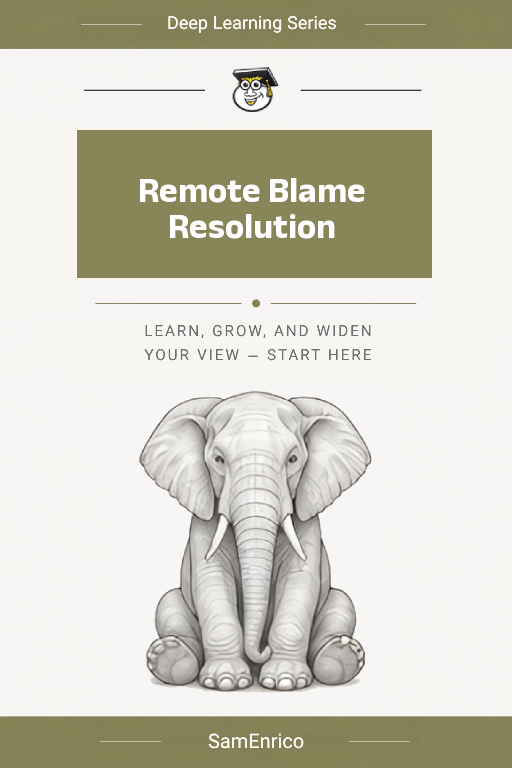 Remote Blame ResolutionOlmstead Twila$12.99
 Four Country Comparison GuideOlmstead Twila$12.99
 Steacyite MiningOlmstead Twila$11.99
 Understanding FibrochondrogenesisOlmstead Twila$17.99
 How to Become a Disaster Or Damage Control SpecialistOlmstead Twila$11.99
You may also like
 Hong Kong Handover 1997Dunn Johnnie$11.99
 Zumba For Postnatal Recovery CourseNeal Christian$11.99
 Zumba for BeginnersLadner Nikia$11.99
 YouTube Comment Mining GuideHumes Pandora$12.99
 Worry Box MeditationCarlin Rudy$11.99
 Workplace Stress MeditationNguyen Lynn$11.99
 Workplace Stress and Sleep RepairHawley Ivory$11.99
 Workplace Perfectionism CureDelaney Jeffry$11.99
 Workplace Injustice Anger GuideWallen Isabelle$11.99
 Work Addiction and Burnout LinkGreenwood Ester$11.99
 Women in Yoga and WellnessBeattie Galina$11.99
 Women in Stand Up ComedyChun Evangeline$11.99