
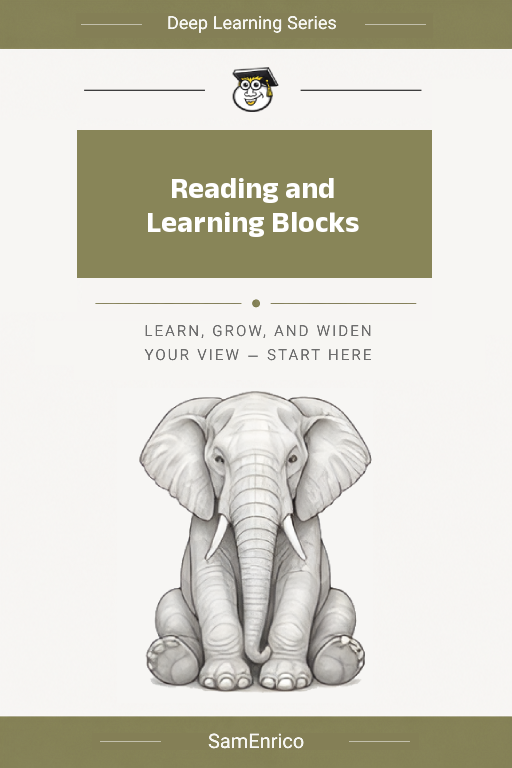
Non-FictionProfessional's Cheat SheetLearning
Reading and Learning Blocks eBook
Schedule 30-60 minutes daily for industry reading,
Schedule 30-60 minutes daily for industry reading, book summaries, and executive education.
Formats
Free sample
Chapter 1: The 2:00 PM Shame...--–- You are sitting at your desk. It is 2:00 PM on a Tuesday. The quarterly industry report has been open on your screen for forty-seven minutes. You have read the first paragraph six times. You know this because you have been counting—not the paragraphs, but the failures.
Each time you reach the end of that paragraph, you realize you have no idea what it said. Your eyes moved across the words. Your brain did not cooperate. You close the tab. You tell yourself you will “get to it tomorrow.” You spend the rest of the afternoon answering emails, because at least email is easy.
At least email makes you feel competent.That feeling—the knot in your stomach, the quiet voice that says maybe I am just not smart enough, the slow erosion of confidence that happens every time you face a dense text—has a name. This book calls it the 2:00 PM Shame. It is not a clinical diagnosis. It is a description of an experience that millions of intelligent, successful professionals live with every single day. And here is the first truth this book needs you to internalize before we go any further: that shame is a liar.
Your struggle with reading is not a character flaw. It is not a sign of low intelligence. It is not laziness. It is not a lack of discipline. It is a mismatch—a mismatch between how your brain is wired and how written language was invented.This chapter will dismantle the shame by replacing it with understanding.
You will learn why reading is fundamentally different from speaking, why some brains build reading circuits easily while others struggle, and exactly where your specific bottleneck lives. By the time you finish this chapter, you will never again call yourself “bad at reading.” You will call yourself what you actually are: a person with a specific neurological bottleneck that can be rewired with targeted practice.The Great Lie About Reading We grow up believing that reading is a basic skill, like tying your shoes or riding a bike. If you struggle with reading, the logic goes, you must not have tried hard enough. You must be lazy. You must be, in some fundamental way, less capable than your peers who breeze through reports and books.This is a lie.
And it is a dangerous lie because it turns a solvable problem into an identity.Here is the truth that the educational system does not teach: reading is not natural. Speaking is natural. Walking is natural. Grasping objects with your hands is natural. These abilities are hardwired into the human brain by millions of years of evolution.
A child left in a normal social environment will learn to speak without any formal instruction. The same child will not learn to read without being taught. Reading is a cultural invention, like algebra or chess or playing the violin. The human brain did not evolve to read. It evolved to see, to hear, to move, to speak.
Reading hijacks those existing circuits and forces them to work together in a way they were never designed to do.Think about that for a moment. Every time you read, your brain is performing a miracle of repurposing. Your visual cortex (designed to recognize faces and threats in the environment) has learned to recognize squiggly lines as letters. Your angular gyrus (an ancient relay station) has learned to map those letters to sounds. Your language centers (designed for spoken conversation) have learned to extract meaning from silent symbols.
This circuit—the reading circuit—does not exist at birth. It must be built, neuron by neuron, with every book, every report, every email you have ever read.Some brains build this circuit quickly and efficiently. These are the people we call “natural readers.” But here is the secret they do not advertise: there is no such thing as a natural reader. There are only brains that happened to wire themselves efficiently for the task of reading, usually because of a combination of genetic luck and early exposure. The rest of us—and we are the majority, not the minority—have brains that built a slower, more effortful circuit.
And that is not a failure. It is just a different outcome of the same biological process.The Reading Circuit: A Neural Highway Under Construction To understand your reading block, you need a basic map of the reading circuit. Do not worry—this is not a neuroscience textbook. You only need to know three neighborhoods in the brain and how they are supposed to talk to each other.Neighborhood One: The Visual Cortex. This is the back of your brain.
Its job is to process what your eyes see. When you look at a page of text, your visual cortex sees shapes—lines, curves, dots, spaces. It does not know these shapes are letters. It just sees patterns.Neighborhood Two: The Angular Gyrus. This is a small relay station near the junction of your parietal, temporal, and occipital lobes.
Its job is to translate. It takes the visual patterns from the visual cortex and maps them to sounds. The shape “b” becomes the sound /b/. The shape “a” becomes the sound /a/. The shape “t” becomes the sound /t/.
Without the angular gyrus, letters would just be meaningless drawings.Neighborhood Three: The Language Centers (Wernicke’s Area and Broca’s Area). These are in the left hemisphere, near your ear and temple. Their job is to process meaning. Wernicke’s area understands words. Broca’s area produces speech and internal narration.
When the angular gyrus sends sounds to Wernicke’s area, Wernicke’s area recognizes those sounds as words with meaning. “Baa-tuh” becomes “bat,” which you know is a flying mammal or a baseball implement depending on context.In a fluent reader, this circuit operates automatically. The visual cortex sees the letters. The angular gyrus maps them to sounds. The language centers extract meaning.
The whole process takes a fraction of a second. You are not aware of any of it happening. You just look at the page and the meaning appears in your mind.In a struggling reader, the circuit has bottlenecks. The information gets stuck somewhere along the highway. And where it gets stuck determines what kind of reading block you experience.The Three Bottlenecks: Where Your Reading Block Lives After decades of research synthesized in the work of Wolf, Shaywitz, and Moats, neuroscientists have identified three primary locations where the reading circuit can fail.
Every reading block falls into one of these three categories. Yours does too.Bottleneck One: Phonological Processing (The Sound Barrier)The phonological bottleneck is the most common cause of reading struggles, affecting an estimated 70 to 80 percent of people with dyslexia. It lives in the angular gyrus—the relay station that maps letters to sounds.If you have a phonological bottleneck, your brain struggles to connect the visual shape of a letter to the sound it represents. The letter “b” does not automatically trigger the sound /b/. You have to work at it.
You have to sound it out. Every single time. This is why you may find yourself reading slowly, sounding out…
This is the end of the free sample. Get the eBook to keep going. Buy now
About this book
Details
- Author
- Weis Carlotta
- Publisher
- SamEnrico
- Language
- English
- Genre
- Non-Fiction, Professional's Cheat Sheet, Learning
- Released
- 2026-06-01
- Pages (approx.)
- 147
- Available as
- eBook, Audiobook

Read better in the ZLOADR app
Your eBooks on your phone or tablet. Sign in with your SamEnrico account and start reading.
More by Weis Carlotta
 IBS And GERD Overlap GuideWeis Carlotta$11.99
 Francis and the Rose Without ThornsWeis Carlotta$11.99
 Apology That Rebuilds TrustWeis Carlotta$11.99
 The Accumulate Positives GuideWeis Carlotta$11.99
 NVC for Visually ImpairedWeis Carlotta$11.99
 Road Rage Management GuideWeis Carlotta$11.99
 Elizabeth Armada Response TimelineWeis Carlotta$11.99
 Parent of Child with AutismWeis Carlotta$11.99
 The Maestro of the Underground: Carlos Chávez and Mexico’s Musical RevolutionWeis Carlotta$11.99
 The Tongues of Timbuktu: The Polyglot Scholars Who Preserved the World's WisdomWeis Carlotta$11.99
 A Collector's Handbook to the Humber IvWeis Carlotta$11.99
 Service Providers Guide to Knee & Leg OrthopedicsWeis Carlotta$11.99
You may also like
 Hong Kong Handover 1997Dunn Johnnie$11.99
 Zumba For Postnatal Recovery CourseNeal Christian$11.99
 Zumba for BeginnersLadner Nikia$11.99
 YouTube Comment Mining GuideHumes Pandora$12.99
 Worry Box MeditationCarlin Rudy$11.99
 Workplace Stress MeditationNguyen Lynn$11.99
 Workplace Stress and Sleep RepairHawley Ivory$11.99
 Workplace Perfectionism CureDelaney Jeffry$11.99
 Workplace Injustice Anger GuideWallen Isabelle$11.99
 Work Addiction and Burnout LinkGreenwood Ester$11.99
 Women in Yoga and WellnessBeattie Galina$11.99
 Women in Stand Up ComedyChun Evangeline$11.99