
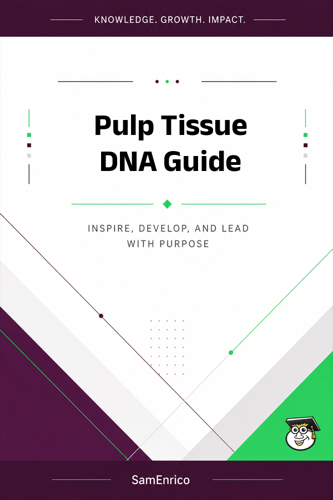
Non-FictionTrue CrimeDNA Analysis
Pulp Tissue DNA Guide eBook
Extract DNA from dental pulp for identification af
Extract DNA from dental pulp for identification after decomposition.
Formats
Free sample
Chapter 1: The Last Witness–- The tooth arrived in a plain brown evidence envelope, unremarkable in every outward respect. It was a lower left first molar, yellowed with age, a small crack running vertically along the lingual surface. Three weeks earlier, it had been recovered from the wreckage of a private aircraft that had disintegrated against a mountainside at 300 miles per hour. The pilot's body had been virtually cremated in the post-impact fire. His dental records offered nothing—he had no restorations, no unique anatomical features, nothing that would distinguish his teeth from any other set of 32.
The investigative team had nearly closed the case as "identification pending DNA," but there was a problem. No soft tissue remained. No blood. No bone marrow intact enough to sample. The only biological material left on the mountain was this single tooth, blackened but structurally intact, discovered by a search-and-rescue volunteer who had almost thrown it away.Three days later, in a laboratory 2,000 miles away, a forensic odontologist placed that tooth under a stereomicroscope.
She photographed it from six angles, logged its weight (1.2 grams), and recorded the condition of its surfaces. Then she began the meticulous process that this book will teach you: decontamination, access, extirpation, extraction, amplification, and interpretation. Forty-eight hours after that, she had a complete nuclear DNA profile. It matched the pilot's brother with a likelihood ratio of 1 in 10 quadrillion. The tooth—this small, unremarkable piece of calcified tissue—had become the last witness to a man's identity.This is the power of dental pulp.
And it is the reason you are reading this book.The Problem That Demands a Solution Every year, thousands of human remains are recovered worldwide that cannot be identified by conventional means. Facial features are destroyed by fire or decomposition. Fingerprints are obliterated by environmental exposure. Dental records are unavailable, incomplete, or non-unique. Soft tissue has autolyzed.
Bones have been colonized by environmental bacteria that degrade DNA and introduce foreign genetic material. In these cases, the standard toolkit of forensic identification fails.Yet, in many of these same cases, teeth remain. Not all teeth—some are fractured, exfoliated, or destroyed—but often a surprising number survive. And inside those teeth, protected by the hardest substances the human body produces, the pulp tissue may still contain viable, amplifiable DNA.This book is the first comprehensive guide dedicated exclusively to that proposition: extracting and analyzing DNA from dental pulp for post-decomposition identification. It is not a general forensic dentistry textbook.
It is not a broad survey of DNA analysis methods. It is a focused, protocol-driven manual for the specific challenge of recovering genetic information from the most protected biological niche in the human body—after death has taken everything else.Why This Book Exists The existing literature on forensic odontology is extensive and valuable. The IOFOS Textbook of Forensic Odonto-Stomatology provides a thorough foundation. Butler's Advanced Topics in Forensic DNA Typing covers the genetics in exhaustive detail. INTERPOL publishes comprehensive DVI guidelines.
But no single volume bridges these domains with the specific focus on dental pulp as a tissue. No book walks the practitioner from the moment a tooth is recovered through every decision point to the final courtroom testimony—all with the pulp as the central character.That gap is what this book fills.Between these covers, you will find:Anatomical foundations that explain why some teeth yield DNA and others do not, based on pulp volume, cellular density, and structural integrity.Environmental science that predicts DNA preservation based on post-mortem conditions, allowing you to triage samples before you invest laboratory resources.Decontamination protocols that balance the competing demands of removing exogenous DNA while preserving endogenous material—a critical trade-off with direct legal implications.Five extirpation methods with a decision matrix that matches technique to sample type, degradation state, and available equipment.Extraction and purification chemistry adapted specifically for degraded, inhibitor-rich pulp samples, including consolidated troubleshooting for humic acids, melanin, tannins, and metal ions.Quantification and quality assessment using forensic-specific q PCR systems that measure quantity, detect inhibitors, and calculate degradation indices—then tell you exactly what to do with each result.PCR optimization for low-quantity, degraded templates, including LCN protocols and the controversial history that shaped their use.Marker selection that walks you through the decision algorithm: STRs for fresh samples, mini-STRs when degradation index exceeds 5, mt DNA when nuclear DNA fails (with the crucial distinction between control region and full genome sequencing), and SNPs when no maternal reference is available.Statistical interpretation that translates electropherograms into courtroom-ready likelihood ratios, with guidance on partial profiles, mixtures, and the Daubert factors that determine admissibility.DVI operations that scale individual casework to mass disasters, including field-decontamination protocols for environments where laboratory conditions cannot be met.Quality assurance that ensures every method is validated, every report is defensible, and every scientist understands their role as both analyst and witness.This is not a book you read once and shelve. It is a reference you keep open on the bench, tabbed at the decision flowcharts, dog-eared at the inhibitor tables, and annotated in the margins with your own validation data.The Audience for This Knowledge This book is written for three primary audiences.First: forensic DNA analysts. You understand PCR, capillary electrophoresis, and statistical genetics. You may not understand the anatomy of a tooth, the difference between an access cavity and a vertical split, or why pulp volume varies by an order of magnitude between an incisor and a molar.
This book gives you the dental knowledge you need without forcing you to become a dentist.Second: forensic odontologists. You understand tooth morphology, dental records, and post-mortem dental examination. You may not understand the chemistry of organic extraction, the difference between a degradation index of 3 and 5, or why BSA concentration matters in PCR. This book gives you the genetic knowledge you need without forcing you to become a molecular biologist.Third: crime laboratory directors,的质量 managers, and legal professionals. You need to understand what the technology can and cannot do, what validation is required before a method enters casework, and how to defend the science under cross-examination.
This book gives you the framework for quality assurance and legal admissibility without over-simplifying the technical details.If you belong to any of these audiences, this book is for you. If you belong to all three—and some of you do—you will find this book indispensable.What This Book Is Not Let me be clear about the boundaries of this work.This book is not a general forensic dentistry textbook. It does not cover bite mark analysis, dental age estimation, or forensic radiology except where those topics intersect with pulp DNA extraction (e.g., using radiographs to locate pulp chambers before drilling).This book is not a comprehensive DNA analysis manual. It assumes you already understand the basics of PCR, STR typing, and capillary electrophoresis. If you need an introduction to those topics, consult Butler's Forensic DNA Typing (Academic Press, 2015) before proceeding.This book is not a substitute for laboratory validation.
Every protocol described herein must be validated in your laboratory, on your equipment, with your reagents, before it enters casework. Chapter 12 provides validation frameworks, but the work of validation is…
This is the end of the free sample. Get the eBook to keep going. Buy now
About this book
Details
- Author
- Hensley Nubia
- Publisher
- SamEnrico
- Language
- English
- Genre
- Non-Fiction, True Crime, DNA Analysis
- Released
- 2026-06-08
- Pages (approx.)
- 147
- Available as
- eBook, Audiobook

Read better in the ZLOADR app
Your eBooks on your phone or tablet. Sign in with your SamEnrico account and start reading.
More by Hensley Nubia
 Sleep Meditation for Light SensitivityHensley Nubia$11.99
 The Meal Prep Weight StrategyHensley Nubia$11.99
 Keto and Fertility GuideHensley Nubia$11.99
 Saint Francis Third OrderHensley Nubia$11.99
 Solomon's Wisdom: The Architect of a Golden AgeHensley Nubia$11.99
 How to Start a Dental Mirror Business (Beginners Guide)Hensley Nubia$11.99
 Faceless YouTube Minimalism ChannelHensley Nubia$12.99
 Nintendo Pivot StoryHensley Nubia$12.99
 Working CapitalHensley Nubia$11.99
 Learn to Play the KendangHensley Nubia$11.99
You may also like
 Hong Kong Handover 1997Dunn Johnnie$11.99
 Zumba For Postnatal Recovery CourseNeal Christian$11.99
 Zumba for BeginnersLadner Nikia$11.99
 YouTube Comment Mining GuideHumes Pandora$12.99
 Worry Box MeditationCarlin Rudy$11.99
 Workplace Stress MeditationNguyen Lynn$11.99
 Workplace Stress and Sleep RepairHawley Ivory$11.99
 Workplace Perfectionism CureDelaney Jeffry$11.99
 Workplace Injustice Anger GuideWallen Isabelle$11.99
 Work Addiction and Burnout LinkGreenwood Ester$11.99
 Women in Yoga and WellnessBeattie Galina$11.99
 Women in Stand Up ComedyChun Evangeline$11.99