
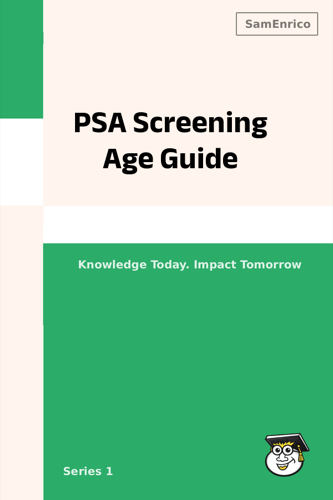
PSA Screening Age Guide
Start prostate cancer screening at age 40 or 50 ba
by Lyon Dulcie
Start prostate cancer screening at age 40 or 50 based on your risk factors.
Formats
About this book
Free sample
Chapter 1: The Smoke Alarm--–- Frank was 54 years old when his primary care doctor called him on a Tuesday afternoon. "Your PSA came back at 4.7," the doctor said. "That's above the normal range. You need to see a urologist." Frank hung up, opened his laptop, and Googled "PSA 4.7." Within thirty minutes, he had convinced himself he had metastatic prostate cancer. He couldn't sleep.
He didn't tell his wife. He spent the next three weeks in a fog of silent terror, assuming every back twinge was a bone metastasis. When he finally saw the urologist, the doctor performed a digital rectal exam, said "your prostate feels a little enlarged but nothing alarming," and ordered a repeat PSA. The second result was 3.2. The doctor explained that Frank had ejaculated the morning before his first blood draw, which can transiently raise PSA by 0.5 to 1.0 ng/m L.
Frank did not have cancer. He had spent three weeks of his life in paralyzing fear over a laboratory artifact.Frank's story is not unusual. It happens thousands of times every day across the United States. Men receive an elevated PSA result, receive no context, and spiral into anxiety. Or worse, they receive a "normal" PSA result, assume they are safe, and miss an aggressive cancer that will kill them a decade later.
Both failures stem from the same root cause: a fundamental misunderstanding of what PSA is, what it measures, and what it cannot tell you.This chapter will give you something that most doctors never provide: a complete, usable framework for understanding the prostate-specific antigen test. You will learn what PSA actually is (a protein with a normal biological function), the many benign reasons your PSA can rise, the critical distinction between a screening test and a diagnostic test, and why the "normal range" printed on your lab report is dangerously misleading. By the end of this chapter, you will never fear a mildly elevated PSA again. And you will never be falsely reassured by a "normal" result that fails to account for your personal risk factors.What Is PSA, Really?Prostate-specific antigen is a protein produced…
This is the end of the free sample. Get the eBook to keep going. Buy now
Contents
- Chapter 1
- Chapter 2
- Chapter 3
- Chapter 4
- Chapter 5
- Chapter 6
- Chapter 7
- Chapter 8
- Chapter 9
- Chapter 10
- Chapter 11
- Chapter 12
Details
- Author
- Lyon Dulcie
- Publisher
- SamEnrico
- Language
- English
- Genre
- Non-Fiction, Health & Wellness, Prostate Screening
- Released
- 2026-06-08
- Pages (approx.)
- 144
- Available as
- eBook, Audiobook

Read better in the ZLOADR app
Your eBooks on your phone or tablet. Sign in with your SamEnrico account and start reading.
More by Lyon Dulcie
 Stress and Weight GainLyon Dulcie$11.99
 Assertiveness In Co Parenting GuideLyon Dulcie$11.99
 ABCDE For Meditation PracticeLyon Dulcie$11.99
 The Anger Channeling GuideLyon Dulcie$11.99
 From the Streets to the Stage: How European Hip-Hop Redefined RebellionLyon Dulcie$11.99
 Motor SportsLyon Dulcie$11.99
 Invoice Factoring Asia GuideLyon Dulcie$12.99
 Rwanda Student Emergency GuideLyon Dulcie$12.99
 How to Start a Account Books Business (Beginners Guide)Lyon Dulcie$11.99
 Understanding Rodini–richieri–Costa SyndromeLyon Dulcie$17.99