
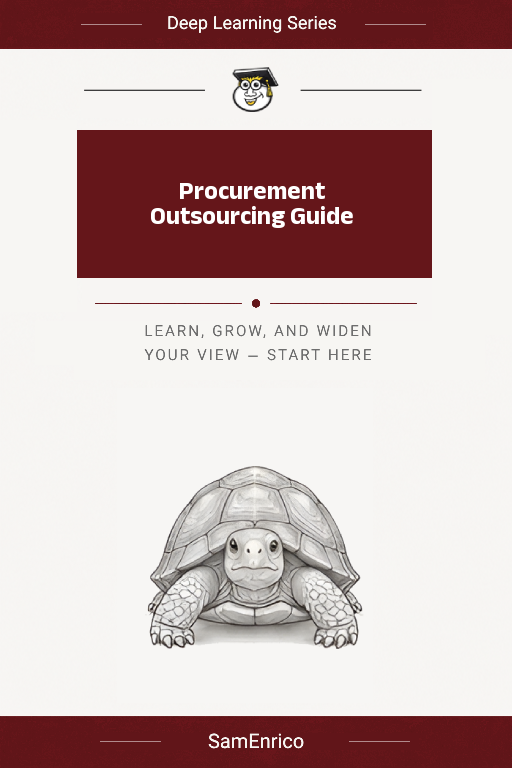
Non-FictionOperational Efficiency ManualOutsourcing
Procurement Outsourcing Guide eBook
Decide which procurement activities to outsource a
Decide which procurement activities to outsource and manage BPO provider relationships.
Formats
Free sample
Chapter 1: The 65% Lie--–- In 2018, a mid-sized manufacturing company in Ohio signed a five-year, 12millionprocurementoutsourcingdealwithagloballyrecognized BPOprovider.Thesalespitchwasflawless:a22−slidedeckpromising3512 million procurement outsourcing deal with a globally recognized BPO provider. The sales pitch was flawless: a 22-slide deck promising 35% cost reduction, access to a network of 400 category experts, and a digital procurement platform that would automate 80% of their tactical buying. The CFO approved the contract within two weeks. Eighteen months later, the same CFO stood in a boardroom explaining why the company had missed earnings for three consecutive quarters. The BPO had delivered only 11% cost savings.
The "category experts" were recent college graduates following scripts. The automated platform required so much manual intervention that the internal procurement team, which was supposed to have been reduced by 40%, had actually grown by 15% just to manage the vendor. When the CFO tried to terminate the contract, the vendor presented a 12millionprocurementoutsourcingdealwithagloballyrecognized BPOprovider.Thesalespitchwasflawless:a22−slidedeckpromising354.7 million exit penalty. The company was, for all practical purposes, a hostage.This is not an isolated cautionary tale. It is the statistical norm.According to the 2018 edition of The Black Book of Outsourcing, which analyzed 1,200 BPO engagements across 47 countries, approximately 65% of procurement outsourcing arrangements fail to meet their original business case within the first 24 months.
Sixty-five percent. That is not a margin of error. That is a systemic collapse. And yet, year after year, companies sign these contracts with the same misplaced confidence, the same glossy sales decks, and the same three flawed assumptions: that cost savings are the only metric that matters, that outsourcing means losing control, and that a vendor's sales pitch reflects its operational reality.This chapter exists to destroy those assumptions—not with rhetoric, but with forensic evidence drawn from thousands of failed engagements and the rare, illuminating successes.The central argument of this chapter, and indeed the entire book, is that procurement outsourcing fails not because vendors are incompetent, but because buyers are strategically misaligned. The 65% failure rate is not a verdict on outsourcing as a concept.
It is a verdict on how companies approach the decision: which activities they choose to outsource, how they measure value, and whether they design contracts that align incentives or merely transfer headcount.Before we can build the strategic blueprint that occupies the remaining eleven chapters of this book, we must first understand the anatomy of failure. We must dismantle the myths that have cost companies billions in wasted fees, hidden transition costs, and eroded internal capability. And we must establish a new framework for thinking about procurement BPO—one that prioritizes capability and cash over simple cost reduction, and one that recognizes that control is not lost in outsourcing; it is either designed into contracts or abandoned by negligence.Let us begin with the most dangerous myth of all.The Three-Pillar Fallacy: Why Cost Savings Alone Kill Deals Every procurement outsourcing sales pitch follows the same script. The vendor presents a chart showing your current fully-loaded cost per purchase order, per supplier onboarding, per invoice processed. Then they show their projected cost—typically 25-40% lower—based on labor arbitrage, economies of scale, and their proprietary technology.
The gap between the two numbers is presented as "value." The CFO nods. The deal closes.This is the Three-Pillar Fallacy—the belief that cost reduction is the only legitimate metric for outsourcing success. In reality, a sustainable procurement BPO relationship rests on three distinct pillars, only one of which is cost. The other two—Cash and Capability—are where most deals quietly die.Pillar One: Cost (The Deceptive Metric)Cost is the easiest pillar to measure and the hardest to realize. The vendor's projected savings almost never account for the full Total Cost of Ownership (TCO) of the relationship.
In Chapter 3, we will examine TCO in forensic detail, but for now, understand that the headline savings number excludes transition costs (typically 10-15% of annual contract value), governance overhead (another 5-10%), attrition-related retraining (3-8% annually), and the cost of change orders when your requirements inevitably shift.Worse, a pure cost focus creates perverse incentives. When a vendor is measured only on how cheaply they can process a purchase order, they will optimize for speed and volume—not accuracy, not compliance, not strategic sourcing. The result is a procurement function that is technically cheaper but operationally dysfunctional. Purchase orders are issued quickly but to the wrong suppliers. Invoices are processed efficiently but with repeated errors that require manual correction.
The cost-per-transaction number looks excellent on a dashboard while the actual cost to the business—in expedited freight, supplier disputes, and maverick spending—climbs silently.Pillar Two: Cash (The Underleveraged Asset)The second pillar is Cash—specifically, working capital optimization. A well-structured procurement BPO relationship should improve Days Payable Outstanding (DPO), capture early payment discounts, and reduce the cash conversion cycle. Most vendors never mention this. Most buyers never ask.Consider the difference between a vendor paid on a time-and-materials basis versus one compensated through a gain-share on improved payment terms. The former has no incentive to help you negotiate better terms with suppliers.
The latter becomes a partner in extending your DPO without damaging supplier relationships. This is not theoretical. One of the case studies we will examine later in this book involves a European automotive parts manufacturer that structured its BPO deal to give the vendor 20% of any improvement in DPO beyond a baseline. Within 18 months, the vendor had renegotiated payment terms with over 300 suppliers, adding $14 million in free working capital to the manufacturer's balance sheet. The cost savings from the arrangement were modest—only 12%—but the cash impact transformed the company's liquidity position.The lesson is simple: if your outsourcing business case does not include specific, measurable cash flow targets, you are leaving money on the table.Pillar Three: Capability (The Strategic Imperative)The third pillar is Capability—access to category expertise, market intelligence, and digital tools that you cannot cost-justify building internally.
This is the pillar that separates strategic outsourcing from tactical staff augmentation.A mature procurement BPO provider should bring three specific capabilities that your internal team lacks:Category depth – A vendor managing procurement for dozens of clients in your industry should know your supplier market better than you do. They should have benchmark data on pricing, lead times, and risk profiles across every major category you purchase.Technology access – The procurement technology stack (e-Sourcing, contract management, supplier portals, analytics) is expensive to license and maintain. A good BPO spreads this cost across their client base, giving you enterprise-grade tools at a fraction of the cost.Talent bench – Great category managers are difficult to hire and retain. A BPO provides a deep bench of specialists who can be deployed as needed, without the fixed cost of permanent headcount.The manufacturers who fail at outsourcing—the 65%—almost invariably treat Capability as an afterthought. They select vendors based on the lowest hourly rate, then discover that the assigned team has no industry experience, the promised technology is a decade old, and the "bench strength" was a sales illusion.The manufacturers who succeed treat Capability as their primary selection criterion.
They accept a slightly higher cost-per-transaction in exchange for access to superior category expertise, because they understand that a 2%…
This is the end of the free sample. Get the eBook to keep going. Buy now
About this book
Details
- Author
- Dickens Cassi
- Publisher
- SamEnrico
- Language
- English
- Genre
- Non-Fiction, Operational Efficiency Manual, Outsourcing
- Released
- 2026-06-01
- Pages (approx.)
- 157
- Available as
- eBook, Audiobook

Read better in the ZLOADR app
Your eBooks on your phone or tablet. Sign in with your SamEnrico account and start reading.
More by Dickens Cassi
 Tension Headache ReliefDickens Cassi$11.99
 Overcoming Plateaus HypnosisDickens Cassi$11.99
 The Late Career LegacyDickens Cassi$11.99
 Self Esteem During SeparationDickens Cassi$11.99
 Land Lease Retirement CommunitiesDickens Cassi$11.99
 The Silk Road to the Amazon: Ibn Battuta’s Lost ExpeditionDickens Cassi$11.99
 The Unseen Hand: How a 19th-Century Lawsuit Changed the WorldDickens Cassi$11.99
 Understanding Facial Dysmorphism Shawl Scrotum Joint Laxity SyndromeDickens Cassi$17.99
 Executive Summary Formulas for Research PapersDickens Cassi$12.99
 How to Become a Molding-machine OperatorDickens Cassi$11.99
 Painter and DecoratorDickens Cassi$11.99
You may also like
 Hong Kong Handover 1997Dunn Johnnie$11.99
 Zumba For Postnatal Recovery CourseNeal Christian$11.99
 Zumba for BeginnersLadner Nikia$11.99
 YouTube Comment Mining GuideHumes Pandora$12.99
 Worry Box MeditationCarlin Rudy$11.99
 Workplace Stress MeditationNguyen Lynn$11.99
 Workplace Stress and Sleep RepairHawley Ivory$11.99
 Workplace Perfectionism CureDelaney Jeffry$11.99
 Workplace Injustice Anger GuideWallen Isabelle$11.99
 Work Addiction and Burnout LinkGreenwood Ester$11.99
 Women in Yoga and WellnessBeattie Galina$11.99
 Women in Stand Up ComedyChun Evangeline$11.99