
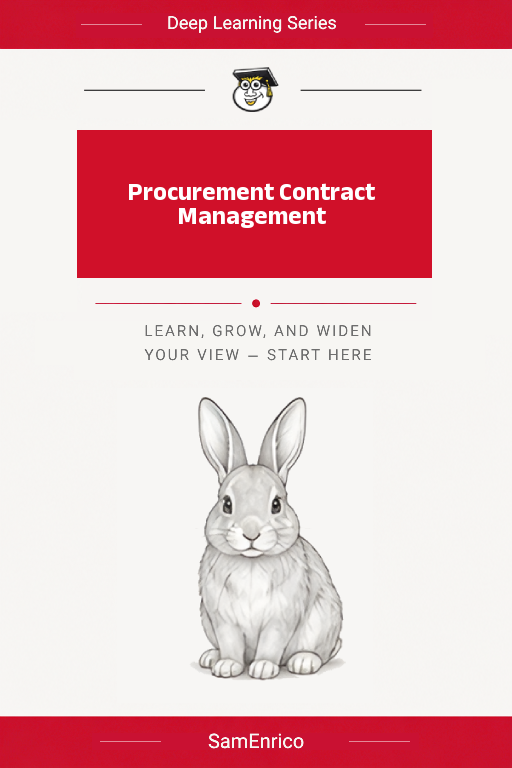
Non-FictionOperational Efficiency ManualContract Management
Procurement Contract Management eBook
Streamline contract creation, approval, and renewa
by Adam Layne
Streamline contract creation, approval, and renewal within source-to-pay process.
Formats
Free sample
Chapter 1: The Value Graveyard--–- Every organization, regardless of size or industry, maintains a graveyard. It is not marked on any office map, nor is it listed in any financial statement. Yet, it quietly accumulates losses year after year, draining millions of dollars from companies that pride themselves on operational excellence. This graveyard is not filled with failed products or bad hires. It is filled with contracts—signed, executed, legally binding agreements that promised value but delivered only frustration, inefficiency, and silent financial hemorrhage.Walk into almost any procurement department and ask a simple question: “Can you show me the current, fully executed version of your top twenty vendor contracts, along with proof that every purchase order issued in the last twelve months complied with those contracts’ pricing and terms?” The silence that follows is the sound of money evaporating.
According to industry research compiled from leading procurement analytics firms, organizations lose between nine and fourteen percent of contract value not through aggressive negotiation by suppliers or unfavorable market conditions, but through pure administrative failure. Lost documents. Missed renewal dates. Non-compliant purchasing. Siloed systems that speak different languages.
Contracts signed and then filed away, never to be referenced again until something goes wrong.This chapter establishes the foundational argument that contract management is not a clerical afterthought or a necessary evil confined to legal departments. It is a core strategic competency that directly determines whether procurement operates as a cost center or a profit driver. We will quantify the problem, introduce the unified phase model that structures this entire book, and provide a clear business case for moving from reactive, paper-based contract management to proactive, digital, analytics-driven control. By the end of this chapter, you will understand why most organizations are leaving staggering amounts of money on the table and, more importantly, why the remaining chapters of this book offer a practical roadmap to reclaim that value.The Silent Leak: Understanding Contract Value Leakage Contract value leakage occurs when the actual financial outcome of a contract falls short of the expected value at signing. This is not about poor negotiation outcomes—a bad deal is a separate problem.
Value leakage is about failing to capture the value that was already agreed upon. Imagine negotiating a five percent discount with a key supplier, securing favorable payment terms, and locking in a volume rebate. Then imagine that no one in accounts payable knows about the discount, so invoices are paid at the old rate. No one in procurement checks the volume rebate, so it goes unclaimed. The contract expires and auto-renews at a higher rate because the renewal notice went to an employee who left the company eighteen months ago.
The discount, the payment terms, the rebate—all of that negotiated value simply leaks away.The magnitude of this problem is staggering. The nine to fourteen percent figure cited earlier is not theoretical. It comes from analyzing thousands of procurement operations across manufacturing, technology, healthcare, financial services, and the public sector. For a mid-sized company with five hundred million dollars in annual spend, that represents between forty-five and seventy million dollars lost every year. For a large enterprise with five billion dollars in spend, the loss ranges from four hundred fifty million to seven hundred million dollars annually.
These are not cost savings opportunities. These are losses of value that have already been negotiated and secured, only to be squandered by broken processes.One of the most telling statistics in procurement research reveals that fifty-six percent of procurement professionals cannot quickly locate the current version of their supplier contracts. More than half of the people responsible for managing supplier relationships do not have immediate, confident access to the legal documents that define those relationships. This is not because these professionals are incompetent. It is because the systems and processes they inherit are fundamentally broken.
Contracts live in shared drives, email attachments, network folders, filing cabinets, and the occasional employee’s personal laptop. When someone needs to check a termination clause, a pricing schedule, or an indemnification provision, the search can take hours or days. Often, the search fails entirely, and decisions are made based on memory, guesswork, or outdated information.The consequences extend far beyond inconvenience. When contract terms are inaccessible, procurement cannot enforce compliance. When pricing is not loaded into purchasing systems, maverick spend flourishes.
When renewal dates are not tracked, suppliers receive automatic extensions at unfavorable rates. When amendments are not version-controlled, disputes arise over which terms actually govern the relationship. Every one of these failures represents value that was earned at the negotiation table and then abandoned in the chaos of contract administration.From Paperwork to Profit Driver: The Strategic Case for CLMContract Lifecycle Management, or CLM, has traditionally been viewed as a back-office function—something that happens after the exciting work of sourcing and negotiation is complete. This perspective is exactly backward. CLM is not the administrative epilogue to procurement; it is the operational engine that transforms negotiated agreements into realized financial outcomes.
A signed contract that cannot be enforced in the purchasing system, cannot be monitored for compliance, and cannot be renewed or terminated intelligently is not a finished product. It is a liability waiting to materialize.The strategic shift required is both conceptual and practical. Conceptually, procurement leaders must stop treating contracts as static documents and start treating them as dynamic digital assets that control the entire procure-to-pay cycle. A contract is not a PDF to be filed. It is a set of instructions that should govern every purchase order, every invoice approval, every quality check, every payment release, and every renewal decision.
When contracts are treated as digital assets, they become the central nervous system of procurement operations rather than archival artifacts.Practically, this shift requires integrating CLM with Source-to-Pay software. Source-to-Pay, or S2P, encompasses the entire procurement lifecycle from identifying a need through sourcing, contracting, purchasing, receiving, invoicing, and paying suppliers. Historically, these stages have been managed by disconnected systems with different data models, different user interfaces, and different owners. The contract sits in a CLM system or a shared drive. The purchase order lives in an ERP system.
The invoice is processed in an accounts payable module. The supplier performance data lives in a spreadsheet. None of these systems talk to each other, so none of them can enforce the terms of the contract consistently.Integration closes this loop. When CLM and S2P are connected, the pricing and terms negotiated in the contract automatically flow into the purchasing system. When a buyer creates a purchase order, the system already knows the correct price, the approved supplier list, and the required delivery terms.
When an invoice arrives for payment, the system can validate it against both the purchase order and the underlying contract. When a contract approaches its expiration date, the system notifies the appropriate stakeholders and provides decision support for renewal, renegotiation, or termination. The gap between signing and spending disappears because the contract is no longer a separate document—it is the operating system for the entire procurement function.The Unified Phase Model: Creation, Approval, Renewal Throughout this book, we will organize our exploration of procurement contract management around a simple, intuitive…
This is the end of the free sample. Get the eBook to keep going. Buy now
About this book
Details
- Author
- Adam Layne
- Publisher
- SamEnrico
- Language
- English
- Genre
- Non-Fiction, Operational Efficiency Manual, Contract Management
- Released
- 2026-05-30
- Pages (approx.)
- 160
- Available as
- eBook, Audiobook

Read better in the ZLOADR app
Your eBooks on your phone or tablet. Sign in with your SamEnrico account and start reading.
More by Adam Layne
 Shift Work Legal Rights GuideAdam Layne$11.99
 Stress Eating Recovery GuideAdam Layne$11.99
 The Recruiter RelationshipAdam Layne$11.99
 Performance Anxiety Self HypnosisAdam Layne$11.99
 Self Esteem After Partner's AffairAdam Layne$11.99
 The Last Broadcast: The Mysterious Disappearance of the USS JeannetteAdam Layne$11.99
 Gears of the Forgotten: The Mechanical Oracle of DelphiAdam Layne$11.99
 How to Become a Mold SetterAdam Layne$11.99
 Online Sales RepresentativeAdam Layne$11.99
 Executive Summary Tool Kit for AnalystsAdam Layne$12.99
 Understanding ExotropiaAdam Layne$17.99
You may also like
 Hong Kong Handover 1997Dunn Johnnie$11.99
 Zumba For Postnatal Recovery CourseNeal Christian$11.99
 Zumba for BeginnersLadner Nikia$11.99
 YouTube Comment Mining GuideHumes Pandora$12.99
 Worry Box MeditationCarlin Rudy$11.99
 Workplace Stress MeditationNguyen Lynn$11.99
 Workplace Stress and Sleep RepairHawley Ivory$11.99
 Workplace Perfectionism CureDelaney Jeffry$11.99
 Workplace Injustice Anger GuideWallen Isabelle$11.99
 Work Addiction and Burnout LinkGreenwood Ester$11.99
 Women in Yoga and WellnessBeattie Galina$11.99
 Women in Stand Up ComedyChun Evangeline$11.99