
Non-FictionSelf-HelpProcrastination
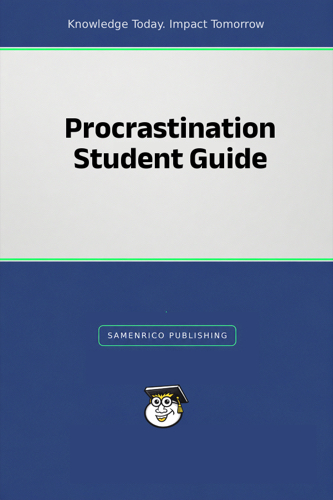
Procrastination Student Guide eBook
Break tasks into small steps and use pomodoro tech
Break tasks into small steps and use pomodoro technique to start.
Formats
Free sample
Chapter 1: The Resistance Gremlin--–- You are not lazy. You are not broken. You are not a “procrastinator personality type” destined to fail at everything you care about. If you have ever spent three hours watching videos about productivity instead of actually doing your homework, if you have ever opened a textbook only to close it ten seconds later because your chest felt tight, if you have ever told yourself “I work better under pressure” while secretly hating the pressure—this chapter is for you. The story you have been told about procrastination is wrong.
And until you understand what is really happening inside your brain, no planner, no app, no motivational speech, and no amount of self-criticism will ever fix it.The Myth of Laziness Every student has heard the same verdict at some point. “You just need more discipline.” “You’re being lazy.” “If you cared enough, you would just do it.” These statements come from parents, from professors, from well-meaning friends, and worst of all, from the voice inside your own head. They are also completely and demonstrably false.Let us examine the evidence for a moment. When you procrastinate on a five-page paper that is due in four days, do you spend that time doing nothing? Almost never.
Instead, you reorganize your desk with the precision of a museum curator. You watch a forty-five-minute documentary about ancient Egyptian burial practices. You learn the entire discography of a band you had never heard of twenty-four hours earlier. You clean your kitchen floor with a toothbrush because the grout between the tiles suddenly seems unacceptable. You are not inactive.
You are highly, intensely, creatively active—just not on the thing that matters.Laziness is the absence of action. Procrastination is the misdirection of action into everything except the one thing that needs to be done. These are not the same thing. A lazy person does not feel guilty about not working. A lazy person simply does not care.
But you do care. You care so much that the thought of starting triggers a physical response: sweaty palms, a racing heart, sudden and unexplained exhaustion that vanishes the moment you give yourself permission to stop trying. That is not laziness. That is fear dressed in work clothes.If laziness were the cause, you would not be reading this book. You would not have searched for solutions.
You would not feel that familiar ache of disappointment every time you look at the clock and realize another hour has disappeared into the void of avoidance. You are here because you want to change. That wanting is the opposite of laziness. It is the raw material from which every solution is built.The Emotional Regulation Problem The top-selling books on productivity and habit formation—Atomic Habits, The Now Habit, Deep Work, Eat That Frog!, The Pomodoro Technique, Make It Stick, The 5 Second Rule, Indistractable, The War of Art, and Mindset—all converge on a single, uncomfortable truth. Procrastination is not a time management problem.
It is an emotional regulation problem.Let that sink in for a moment. Every time management system you have ever tried failed not because the system was bad, but because the system was designed to solve the wrong problem. Time management assumes that you know what to do and that your only obstacle is organizing your hours. But you already know what to do. You know the paper is due.
You know the exam is coming. You know the reading assignment is not going to complete itself. The obstacle is not a lack of planning. The obstacle is that the moment you think about starting, you feel something unpleasant.That unpleasant feeling has many names. Sometimes it is fear of failure: “What if I do all this work and it is still not good enough?” Sometimes it is perfectionism: “If I cannot do this perfectly, I should not do it at all.” Sometimes it is boredom: “This material is so dry that my brain shuts off just looking at the textbook.” Sometimes it is resentment: “I should not have to do this assignment.
It is pointless. The professor is terrible.” Sometimes it is uncertainty: “I do not even know where to begin, so how can I begin?”Whatever name it wears, the feeling is real. It lives in your body. Your stomach tightens. Your shoulders rise toward your ears.
Your jaw clenches. Your brain, trying to protect you from this discomfort, looks for an escape route. The escape route is anything that provides immediate relief. A notification. A video.
A snack. A sudden urgent need to organize your bookshelf. The relief is real, and it comes immediately. That is the trap. Your brain learns that avoiding the task produces a small shot of relief, so it reinforces the avoidance behavior.You are not weak for experiencing this.
You are human. Every human brain is wired to seek pleasure and avoid pain. The problem is that your brain has misclassified a homework assignment as a source of pain. And until you retrain that classification, no amount of willpower will consistently overpower it.Meet the Resistance Gremlin Give the enemy a name. In The War of Art, Steven Pressfield calls it “Resistance.” In cognitive behavioral therapy, it is called “avoidance coping.” In neuroscience, it is called “threat detection and emotional dysregulation.” But those names are too clinical.
They do not capture the sneaky, whispering, persuasive nature of the voice that lives between your intention and your action.Let us call it the Resistance Gremlin.The Resistance Gremlin is not a monster that lives outside you. It is a pattern of thinking that has become automatic through repetition. Every time you avoided a task and felt temporary relief, you strengthened the gremlin’s voice. Every time you told yourself “I will start tomorrow,” you gave the gremlin more power. But patterns can be unlearned.
Automatic thoughts can be replaced. The gremlin is not your identity. It is just a habit.The Resistance Gremlin has a small number of phrases it repeats endlessly. Listen for these voices in your own head. See if any of them sound familiar.“I will start tomorrow morning.
I work better in the morning.”“I need to do more research first. I am not ready yet.”“What if I do this wrong? I should wait until I know exactly what to say.”“This assignment is stupid. I should not have to do it.”“I already wasted so much time today. I might as well start fresh next week.”“One more video.
Just one more. Then I will definitely start.”“I am just not a math person. That is why this is so hard.”“If I fail this, everyone will know I am not as smart as they think.”Notice what all these statements have in common. They are not about the task itself. They are about your relationship to the task.
The Resistance Gremlin never says “this math problem is objectively impossible for any human to solve.” It says “you are not the kind of person who can solve this math problem.” It attacks your identity, not your ability. That is why it hurts so much. And…
This is the end of the free sample. Get the eBook to keep going. Buy now
About this book
Details
- Author
- Martino Shana
- Publisher
- SamEnrico
- Language
- English
- Genre
- Non-Fiction, Self-Help, Procrastination
- Released
- 2026-06-09
- Pages (approx.)
- 136
- Available as
- eBook, Audiobook

Read better in the ZLOADR app
Your eBooks on your phone or tablet. Sign in with your SamEnrico account and start reading.
More by Martino Shana
 Smoking Cessation for Couples WorkbookMartino Shana$11.99
 Mindfulness for Public SpeakingMartino Shana$11.99
 Financial Stress and EvictionMartino Shana$11.99
 The Healing Hands of Ancient Egypt: The Forgotten Surgeons of the NileMartino Shana$11.99
 How to Produce an Auger (Drill)Martino Shana$11.99
 Heteroskedasticity Detection WorkbookMartino Shana$12.99
 Director of Public RelationsMartino Shana$11.99
 How to Become a Stock Sheets Cleaner-inspectorMartino Shana$11.99
You may also like
 Hong Kong Handover 1997Dunn Johnnie$11.99
 Zumba For Postnatal Recovery CourseNeal Christian$11.99
 Zumba for BeginnersLadner Nikia$11.99
 YouTube Comment Mining GuideHumes Pandora$12.99
 Worry Box MeditationCarlin Rudy$11.99
 Workplace Stress MeditationNguyen Lynn$11.99
 Workplace Stress and Sleep RepairHawley Ivory$11.99
 Workplace Perfectionism CureDelaney Jeffry$11.99
 Workplace Injustice Anger GuideWallen Isabelle$11.99
 Work Addiction and Burnout LinkGreenwood Ester$11.99
 Women in Yoga and WellnessBeattie Galina$11.99
 Women in Stand Up ComedyChun Evangeline$11.99