
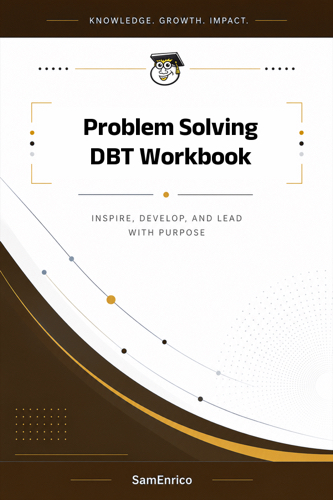
Problem Solving DBT Workbook eBook
Step by step method for changing situations causin
Step by step method for changing situations causing distress.
Formats
Free sample
Chapter 1: The Fork in the Road--–- You are reading this for one of two reasons. Either you are trapped in a situation that feels like it is slowly crushing you, or you have been trying to change something for months—maybe years—and nothing you have done has worked. Perhaps it is a relationship where you keep having the same fight. Perhaps it is a job where you feel invisible and overworked. Perhaps it is a family member who violates your boundaries every holiday, or a roommate who "forgets" to pay bills, or a friend who only calls when they need something.
Whatever the situation is, you have likely tried everything you can think of: explaining yourself more clearly, getting angrier, shutting down, leaving, coming back, hoping, praying, ignoring it, or pretending it does not bother you. And yet here you are. Still bothered. Still stuck.This chapter is not going to tell you to breathe deeply and accept your fate. It is not going to suggest that you "let it go" or "just communicate better" or "focus on the positive." Those are not solutions.
They are placebos. What you need is a decision. And not just any decision—you need to know, with absolute clarity, whether this situation is something you can actually change or something you must learn to live with. Getting that answer wrong is the single biggest reason people stay stuck for years.If you try to change something that cannot be changed, you will exhaust yourself fighting reality. You will become bitter, frustrated, and convinced that nothing works.
That is how people end up burned out and hopeless. On the other hand, if you passively accept something that can be changed, you will live in quiet resentment, always wondering what your life might look like if you had just spoken up, taken action, or walked away. That is how people end up living lives that feel small and disappointing.This chapter gives you a tool to answer that question before you do anything else. It is called the Clarifying the Goal worksheet, and it takes about ten minutes to complete. But those ten minutes will save you weeks, months, or even years of spinning your wheels on the wrong problem.
By the end of this chapter, you will know exactly which direction to go: toward the problem-solving protocol in Chapters 5 through 8, or toward the radical acceptance practices in Chapter 11.The Mistake Almost Everyone Makes Before we get to the solution, let us name the problem. Most people approach distressing situations with what feels like common sense: If something is bothering me, I should try to fix it. That seems reasonable. But here is the hidden trap: not everything that bothers you is fixable. And not everything that is fixable should be fixed by you.Imagine you are standing in a parking lot, and your car will not start.
You try the ignition again. Nothing. You pop the hood, but you do not know anything about engines. You kick the tire in frustration. You call a friend who also knows nothing about cars.
You sit in the driver's seat and try to will the engine to turn over. You have now spent forty-five minutes on a problem you cannot solve, and you are late for work.Now imagine a different scenario. Your car will not start, but this time you have a mechanic on speed dial. You call them, they arrive in ten minutes, and they fix it in another five. You are twenty minutes late instead of an hour.
What was the difference? Not effort. Not willpower. The difference was accurately assessing the problem and using the right tool.Most people, when faced with a distressing life situation, do not call the mechanic. They kick the tire.
They re-explain themselves for the tenth time. They get angrier. They get quieter. They try the same failed strategy with more intensity. This is not because they are stupid or weak.
It is because they have not been taught how to distinguish between changeable and unchangeable problems.Here is the hard truth: some situations are like a dead battery. You can jump it, replace it, or call for help. Other situations are like a rainy day. You can stand outside and scream at the sky, or you can accept that it is raining and grab an umbrella. The first category requires problem-solving.
The second category requires acceptance. Confusing the two is the source of most human suffering.The Two Paths: Change vs. Acceptance Every distressing situation you will ever face falls into one of three categories. Understanding these categories is the entire foundation of this workbook.Category One: Changeable Situations These are situations where your action can directly alter the outcome. The problem is external, and you have reasonable influence over it.
Examples include: a coworker who interrupts you in meetings, a partner who leaves dirty dishes in the sink, a landlord who has not fixed the heat, a friend who cancels plans last minute, or a boss who gives you unclear instructions. In each of these cases, there is a specific behavior change you can request, a boundary you can set, or an action you can take. Changeable situations are the target of Chapters 5 through 8.Category Two: Unchangeable Situations These are situations where no amount of your action will alter the fundamental reality. The problem may be a past event, another person's permanent character, a biological limitation, or a loss that cannot be undone. Examples include: a parent who has already died, a chronic illness that has no cure, an ex-partner who will never apologize, a personality disorder in a family member who refuses treatment, or a mistake you made five years ago that cannot be erased.
Unchangeable situations are the target of Chapter 11.Category Three: Partially Changeable Situations This is the gray area, and it is where most people get stuck. A partially changeable situation has some elements you can influence and some you cannot. For example, you cannot change your boss's personality (unchangeable), but you can change how you communicate with them (changeable). You cannot change your partner's past (unchangeable), but you can change the agreements you make for the future (changeable). The skill with partially changeable situations is radical acceptance of the unchangeable parts while applying problem-solving to the changeable parts.
This chapter will teach you how to make that distinction.The Clarifying the Goal Worksheet The centerpiece of this chapter is a tool that will take you from vague distress to clear direction. The Clarifying the Goal worksheet asks a series of questions designed to expose whether you are trying to change the unchangeable or passively accepting the changeable. You can photocopy this worksheet, write in the book, or recreate it in a notebook. The important thing is to complete it in writing. Thinking through these questions in your head is not enough.
Writing forces precision.Here is the worksheet:Step One: Name the Situation Describe the situation that is causing you distress. Be specific about what happened and who did what. Avoid feelings and interpretations at this stage. Just the facts.Example: "My partner comes home from work, sits on the couch, and scrolls…
This is the end of the free sample. Get the eBook to keep going. Buy now
About this book
Details
- Author
- Criswell Violette
- Publisher
- SamEnrico
- Language
- English
- Genre
- Non-Fiction, Self-Help, Problem Solving
- Released
- 2026-06-10
- Pages (approx.)
- 156
- Available as
- eBook, Audiobook

Read better in the ZLOADR app
Your eBooks on your phone or tablet. Sign in with your SamEnrico account and start reading.
More by Criswell Violette
 Self Esteem for Chronic IllnessCriswell Violette$11.99
 The First Week Smoke Free GuideCriswell Violette$11.99
 Graves Disease GuideCriswell Violette$11.99
 Child Murder Media EthicsCriswell Violette$11.99
 Lifetime of TherapyCriswell Violette$11.99
 Engagement Broken GuideCriswell Violette$11.99
 Tactile Marking SystemsCriswell Violette$11.99
 The Second Battle of Panipat: Akbar's Gambit That Reshaped IndiaCriswell Violette$11.99
 The Amsterdam Diamond Heist: Bones, Blood, and a Billion-Dollar MysteryCriswell Violette$11.99
 How to Setup and Launch a Team Building EventCriswell Violette$11.99
 How to Start a Cotton Yarn Printing Business (Beginners Guide)Criswell Violette$11.99
 A Collector's Handbook to the BMW 328Criswell Violette$11.99
You may also like
 Define Problem Statement WorkshopNichols Curtis$11.99
 The Interruption MVP MethodLyon Camellia$11.99
 Pain Point Innovation GuideHagan Davina$11.99
 The Struggle Is Data GuideBattle Kirby$11.99
 Problem Solving VisualizationWeeks Jamar$11.99
 Problem Solving for EmotionsCollado Zelda$11.99
 Problem Framing WorkshopDancy Rosario$11.99
 Group Creative Problem Solving HandbookOliveira Mardell$11.99
 Problem Solving DreamsSchmid Ray$11.99
 Collaborative Problem SolvingGilson Dara$11.99
 Collaborative Problem Solving HandbookCross Lisa$11.99
 TM Obstacle TroubleshootingRubio Carly$11.99