
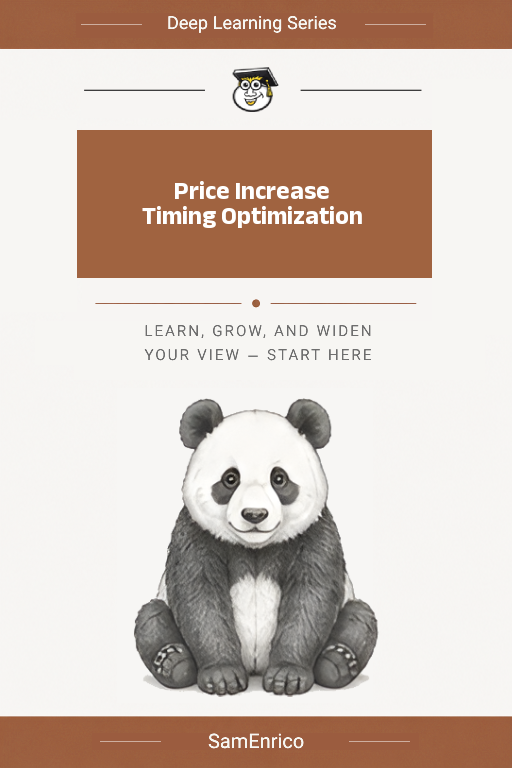
Non-FictionBusiness BriefTiming Strategy
Price Increase Timing Optimization eBook
Schedule price changes just before paydays or afte
by Flagg Thalia
Schedule price changes just before paydays or after competitor moves to minimize customer resistance.
Formats
Free sample
Chapter 1: The Hidden Tax--–- Every time a customer pays for something, they experience a sensation that behavioral economists call the pain of paying. This is not a metaphor. It is a measurable neurological response.Research using functional magnetic resonance imaging (f MRI) has shown that the same areas of the brain activated by physical pain—the insula and the prefrontal cortex—are activated when a person sees a price that feels too high. The brain literally hurts. A price increase does not just affect a customer's wallet.
It affects their nervous system.This pain is not constant. It fluctuates based on context, timing, and the customer's mental state. A $50 charge feels very different on the day after payday than it does on the day before. A 10 percent increase feels very different when your competitor just announced a 15 percent increase. The same absolute price can trigger intense pain or barely register at all, depending entirely on when and how it is presented.This chapter unpacks the neuroscience and behavioral economics of price resistance.
You will learn why customers hate price increases, why that hatred is not uniform across time, and how to use timing to reduce the perceived pain. By the end of this chapter, you will understand that the size of your price increase matters less than the moment you choose to announce it.The Neuroscience of "Fairness"When customers encounter a price increase, their brain performs an automatic calculation. It asks: "Is this fair?" This question is processed in the ventromedial prefrontal cortex, the same region that evaluates social norms and moral judgments. The brain is not running a rational cost-benefit analysis. It is making an emotional, comparative judgment.The concept of fairness in pricing is not rational.
It is emotional and deeply contextual. A price increase that would be considered fair in one context is outrageous in another. A 10 percent increase on a life-saving medication feels unfair and exploitative. The same 10 percent increase on a luxury handbag feels expected and reasonable.The most powerful influence on perceived fairness is what psychologists call reference points. Customers do not evaluate your new price in isolation.
They compare it to three specific benchmarks.First, they compare it to your old price. This is the temporal reference. If you raised prices last month, another increase this month will feel unfair regardless of the percentage. If you have not raised prices in three years, the same increase will feel long overdue. The temporal reference resets after each increase.
Customers anchor on the most recent price they paid.Second, they compare your new price to your competitors' prices. This is the social reference. When you raise prices alone, you violate the social reference. Customers look at your competitors who have not raised prices and see greed. When you raise prices after competitors have done the same, the social reference is satisfied.
Customers accept the increase as a market condition rather than a personal affront. This is the psychological foundation of the competitor cover strategy, which you will learn in Chapter 5.Third, they compare your new price to their available cash. This is the budgetary reference. A customer with a full bank account after payday experiences less pain than the same customer with a low account before payday. The price is identical.
The pain is different. This is the psychological foundation of the payday window strategy, which you will learn in Chapter 3.When you violate all three reference points—raising prices alone, shortly after a previous increase, just before payday—you trigger maximum pain. When you satisfy all three—raising prices after competitors, after a long pause, just after payday—you minimize pain. The price increase can be identical. The customer response will be completely different.Loss Aversion and the Endowment Effect To understand why price increases hurt so much, you need to understand two of the most powerful findings in behavioral economics: loss aversion and the endowment effect.Behavioral economists Daniel Kahneman and Amos Tversky demonstrated that losses hurt about twice as much as equivalent gains feel good.
This is loss aversion. Losing 10feelstwiceaspainfulasfinding10 feels twice as painful as finding 10feelstwiceaspainfulasfinding10 feels pleasurable. The asymmetry is baked into the human brain.A price increase is experienced by customers as a loss. They are losing the ability to buy at the old price. That loss hurts twice as much as any value gain you might have added since their last purchase.
You could have added five new features and improved your response time by 50 percent. The customer will still feel the loss of the old price more acutely than they feel the gain of the new features.The endowment effect amplifies this. Customers feel ownership over the old price. They have endowed themselves with the right to pay that amount. This is not rational.
They do not have a contractual right to the old price. But psychologically, they feel it as theirs. Taking it away feels like a violation, like someone reaching into their wallet and removing cash.The endowment effect explains why long-term customers are often the most vocal opponents of price increases. They have endowed themselves with the old price for years. It feels like part of their identity as a customer.
When you take it away, they feel personally aggrieved.The implications for timing are clear. You want to announce price increases when customers are least focused on what they are losing. That means after payday, when they feel abundant rather than scarce. That means after competitor increases, when the loss feels shared rather than isolated. That means at times of high value perception, when the gain of your product outweighs the loss of the price.The "Fairness" Threshold Not all price increases are created equal.
Research across multiple industries shows that customers have a fairness threshold—a point beyond which an increase feels exploitative rather than reasonable. Below this threshold, customers may grumble but stay. Above this threshold, they cancel, switch, or complain publicly.This threshold is not a fixed percentage. It varies systematically across four dimensions.The first dimension is product category. Necessities have lower fairness thresholds than luxuries.
A 5 percent increase on prescription medication can trigger outrage. A 20 percent increase on a luxury watch might barely register. Customers expect necessities to be stable. They expect luxuries to be volatile. This asymmetry is not rational, but it is predictable.The second dimension is relationship length.
Long-term customers expect grandfathering or smaller increases. They have invested time and loyalty in your brand. A price increase that feels reasonable to a new customer feels like a betrayal to a ten-year customer. The fairness threshold declines with tenure. The longer they have been with you, the more they expect to be protected.The third dimension is communication quality.
Poor communication lowers the threshold. Customers who are surprised by a price increase on their bill feel more violated than customers who received advance notice, an explanation, and a value reaffirmation. The same increase can feel fair or unfair depending entirely on how it was communicated.The fourth dimension is timing. Increases during economic hardship are judged more harshly. Raising prices during a recession, when your customers are struggling, lowers the fairness threshold significantly.
Raising prices during economic growth, when customers feel prosperous, raises the threshold.The most successful price increases stay below the fairness…
This is the end of the free sample. Get the eBook to keep going. Buy now
About this book
Details
- Author
- Flagg Thalia
- Publisher
- SamEnrico
- Language
- English
- Genre
- Non-Fiction, Business Brief, Timing Strategy
- Released
- 2026-06-01
- Pages (approx.)
- 130
- Available as
- eBook, Audiobook

Read better in the ZLOADR app
Your eBooks on your phone or tablet. Sign in with your SamEnrico account and start reading.
More by Flagg Thalia
 MDD and Worthlessness GuideFlagg Thalia$11.99
 Detox Vital Sign MonitoringFlagg Thalia$11.99
 Conflict to Creativity FrameworkFlagg Thalia$11.99
 Parent Guilt Release GuideFlagg Thalia$11.99
 Anger And ADHDFlagg Thalia$11.99
 Self Esteem For LGBTQ EmployeesFlagg Thalia$11.99
 Plant Based AthletesFlagg Thalia$11.99
 Blue Zone Meat Reduction PlanFlagg Thalia$11.99
 The Guru's Shadow: The Untold Wisdom of Sage VyasaFlagg Thalia$11.99
 The Bloodied Pass of Klis: Croatia's Last Stand Against the OttomansFlagg Thalia$11.99
 How to Become a Power-shovel OperatorFlagg Thalia$11.99
 How to Produce Toddler UnderwearFlagg Thalia$11.99
You may also like
 Hong Kong Handover 1997Dunn Johnnie$11.99
 Zumba For Postnatal Recovery CourseNeal Christian$11.99
 Zumba for BeginnersLadner Nikia$11.99
 YouTube Comment Mining GuideHumes Pandora$12.99
 Worry Box MeditationCarlin Rudy$11.99
 Workplace Stress MeditationNguyen Lynn$11.99
 Workplace Stress and Sleep RepairHawley Ivory$11.99
 Workplace Perfectionism CureDelaney Jeffry$11.99
 Workplace Injustice Anger GuideWallen Isabelle$11.99
 Work Addiction and Burnout LinkGreenwood Ester$11.99
 Women in Yoga and WellnessBeattie Galina$11.99
 Women in Stand Up ComedyChun Evangeline$11.99