
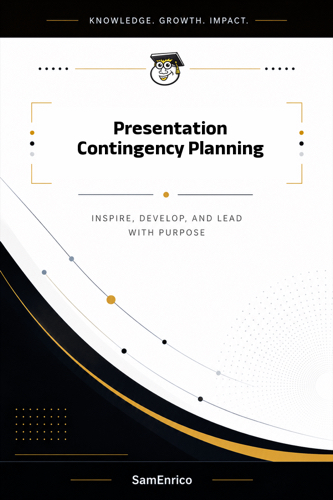
Non-FictionSelf-HelpRisk Management
Presentation Contingency Planning eBook
Teaches backup plans for technology failures, time
by Acosta Yetta
Teaches backup plans for technology failures, time crunches, and audience disruptions.
Formats
Free sample
Chapter 1: The Hope Trap--–- It begins with a click. Or rather, it begins with the absence of one. You are standing in front of forty-seven people who have surrendered their morning coffee, their email backlog, and their dignity to sit in flimsy conference chairs. You have prepared for three weeks. Your slides are beautiful.
Your data is bulletproof. Your suit is freshly pressed. You click the remote. Nothing happens. You click again.
The projector blinks once, twice, then displays a blue screen that reads, in calm, indifferent letters: “No Signal.”You feel the room tilt. Your mouth goes dry. Someone in the third row coughs. Another person whispers to a neighbor. You click a third time, as if repetition will intimidate the hardware into submission.
It does not. You turn to the event organizer, who shrugs with the practiced helplessness of someone who has seen this happen a hundred times. “We’ll get someone,” she says. And you wait. Thirty seconds.
One minute. Two minutes. The audience begins to check their phones. The energy drains out of the room like water from a punctured bottle.By the time the tech support person arrives, untangles the cables, and restores the signal, you have lost them. Not all of them.
But enough. You rush through your opening to “make up time.” You speak faster. You skip a slide you liked. You arrive at your conclusion breathless and apologetic. Someone raises a hand and asks a question you already answered during the part you rushed through.
You say, “As I mentioned earlier,” with an edge in your voice that you immediately regret. The session ends. People leave. You pack your laptop and think, If only the projector had worked.Here is the truth you do not want to hear: the projector was never the problem.The problem was the hope trap.The Architecture of Wishful Thinking Every presenter falls into the hope trap. It is not a character flaw; it is a cognitive bias.
Psychologists call it the optimism bias—the tendency to believe that negative outcomes are more likely to happen to other people than to ourselves. We plan for the best because imagining the worst feels like bad luck. We tell ourselves that the projector worked during the rehearsal, so it will work during the presentation. We assume the previous speaker will end on time because that is what the schedule says. We trust that the audience will be attentive because we have prepared interesting material.None of these assumptions are safe.
They are hopes dressed up as plans.The hope trap is seductive because it requires less work. Preparing for success is easy. You make your slides, you practice your transitions, you choose a font that conveys authority without being aggressive. Preparing for failure is harder. It requires imagining scenarios that feel unlikely, practicing responses that feel awkward, and carrying backup materials that feel excessive—until the moment they become essential.Consider the data.
In a survey of 1,200 business professionals conducted by a major presentation training firm, 87 percent reported experiencing at least one significant presentation failure in the preceding twelve months. The most common failures were technology-related (projector issues, adapter mismatches, file corruption), followed by time-related (running over or being cut short), followed by audience-related (hostile questions, side conversations, low attendance). Despite this near-universal experience of failure, only 23 percent reported having any formal contingency plan. The rest relied on hope.Hope, in this context, is not a strategy. It is a debt you accrue in advance and pay back with interest during the moment of failure.Two Kinds of Failure To escape the hope trap, you must first understand what can actually go wrong.
Most presenters think of failure as a single event—the projector dies, the question stumps you, the clock runs out. But in reality, failures fall into two distinct categories, and the distinction matters enormously.The first category is component failure. This is when a single piece of your presentation ecosystem breaks. The battery dies. The remote stops working.
A single slide is corrupted. You forget a key data point. Someone asks a question you cannot answer. Component failures are isolated, localized, and usually recoverable—provided you have planned for them. They are the blown tire on a highway, not the collapsed bridge.
Annoying, but not catastrophic.The second category is infrastructure failure. This is when the underlying conditions of your presentation collapse. The venue loses power entirely. The agenda is restructured and your time is cut from thirty minutes to five. A loud construction project starts outside the window.
The audience becomes openly hostile. Infrastructure failures change the fundamental nature of the presentation. They are not a blown tire; they are a road that no longer exists.This distinction comes from disaster recovery literature, specifically the field of IT systems design. In that world, engineers plan differently for a failed hard drive (component) versus a failed data center (infrastructure). A hard drive failure is managed with redundancy—you have a backup drive ready to take over.
A data center failure requires failover to an entirely different location. The scale of the response matches the scale of the failure.Presenters need the same mental model. A component failure—your clicker stops working—requires a small, nearly invisible adjustment. You walk to the laptop and advance slides manually. The audience barely notices.
An infrastructure failure—the projector dies and cannot be revived—requires a more significant pivot. You abandon slides entirely and continue with a whiteboard, a flipchart, or pure oratory. The audience notices, but they notice your composure more than the failure.The mistake most presenters make is treating all failures as infrastructure failures. They panic over a dead clicker as if the entire building were on fire. Or, worse, they treat infrastructure failures as component failures, trying to “fix” the unfixable instead of pivoting to a new mode entirely.Graceful Degradation: The Engineer’s Gift to Presenters There is a concept from engineering that will change how you think about presentation failures.
It is called graceful degradation.Graceful degradation is the property of a system that continues to operate, at reduced functionality, even when part of the system fails. A website that loses its database connection but still displays a cached version of its homepage is degrading gracefully. A car that loses power steering but can still be steered manually is degrading gracefully. The system does not disappear; it adapts. It loses features but retains function.Most presentations do not degrade gracefully.
They degrade catastrophically. The projector fails, so the presenter freezes. The video does not load, so the presenter apologizes and skips an entire section. The Q&A goes sideways, so the presenter becomes defensive and rushed. The presentation does not lose a feature; it loses its entire structure.
The audience watches a system collapse, not adapt.Graceful degradation for a presentation looks different. It means designing your content and delivery so that any single piece can fail without taking down the whole. It means knowing exactly what you will say when the video does not play (you will describe it instead). It means knowing how you will continue when the projector dies (you will…
This is the end of the free sample. Get the eBook to keep going. Buy now
About this book
Details
- Author
- Acosta Yetta
- Publisher
- SamEnrico
- Language
- English
- Genre
- Non-Fiction, Self-Help, Risk Management
- Released
- 2026-06-10
- Pages (approx.)
- 138
- Available as
- eBook, Audiobook

Read better in the ZLOADR app
Your eBooks on your phone or tablet. Sign in with your SamEnrico account and start reading.
More by Acosta Yetta
 Competition Comparison HealingAcosta Yetta$11.99
 Warrant Cashless ExerciseAcosta Yetta$11.99
 Running HIIT GuideAcosta Yetta$11.99
 The Green Conquest: Cyrus the Great and the Achaemenid Empire's RiseAcosta Yetta$11.99
 Personnel Security SpecialistAcosta Yetta$11.99
 How to Produce Ceramic ValvesAcosta Yetta$11.99
 Factoring in Nigeria HandbookAcosta Yetta$12.99
 How to Start a Lock for Motor Vehicle Business (Beginners Guide)Acosta Yetta$11.99
You may also like
 Hong Kong Handover 1997Dunn Johnnie$11.99
 Zumba For Postnatal Recovery CourseNeal Christian$11.99
 Zumba for BeginnersLadner Nikia$11.99
 YouTube Comment Mining GuideHumes Pandora$12.99
 Worry Box MeditationCarlin Rudy$11.99
 Workplace Stress MeditationNguyen Lynn$11.99
 Workplace Stress and Sleep RepairHawley Ivory$11.99
 Workplace Perfectionism CureDelaney Jeffry$11.99
 Workplace Injustice Anger GuideWallen Isabelle$11.99
 Work Addiction and Burnout LinkGreenwood Ester$11.99
 Women in Yoga and WellnessBeattie Galina$11.99
 Women in Stand Up ComedyChun Evangeline$11.99