
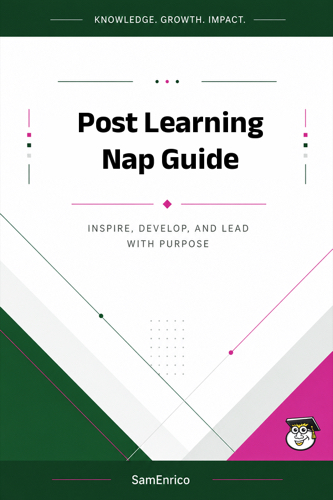
Post Learning Nap Guide eBook
Teaches napping immediately after learning to enha
Teaches napping immediately after learning to enhance encoding.
Formats
Free sample
Chapter 1: The 60-Minute Heist--You are currently losing 50 to 90 percent of every dollar you spend on education, every hour you practice a musical instrument, every seminar you attend, and every book you read. This is not an exaggeration. It is not a metaphor for poor teaching or lazy studying. It is a biological fact, as measurable as your heart rate or body temperature. And no one told you.The name of the thief is the Forgetting Curve, and it begins its work within minutes of you learning something new.Let us run a small experiment together.
Right now, read the following sequence of ten random words. Read them once, at a normal pace, and then close your eyes for thirty seconds:Elephant, bicycle, thunder, notebook, candle, shadow, river, button, mirror, staircase.Now, without looking back, write down as many as you can remember. Most people recall between four and six. That is a 40 to 60 percent loss in less than one minute. Now imagine what happens after an hour.
After a day. After a week. This is not a test of intelligence. It is a test of biology. Your brain was never designed to remember random lists, lecture slides, or golf swing mechanics.
It was designed to remember where the predator was hiding and which berry made your ancestor sick. Everything else is, from your brain’s perspective, noise.This chapter reveals the true scale of the problem, introduces the science of why forgetting is not a failure but a feature, and then hands you the weapon that every best-selling book on memory and sleep has confirmed but never fully operationalized: the Nap Buffer. By the end of this chapter, you will understand exactly why you forget, how fast it happens, and why a well-timed nap is not rest but the single most powerful learning tool you are not using.The Scale of the Loss Let us begin with the man who discovered the Forgetting Curve. His name was Hermann Ebbinghaus, a German psychologist who, in the 1880s, conducted the most tedious self-experiment in the history of science. He taught himself thousands of nonsense syllables—meaningless three-letter combinations like RUC, TAZ, and BIV—and then tested his own memory at various intervals.
What he discovered was a mathematical law. Forgetting is not linear. It does not happen at a steady, predictable rate. Instead, it follows a steep, exponential decline in the first hour, followed by a gradual leveling off.Ebbinghaus found that within one hour of learning, he had forgotten roughly 50 percent of the material. Within 24 hours, he had forgotten 70 percent.
Within a week, 80 percent. The curve is merciless, and it applies to almost everything you learn that is not emotionally charged or survival-relevant. You remember the car that almost hit you because your amygdala tagged it as life-threatening. You forget the name of the person you met at the networking event because your amygdala correctly judged that stranger as non-lethal.Modern research has confirmed and refined Ebbinghaus’s findings. A 2015 study published in the journal Memory & Cognition tested medical students who had just completed a lecture on cardiology.
One hour after the lecture, the students had forgotten nearly 60 percent of the key facts. Twenty-four hours later, without review, they remembered less than 30 percent. These were motivated, intelligent learners who wanted to remember. Biology did not care about their motivation.Consider the financial implications. The average American student loan debt is roughly $37,000 per borrower.
If you forget 50 to 70 percent of what you learn in your courses, you are effectively burning half of that investment. Consider the professional: the employee who attends a $2,000 training seminar, takes diligent notes, and then forgets most of it by the next morning has essentially thrown money into a furnace. Consider the musician: the guitarist who practices scales for two hours but forgets the fingerings by the next day is practicing forgetting as much as she is practicing music.This is not a character flaw. It is not about willpower. It is about the architecture of your memory system, and that system operates according to rules that have nothing to do with how hard you try.Why Your Brain Destroys What You Just Learned To understand why forgetting is so aggressive, you must understand the difference between three types of memory: sensory, short-term, and long-term.
Sensory memory lasts less than a second. It is the ghost of an image after you blink or the echo of a sound after it stops. Short-term memory, sometimes called working memory, lasts about 15 to 30 seconds without rehearsal. This is where you hold a phone number while you dial it or a sentence while you finish reading the paragraph. The capacity of short-term memory is famously limited to about seven items, plus or minus two.Long-term memory is the goal.
This is where information is stored indefinitely, though retrieval is not guaranteed. The problem is that your brain does not automatically move information from short-term to long-term storage. It requires a specific neurochemical process called consolidation, and consolidation is expensive. It takes energy. It takes time.
And most importantly, consolidation is not prioritized.Your brain is constantly receiving millions of bits of sensory data. It cannot save all of them. So it makes a ruthless calculation: is this information likely to be needed again? If the answer is no, the information is either never stored or actively deleted. The default setting of your brain is delete.
Save is the exception.This is where the Forgetting Curve comes from. The curve is not a design flaw. It is a feature. Your brain is aggressively deleting information that it has judged as low-priority, and it makes that judgment within minutes of you learning it. If you do not signal to your brain that the information matters—by reviewing it, using it, or, as you will learn, sleeping on it—the delete command executes.The Nap Buffer: Your 60-Minute Window Here is the most important sentence in this book: For approximately 60 minutes after learning something new, your brain is in a state of heightened plasticity, meaning it is unusually receptive to saving that information, but only if you give it the right conditions.
This window is called the Nap Buffer.The Nap Buffer is not a theory. It is a physiological reality. In the first hour following a learning event, the neural pathways that encode that information are still electrically active. They are like wet concrete. Disturb them, and they harden incorrectly.
Reinforce them, and they set permanently. Sleep, particularly Stage 2 sleep and Slow-Wave Sleep (SWS), is the most powerful reinforcement available.A landmark study from the University of Lübeck in Germany demonstrated this with remarkable clarity. Researchers taught participants a complex finger-tapping sequence—similar to learning a piano scale. One group took a 60-minute nap immediately after learning. Another group stayed awake.
A third group took the same nap but six hours after learning. The results were stark. The group that napped immediately after learning showed a 50 percent improvement in performance upon waking. The group that napped six hours later showed no improvement over the awake group. The window mattered more than the nap itself.Another study, this one from the University of California…
This is the end of the free sample. Get the eBook to keep going. Buy now
About this book
Details
- Author
- Crawley Nicolette
- Publisher
- SamEnrico
- Language
- English
- Genre
- Non-Fiction, Self-Help, Encoding
- Released
- 2026-06-09
- Pages (approx.)
- 128
- Available as
- eBook, Audiobook

Read better in the ZLOADR app
Your eBooks on your phone or tablet. Sign in with your SamEnrico account and start reading.
More by Crawley Nicolette
 Contract Abstraction for ComplianceCrawley Nicolette$11.99
 Star Knowledge Spiritual GuideCrawley Nicolette$11.99
 Imposter Racial Minority GuideCrawley Nicolette$11.99
 Daily Benefit Amount GuideCrawley Nicolette$11.99
 Long Breath vs Short Breath NoticeCrawley Nicolette$11.99
 Parent Time PodcastsCrawley Nicolette$11.99
 Holocaust Survivor TaleCrawley Nicolette$11.99
 Affirmations For Tech BurnoutCrawley Nicolette$11.99
 The Golden Notes of the Kingdom: The Court Musicians of AxumCrawley Nicolette$11.99
 The Phantom of the Viennese Court: Mozart's Lost SymphonyCrawley Nicolette$11.99
 The Last Broadcast: The Rise and Fall of Radio LuxembourgCrawley Nicolette$11.99
 The Dancer's Guide to Cumbia VilleraCrawley Nicolette$11.99
You may also like
 Hong Kong Handover 1997Dunn Johnnie$11.99
 Zumba For Postnatal Recovery CourseNeal Christian$11.99
 Zumba for BeginnersLadner Nikia$11.99
 YouTube Comment Mining GuideHumes Pandora$12.99
 Worry Box MeditationCarlin Rudy$11.99
 Workplace Stress MeditationNguyen Lynn$11.99
 Workplace Stress and Sleep RepairHawley Ivory$11.99
 Workplace Perfectionism CureDelaney Jeffry$11.99
 Workplace Injustice Anger GuideWallen Isabelle$11.99
 Work Addiction and Burnout LinkGreenwood Ester$11.99
 Women in Yoga and WellnessBeattie Galina$11.99
 Women in Stand Up ComedyChun Evangeline$11.99