
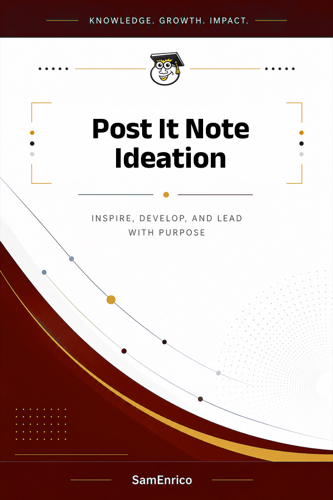
Non-FictionSelf-HelpPost It Method
Post It Note Ideation eBook
Run rapid single idea per note sessions for quanti
Run rapid single idea per note sessions for quantity and clustering.
Formats
Free sample
Chapter 1: The Yellow Lie--–- The meeting invite lands in your inbox at 4:47 PM on a Thursday. Subject line: "Brainstorming Session – Conference Room B – 9 AM Friday." Your heart sinks. You know what is coming. Tomorrow morning, eight people will sit in a beige room with a whiteboard and dry-erase markers that have been dry for three years. The loudest person will talk for the first twenty minutes.
Someone will suggest something obviously terrible. No one will say it is terrible because the rules of "brainstorming" forbid criticism. The facilitator will write everything on the whiteboard in illegible handwriting. At 10:30 AM, someone will check their phone. At 10:45 AM, the meeting will end.
The whiteboard will be erased by noon. Nothing will change. You will have lost ninety minutes of your life that you will never get back.This is not hyperbole. This is the lived experience of knowledge workers across every industry, every continent, every organizational level. According to a 2019 study by the Harvard Business Review, the average professional attends 8.7 meetings per week, and 67 percent of those meetings are classified as "unproductive" by the attendees themselves.
Brainstorming sessions rank dead last in perceived value — below status updates, below quarterly reviews, below the meeting about the meeting. And yet we keep doing them. We keep booking the room, uncapping the dead markers, and hoping that this time will be different.It will not be different. Not unless you stop doing what you are doing and learn a completely different way.This book exists because the standard model of group ideation is not merely ineffective. It is actively counterproductive.
The research on this point is so settled that continuing to use verbal brainstorming in professional settings is, to put it bluntly, professional malpractice. The psychologist Donald Taylor conducted one of the earliest studies in 1958, just five years after Alex Osborn published his book Applied Imagination and launched the brainstorming craze. Taylor compared groups of people brainstorming together against "nominal groups" — the same number of people working alone whose ideas were later combined. The nominal groups produced between 30 and 50 percent more ideas. The same result has been replicated in over forty studies across six decades.
Working alone, then pooling ideas, consistently outperforms working together out loud.And yet the myth persists. Why? Because verbal brainstorming feels productive. It feels like collaboration. It feels like energy.
The room buzzes. People laugh. Someone says something outrageous and everyone cheers. But feelings are not data. The data says something uncomfortable: most of what happens in a verbal brainstorm is performance, not production.
The extroverts perform. The introverts withdraw. The loudest voice sets the agenda. The first three ideas anchor everything that follows. And at the end, you have a whiteboard full of words and no mechanism to turn those words into action.This book offers an alternative.
It is not a theory. It is a protocol. A repeatable, teachable, measurable protocol that has been tested in Fortune 500 companies, startup accelerators, nonprofit strategy sessions, and university design programs. The protocol has a name: Post-It Note Ideation. And before you dismiss it as a gimmick — "oh, the sticky note book" — consider what you are actually dismissing.
You are dismissing a method that produces six to eight times more ideas per minute than verbal brainstorming. You are dismissing a method that eliminates production blocking, the single largest drag on group creativity. You are dismissing a method that forces one idea per note, which means no one can hide a bad idea inside a long sentence. You are dismissing a method that makes ideas movable, sortable, killable, and archivable — none of which is possible when ideas are shouted into the void.The sticky note is not the point. The constraint is the point.The Constraint That Sets You Free The 3×3 inch Post-it Note is a remarkably stupid object.
It is a piece of paper with low-tack adhesive on the back. That is all. And yet that stupid object, when combined with a specific set of rules about time, quantity, and silence, becomes one of the most powerful creative tools ever invented.Consider what the 3×3 note does to your cognition. It forces brevity. You cannot write a paragraph on a 3×3 note.
You cannot write two ideas. You cannot write an idea that requires three sub-bullets and a conditional clause. You can write one thing. One sentence. One verb and one object.
"Call the customer back." That fits. "Call the customer back and also send a follow-up email and check inventory levels" does not fit. That is not a failure of the note. That is a feature. That second example is actually three ideas masquerading as one.
The note forces you to separate them.This is the cognitive load principle in action. The psychologist George Miller published a paper in 1956 titled "The Magical Number Seven, Plus or Minus Two." The paper argued that human working memory can hold approximately seven chunks of information at once. More recent research has revised that number downward to four, plus or minus one. Regardless of the exact number, the implication is clear: your brain cannot hold a complex, multi-part idea all at once. When you write "reduce costs and improve quality and retrain staff and launch a new marketing campaign," you are asking your working memory to juggle four chunks simultaneously.
The note, by physically preventing you from doing that, is protecting you from your own ambition.The 3×3 note also prevents anchoring. The psychologist Amos Tversky, working with Daniel Kahneman, identified anchoring as one of the most persistent cognitive biases. When the first piece of information is presented — the first number, the first idea, the first option — everything else is judged in relation to that anchor. In a verbal brainstorm, the first person to speak sets the anchor. Their idea might be terrible, but it is now the reference point.
Every subsequent idea is evaluated as "more like that" or "less like that." The first speaker, whether they are the smartest person in the room or not, becomes the invisible dictator of the session.On a whiteboard, anchoring is even worse. The first idea written stays in the corner of the board for the entire session. It cannot be moved. It cannot be discarded without erasing it, which feels aggressive and permanent. On a Post-it note, the first idea is just a yellow square.
It can be moved to the left. It can be moved to the right. It can be moved to the graveyard — a physical location in the room where dead ideas go to rest — without anyone feeling attacked. The note is not the person. The note is not the ego.
The note is just a note. This psychological distancing is not a minor convenience. It is the difference between a session where ideas are debated and a session where ideas are manipulated.Then there is the tactile factor. Writing by hand on a small, sticky surface activates the brain differently than typing on a keyboard. The neuroscientist Virginia Berninger at the University of Washington conducted a series of studies comparing handwriting to typing.
Handwriting activated the reticular activating system — the brain's attention filter — and the motor cortex more intensely than typing. Handwriting…
This is the end of the free sample. Get the eBook to keep going. Buy now
About this book
Details
- Author
- Leighton Lonny
- Publisher
- SamEnrico
- Language
- English
- Genre
- Non-Fiction, Self-Help, Post It Method
- Released
- 2026-06-10
- Pages (approx.)
- 137
- Available as
- eBook, Audiobook

Read better in the ZLOADR app
Your eBooks on your phone or tablet. Sign in with your SamEnrico account and start reading.
More by Leighton Lonny
 Growth Mindset Daily JournalLeighton Lonny$11.99
 The SMART for Health GoalsLeighton Lonny$11.99
 Delegation for IT ManagersLeighton Lonny$11.99
 Letting Go of GuiltLeighton Lonny$11.99
 Financial Stress And Eating HabitsLeighton Lonny$11.99
 Traffic Anger Control WorkbookLeighton Lonny$11.99
 Body Scan Meditation for NewcomersLeighton Lonny$11.99
 The Silent Heist: Australia's Vanishing BillionaireLeighton Lonny$11.99
 Rhythms of Gold: The Untold Story of Africa's Olympic Dance RevolutionLeighton Lonny$11.99
 How to Produce Puppet and Puppet Theater AccessoriesLeighton Lonny$11.99
 How to Produce Electronics CleanersLeighton Lonny$11.99
 The Essential Guide to BounceLeighton Lonny$11.99
You may also like
 Hong Kong Handover 1997Dunn Johnnie$11.99
 Zumba For Postnatal Recovery CourseNeal Christian$11.99
 Zumba for BeginnersLadner Nikia$11.99
 YouTube Comment Mining GuideHumes Pandora$12.99
 Worry Box MeditationCarlin Rudy$11.99
 Workplace Stress MeditationNguyen Lynn$11.99
 Workplace Stress and Sleep RepairHawley Ivory$11.99
 Workplace Perfectionism CureDelaney Jeffry$11.99
 Workplace Injustice Anger GuideWallen Isabelle$11.99
 Work Addiction and Burnout LinkGreenwood Ester$11.99
 Women in Yoga and WellnessBeattie Galina$11.99
 Women in Stand Up ComedyChun Evangeline$11.99