
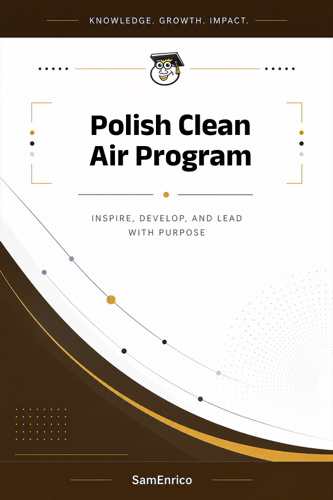
Non-FictionAnnual CheckupAir Quality
Polish Clean Air Program eBook
Reviews anti-smog subsidies, heat pump funding, an
Reviews anti-smog subsidies, heat pump funding, and boiler replacement grants in Poland.
Formats
Free sample
Chapter 1: Breathing Was War--–- The old woman did not own a winter coat. Not because she was poor, though she was, but because she never left her house between November and March. The air outside, she explained to the social worker who visited in January 2019, tasted like licking a chimney. She had survived the German occupation, the communist food shortages, and the death of her husband, but she could not survive the smog. Her home, a small brick house in the Silesian town of Piekary Śląskie, sat in a valley where cold air trapped smoke from hundreds of neighboring chimneys.
She kept her windows sealed with tape and masking tape over the tape. She ran an air purifier in her bedroom, a luxury she had purchased with money saved from skipping meals. The purifier's filter, which the manufacturer said should last six months, lasted eighteen days. She showed the social worker the filter: a rectangle of fibrous material that had started white and was now the color of charcoal. "This," she said, holding up the filter, "is what my lungs look like."Her name was Krystyna, and she was not an isolated case.
She was one of millions. Poland in the 2010s held an unenviable distinction: it was home to thirty-six of the European Union's fifty most polluted cities. Not the most polluted cities in Eastern Europe, but the most polluted cities in the entire European Union, a bloc that stretches from the Atlantic coast of Portugal to the Arctic reaches of Finland. Polish cities routinely exceeded EU air quality standards by over three hundred percent during winter months. In Kraków, particulate matter concentrations reached levels that health authorities classified as "hazardous" on more than ninety days per year.
In smaller towns like Sucha Beskidzka and Żywiec, nestled in mountain valleys where cold air trapped pollutants close to the ground, residents breathed air that the World Health Organization later calculated was equivalent to smoking several cigarettes per day.The culprit was not some mysterious industrial plume or a chemical plant disaster. It was something far more mundane, far more distributed, and for that reason far more difficult to solve: the residential heating habits of ordinary Polish families. Approximately three million homes in Poland were heated by old coal boilers, many of them relics from the communist era that had been patched and repaired for decades beyond their intended lifespan. These devices, known colloquially as kopciuchy—a derogatory term that roughly translates to "smokers" or "belchers"—had no emissions controls, no efficiency standards, and no regulatory oversight. They burned everything from hard coal to wood scraps to garbage, often producing up to thirty times more particulate matter than a modern heating system.
The problem was compounded by the fact that Poland's housing stock, particularly in rural and suburban areas, was among the least energy-efficient in Europe. Poorly insulated homes required more heat, which meant more coal burning, which meant more pollution, which meant more of the deadly haze that Krystyna could not risk breathing.This chapter establishes the public health and environmental catastrophe that necessitated the Clean Air Program (Czyste Powietrze), which would become Europe's largest residential renovation initiative. It argues that Poland's unique dependence on solid fuels for home heating—unlike Western European nations that transitioned earlier to natural gas or district heating—created a niska emisja (low emission) crisis that required an unprecedented state intervention. The term "low emission" is something of a misnomer, as the pollution from residential heating is anything but low in its health impacts. It refers instead to the height at which pollutants are released: unlike tall industrial smokestacks that disperse emissions over wide areas, residential chimneys release concentrated pollution at ground level, exactly where people breathe.
This is the crisis that would eventually force Poland to confront its coal addiction not at the power plant level but at the kitchen table level, where the decision to burn cheap coal was simultaneously an economic necessity and a public health disaster.The Air That Kills To understand the scale of Poland's air quality crisis, one must first understand what exactly was floating in the gray haze that settled over Polish cities each winter. The most dangerous component was particulate matter, specifically PM2.5 and PM10—particles smaller than 2.5 and 10 micrometers in diameter, respectively. For perspective, a human hair is approximately 70 micrometers wide. These particles are small enough to bypass the body's natural defenses, travel deep into the lungs, cross into the bloodstream, and travel to virtually every organ. The World Health Organization has classified particulate matter as a Group 1 carcinogen, placing it in the same category as asbestos, tobacco smoke, and ultraviolet radiation.
There is no safe level of exposure. Every additional microgram per cubic meter increases rates of lung cancer, heart disease, stroke, asthma, and dementia.Poland's particulate matter levels were not merely high. They were catastrophically high. The WHO recommended that average annual PM2.5 concentrations not exceed 10 micrograms per cubic meter. The European Union, with a weaker standard, set a limit of 25 micrograms.
In southern Polish cities like Kraków, Zabrze, and Katowice, winter monthly averages routinely exceeded 150 micrograms. On the worst days, readings topped 400 micrograms—forty times the EU limit, sixteen times the Polish legal limit, and forty times the level that health authorities consider safe for any human being. Those were the days when schools canceled outdoor activities, when hospitals saw spikes in emergency admissions, and when Krystyna kept her windows sealed with tape over tape.The health consequences were not theoretical. Polish epidemiologists published a landmark study in 2016 that calculated air pollution was responsible for approximately 45,000 premature deaths annually in Poland. That figure was greater than the number of Poles who died from traffic accidents, alcohol-related causes, and homicides combined.
It was equivalent to the population of a small city disappearing every year, not from a sudden catastrophe but from a slow accumulation of damage to lungs and hearts and brains. The study also calculated that air pollution reduced average Polish life expectancy by ten months, with residents of the most polluted regions losing over two years of life. For comparison, the obesity epidemic in the United States reduces average life expectancy by approximately eight months.The economic costs were equally staggering. The European Environment Agency estimated that air pollution cost the Polish economy over 100 billion złoty annually in healthcare spending, lost productivity, and premature mortality. That was roughly four percent of Poland's GDP, a drag on the economy comparable to a mild recession every single year.
The costs fell disproportionately on the poor, who were more likely to live in polluted areas, more likely to have pre-existing health conditions, and less likely to have access to private healthcare. The wealthy could buy air purifiers, move to less polluted neighborhoods, or afford private medical care. The poor breathed the same air as everyone else but had fewer defenses against it.The Geography of Poison Why was Poland's air so much worse than that of its Western European neighbors? The answer lies in a combination of geography, history, and economics that created a perfect storm of pollution. Geographically, much of southern Poland lies in basins and valleys that trap cold…
This is the end of the free sample. Get the eBook to keep going. Buy now
About this book
Details
- Author
- Charlton Noemi
- Publisher
- SamEnrico
- Language
- English
- Genre
- Non-Fiction, Annual Checkup, Air Quality
- Released
- 2026-06-07
- Pages (approx.)
- 150
- Available as
- eBook, Audiobook

Read better in the ZLOADR app
Your eBooks on your phone or tablet. Sign in with your SamEnrico account and start reading.
More by Charlton Noemi
 Car Wash Operation Fallen EmpireCharlton Noemi$11.99
 Upsell Email SequencesCharlton Noemi$11.99
 Cocaine Relapse Prevention CourseCharlton Noemi$11.99
 Red Tails Over Europe: The Secret Missions of the Tuskegee AirmenCharlton Noemi$11.99
 The Last Telegram: A Love Written in CodeCharlton Noemi$11.99
 Understanding HypothyroidismCharlton Noemi$17.99
 How to Start a Hobby in Musical InstrumentsCharlton Noemi$11.99
 Intelligent Course Scheduling GuideCharlton Noemi$12.99
 International IP Renewal WorkbookCharlton Noemi$12.99
 Groundwater MonitoringCharlton Noemi$11.99
You may also like
 Hong Kong Handover 1997Dunn Johnnie$11.99
 Zumba For Postnatal Recovery CourseNeal Christian$11.99
 Zumba for BeginnersLadner Nikia$11.99
 YouTube Comment Mining GuideHumes Pandora$12.99
 Worry Box MeditationCarlin Rudy$11.99
 Workplace Stress MeditationNguyen Lynn$11.99
 Workplace Stress and Sleep RepairHawley Ivory$11.99
 Workplace Perfectionism CureDelaney Jeffry$11.99
 Workplace Injustice Anger GuideWallen Isabelle$11.99
 Work Addiction and Burnout LinkGreenwood Ester$11.99
 Women in Yoga and WellnessBeattie Galina$11.99
 Women in Stand Up ComedyChun Evangeline$11.99