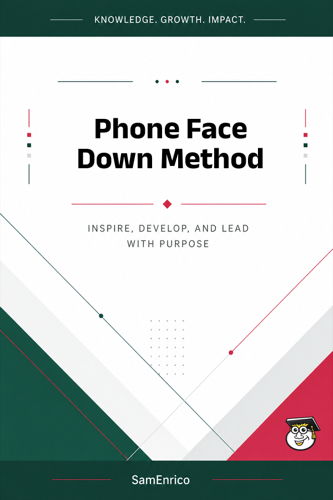
Phone Face Down Method eBook
Keeps phone screen invisible and on silent to remo
by Nixon Tyra
Keeps phone screen invisible and on silent to remove visual temptation.
Formats
Free sample
Chapter 1: The Invisible Thief--–- The most dangerous distraction is not the one you see coming. It is not the buzz of a text message at midnight, not the siren song of social media during a workday, not the endless scroll of doom just before bed. Those are obvious. Those you can feel in your bones, the familiar tug of a habit you know you should break. The truly dangerous distraction is the one you do not even notice.
It has no sound. No vibration. No glowing light. It sits perfectly still, perfectly silent, perfectly innocent—and it steals your attention one millisecond at a time, every day, from the moment you wake up until the moment you go to sleep.Your phone is the invisible thief. And you have invited it into every room of your life.Take a moment right now and look at your phone.
Where is it? If you are reading this book on a screen, your phone is likely somewhere within arm's reach. Perhaps it is sitting on the desk next to your computer, screen facing up. Perhaps it is in your pocket, warm against your leg. Perhaps it is on the couch cushion beside you, waiting patiently for you to finish this sentence.Now ask yourself: When was the last time you looked at it?
Not unlocked it. Not scrolled through anything. Just looked at it. Glanced at its dark, reflective surface. Noticed its presence.If you are like most people, the answer is: within the last thirty seconds.
You looked at your phone while I was writing that sentence. You did not even realize you were doing it. Your eyes drifted from this page to that black rectangle, a reflex as automatic as breathing, honed by years of conditioning.That glance cost you something. Not much. A fraction of a second.
A tiny shard of attention. But you are not paying for that glance once. You are paying for it thousands of times per day, every day, for every year of your adult life. And the cumulative cost is staggering.This chapter is about the problem that no one talks about. Not addiction.
Not social media. Not screen time. Those are symptoms. The real problem is something I call Passive Decay—the continuous, low-level cognitive leakage caused by the mere presence of a visible smartphone. Passive Decay is the thief in the room.
And once you see it, you cannot unsee it.The Forty Percent Heist In 2017, a team of researchers at the University of Chicago published a study that should have changed the way every office, every school, and every home in America thinks about smartphones. The study was elegantly simple. Researchers asked several hundred participants to complete a series of cognitive tasks—tests of working memory, fluid intelligence, and sustained attention. These were not easy tasks. They required focus, concentration, and mental stamina.Before the tasks began, participants were asked to place their smartphones somewhere in the testing room.
Some participants placed their phones in another room entirely. Some placed them on the desk, face down. Some placed them on the desk, face up. All phones were set to silent. No vibrations.
No ringtones. No screen wakes. Participants were explicitly instructed not to touch their phones during the experiment. Everyone complied.The results were devastating.Participants who left their phones in another room performed the best. Their working memory scores were sharp.
Their attention was sustained. Their problem-solving was fluid. This was the human brain operating at its natural capacity, unencumbered by the presence of a digital companion.Participants who left their phones on the desk, face down, performed measurably worse. Their scores dropped by approximately twenty percent. They took longer to complete the tasks.
They made more errors. And when asked afterward, they reported feeling "distracted" even though they could not identify the source of the distraction.Participants who left their phones on the desk, face up, performed the worst of all. Their cognitive scores dropped by approximately forty percent.Let me repeat that number because it is the most important number in this book. Forty percent. Having a silent, face-up smartphone on your desk reduces your available cognitive capacity by nearly half.
That is the difference between an A and a C. Between a promotion and a performance improvement plan. Between remembering your child's recital and showing up an hour late with a half-baked excuse about traffic.The researchers called this the "brain drain" phenomenon. I call it the forty percent heist. And it is happening to you right now, as you read this book, if your phone is visible anywhere in your peripheral vision.Think about what forty percent means in your own life.
If you are a writer, forty percent of your prose is harder to find. If you are a programmer, forty percent of your bugs are harder to solve. If you are a parent, forty percent of your patience is harder to access. If you are a student, forty percent of your study time is wasted. Forty percent is not a small leak.
It is a gaping hole in the hull of your attention, and the water is pouring in whether you are looking at your phone or not.The Anatomy of Passive Decay To understand why a silent phone destroys your focus, we must first understand how your brain filters the world. Every second, your senses are bombarded with millions of pieces of information—sounds, sights, smells, textures, temperatures, pressures. If you were consciously aware of all of them, you would be overwhelmed instantly. So your brain has a remarkable filtering system called the reticular activating system, or RAS.The RAS is a network of neurons located in your brainstem, near the top of your spinal cord. Its job is to act as a gatekeeper.
It scans all incoming sensory information and decides what is important enough to bring to your conscious attention. Everything else is discarded. You do not feel your socks right now because your RAS decided they are not important. You do not hear the hum of the refrigerator because your RAS filtered it out. You are not aware of the pressure of the chair against your back because your RAS decided it is irrelevant.The RAS has three primary triggers: novelty, movement, and relevance to survival.
When something is new, your RAS flags it. When something moves, your RAS tracks it. When something might threaten your survival—or your social survival—your RAS elevates it to the top of the priority list.Now consider your smartphone. It is novel (the screen changes constantly). It moves (notifications arrive, the display lights up).
And your brain has learned, through years of conditioning, that the phone is relevant to your social survival. A message from your boss could mean you are getting fired. A text from your partner could mean there is an emergency. A notification from your child's school could mean they are sick. Your brain treats these as survival signals.So your RAS constantly monitors your phone.
Even when you are trying to focus on something else. Even when you have told yourself, "I will not check my phone for the…
This is the end of the free sample. Get the eBook to keep going. Buy now
About this book
Details
- Author
- Nixon Tyra
- Publisher
- SamEnrico
- Language
- English
- Genre
- Non-Fiction, Self-Help, Phone Management
- Released
- 2026-06-07
- Pages (approx.)
- 143
- Available as
- eBook, Audiobook

Read better in the ZLOADR app
Your eBooks on your phone or tablet. Sign in with your SamEnrico account and start reading.
More by Nixon Tyra
 Loneliness Art Therapy GuideNixon Tyra$11.99
 Alumni Network Relationship GuideNixon Tyra$11.99
 Wholesaling Scaling GuideNixon Tyra$11.99
 Wholesaling Contractor NetworkNixon Tyra$11.99
 Zumba International Rhythms TourNixon Tyra$11.99
 Diamond District InfiltrationNixon Tyra$11.99
 The Underground Tunnels BelowNixon Tyra$11.99
 Cold Air Anger ReductionNixon Tyra$11.99
 The Unseen Victory: How a 1980s Video Game Designer Changed the WorldNixon Tyra$11.99
 The Great Firewall: China's Digital Iron CurtainNixon Tyra$11.99
 Tangaroa's Symphony: The Ocean’s First SongNixon Tyra$11.99
 How to Become a House BuilderNixon Tyra$11.99