
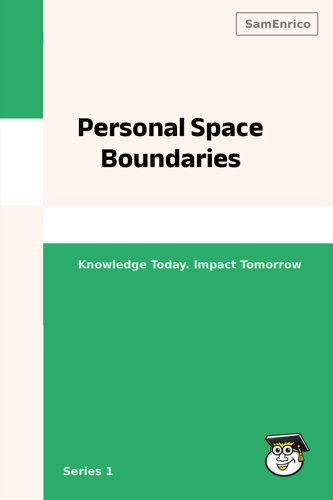
Personal Space Boundaries eBook
Respect intimate, personal, social, and public zon
Respect intimate, personal, social, and public zones.
Formats
Free sample
Chapter 1: The Invisible Leash--–- The first time I realized my personal space was not my own, I was standing in an elevator with a man whose cologne had declared war on my lungs. He wasn't trying to be threatening. He was just... close. The kind of close that makes you count the pores on someone's nose.
The kind of close where you can see what they had for lunch. I did what most polite people do: nothing. I held my breath, clutched my purse like a shield, and stared at the floor numbers as if they held the secrets of the universe. When the doors finally opened on my floor, I practically fell out, gasping for air that didn't smell like a department store counter. In the parking lot, I realized my heart was racing.
My shoulders were up around my ears. And I had absolutely no idea why.That was the moment I became obsessed with a question that most of us never think to ask: Where does my space end, and yours begin?This book is the answer to that question. But before we can talk about fixing your boundaries, we have to understand what they actually are. And that means accepting a slightly uncomfortable truth: you are walking around with an invisible leash attached to your body at all times. That leash isn't tied to a dog.
It's tied to your nervous system. And when someone pulls on it—when they stand too close, touch without asking, or stay too long—your body reacts before your brain even knows what happened.Welcome to the hidden geography of human connection.The Bubble You Never Knew You Had Let me tell you about Edward T. Hall. He was an anthropologist in the 1960s who did something that seems obvious in retrospect but was revolutionary at the time: he noticed that people from different cultures stood different distances from each other when they talked. Not slightly different.
Dramatically different. A person from Greece might stand at arm's length while having a casual conversation. A person from Sweden might stand twice that far. And when these two people talked to each other, the Greek would keep stepping forward (because the Swede felt too far away), and the Swede would keep stepping back (because the Greek felt too close). They would literally shuffle across a room without realizing it, each one trying to restore their own comfort zone.Hall called this phenomenon proxemics—the study of how humans use space as a form of communication.
And his most important discovery was this: every single person on earth carries an invisible bubble around them at all times. That bubble expands and contracts based on who you're with, where you are, and how you're feeling. It is not a metaphor. It is a biological reality.Here's what we now know from neuroscience. That bubble is anchored in your amygdala—the part of your brain responsible for threat detection.
When someone enters your space without permission, your amygdala fires a warning signal. Your cortisol levels spike. Your heart rate increases. Your body prepares for fight, flight, or freeze. And all of this happens in milliseconds, long before your conscious mind has time to think, "Hey, this person is standing a little close, isn't that interesting?"This is why you can feel "creeped out" by someone without being able to explain why.
This is why you can walk into a crowded room and instantly feel suffocated, even if no one has touched you. This is why you can be in a conversation that seems perfectly normal on the surface, but something feels wrong—and later you realize it's because the other person was standing six inches too close the entire time.Your body knows. It always knows.Territory vs. Space: The Crucial Distinction Before we go any further, we need to make a distinction that most books on this topic get wrong. There is a difference between territory and personal space.
They are not the same thing, and confusing them leads to bad advice.Territory is static. It's the chair you always sit in at the family dinner table. It's your assigned desk at work. It's your side of the bed, your parking spot, your favorite coffee shop corner. Territory is space that you claim as yours through repeated use, ownership, or social agreement.
When someone sits in your chair, you feel a violation—but it's a violation of property, not of person. You can reclaim territory by simply sitting somewhere else, or by saying, "Excuse me, I usually sit there."Personal space is different. Personal space is the bubble that moves with you. It's not attached to any object or location. It is attached to your body.
When someone violates your personal space, they are not taking something from you. They are entering something that you carry. And that is far more intimate—and far more triggering—than taking your chair.Think of it this way. Territory is like your house. Personal space is like your skin.
You can sell your house. You can't sell your skin. You can choose to let someone into your house. You can't choose to let someone into your skin—they're either touching you or they're not. That's the difference between a territorial violation (annoying) and a spatial violation (alarming).Most people who struggle with boundaries have learned to tolerate both.
They let people take their territory and invade their space. This book is going to help you stop tolerating the second one first, because protecting your personal space is the foundation of protecting everything else.The Four Zones of Human Interaction Now we come to the heart of the model. Drawing on Hall's original research and decades of subsequent studies in environmental psychology, we can divide personal space into four distinct zones. Each zone has a different distance range, a different social function, and a different set of rules for entry.Here they are, from closest to farthest.The Intimate Zone (0 to 18 inches). This is the sanctuary of trust.
It is reserved for whispering, touching, tears, and private truths. Within this zone, we can subdivide further: Core Intimate (0 to 9 inches) is for romantic partners, young children, and moments of extreme vulnerability. Extended Intimate (9 to 18 inches) may include a best friend, a trusted therapist during sessions, or a parent providing comfort. When you let someone into this zone, you are saying, "I trust you not to hurt me." When someone forces their way in—the colleague who stands six inches away at the copier, the stranger on the subway who presses against you, the relative who hugs too long—your body responds as if you are under threat. Because biologically, you are.
The Intimate Zone is for bonding. It is also for battle. And your nervous system doesn't know which is coming until it's too late.The Personal Zone (18 inches to 4 feet). This is the bubble of autonomy. It is close enough for intimate conversation with a trusted friend, yet far enough to maintain individual identity.
Most casual conversations between friends happen at this distance. Most family dinners, most coffee dates, most "how was your day" exchanges. The Personal…
This is the end of the free sample. Get the eBook to keep going. Buy now
About this book
Details
- Author
- Elkins Gaynell
- Publisher
- SamEnrico
- Language
- English
- Genre
- Non-Fiction, Self-Help, Proxemics
- Released
- 2026-06-06
- Pages (approx.)
- 129
- Available as
- eBook, Audiobook

Read better in the ZLOADR app
Your eBooks on your phone or tablet. Sign in with your SamEnrico account and start reading.
More by Elkins Gaynell
 Ellis Island Grandparent TalesElkins Gaynell$11.99
 Immigrant VR Company FounderElkins Gaynell$11.99
 Teen Dating Self Esteem GuideElkins Gaynell$11.99
 Natural Disaster ChildhoodElkins Gaynell$11.99
 Dream Garden JournalElkins Gaynell$11.99
 Anger Depression LinkElkins Gaynell$11.99
 Small Talk for Social AnxietyElkins Gaynell$11.99
 Red Tails Over Berlin: The Untold Story of the Tuskegee Airmen’s Secret MissionElkins Gaynell$11.99
 Neri Oxman: The Architect Who Redefined War and DesignElkins Gaynell$11.99
 How to Produce Office PaperElkins Gaynell$11.99
 Travel PhotographyElkins Gaynell$11.99
 How to Produce ClothespinsElkins Gaynell$11.99
You may also like
 Hong Kong Handover 1997Dunn Johnnie$11.99
 Zumba For Postnatal Recovery CourseNeal Christian$11.99
 Zumba for BeginnersLadner Nikia$11.99
 YouTube Comment Mining GuideHumes Pandora$12.99
 Worry Box MeditationCarlin Rudy$11.99
 Workplace Stress MeditationNguyen Lynn$11.99
 Workplace Stress and Sleep RepairHawley Ivory$11.99
 Workplace Perfectionism CureDelaney Jeffry$11.99
 Workplace Injustice Anger GuideWallen Isabelle$11.99
 Work Addiction and Burnout LinkGreenwood Ester$11.99
 Women in Yoga and WellnessBeattie Galina$11.99
 Women in Stand Up ComedyChun Evangeline$11.99