
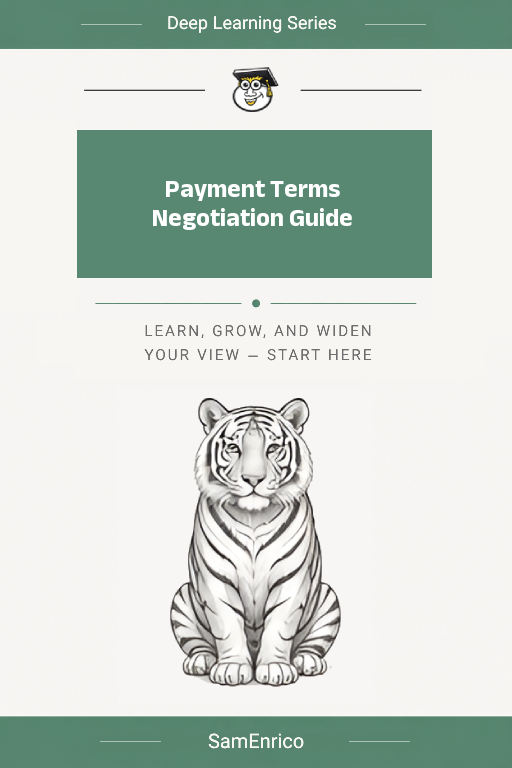
Non-FictionBusiness BriefPayment Terms
Payment Terms Negotiation Guide eBook
Negotiate 30 percent deposit before shipping to re
by Harry Bernie
Negotiate 30 percent deposit before shipping to reduce exposure. Balance cash flow needs against buyer trust when structuring cross border payment terms.
Formats
Free sample
Chapter 1: The Deposit Anchor--It was 3:47 AM in Chicago when Mark Chen’s phone buzzed with a notification that made his stomach drop. His factory in Ho Chi Minh City had just gone silent. Not slow to respond. Not asking for clarification. Silent.
Three weeks earlier, Mark had wired 180,000asa30180,000 as a 30% deposit on a 180,000asa30600,000 order of custom furniture for his chain of boutique hotels. The Vietnamese supplier had been vetted, referenced, and seemed professional. They had a website, a Linked In presence, and even sent a gift basket after signing the contract. Then, without warning, the emails bounced back. The phone number disconnected.
The factory address, when checked by a local contact, revealed a locked gate and a single handwritten note: “Closed for renovations.”Mark’s story is not unique. It plays out thousands of times every year across every imaginable industry. A buyer wires a deposit. A supplier disappears. Or worse—the supplier doesn’t disappear but delivers defective goods, misses deadlines by months, or holds the buyer hostage with quality issues because, after all, the deposit is already spent.
But here is what Mark discovered that most trade finance books never tell you: he got his money back. Not through a lawyer, not through a bank guarantee, but through a little-known clause in the Bill of Lading that turned the tables completely. That story appears in Chapter 12. First, you need to understand why Mark made the mistake he made—and why almost every negotiator makes the same one.They fixate on the number.The deposit percentage becomes the entire negotiation. Should it be 30%?
40%? Can we get away with 10%? The number dominates conversations, emails, and contracts. But here is the dirty secret of cross-border trade: the deposit percentage is not a financial calculation. It is a psychological weapon and a risk allocation tool disguised as a number.
Get it wrong, and you either starve (0% deposit, waiting 90 days for payment while your rent comes due) or scare away the buyer (100% deposit, which screams “I don’t trust you and never will”). Get it right, and you trigger a commitment mechanism that reduces cancellation rates by an estimated 70%—if you understand what the number actually represents.This chapter establishes the foundation for everything that follows. You will learn why 30% became the default anchor in global trade, why that number is neither magic nor mandatory, and how to calculate your own deposit floor using a simple formula that accounts for your specific industry, counterparty risk, and cash flow needs. You will also learn why the common wisdom—“30% covers raw materials”—is factually wrong in most industries and how correcting that error changes your negotiation leverage dramatically.The Deposit Anchor: Why 30% Is Not a Golden Rule Walk into any trade finance seminar, and someone will eventually say it: “Thirty percent is the golden ratio for deposits. Enough to show commitment, not enough to fully finance a competitor.” This statement gets repeated so often that it has achieved the status of received wisdom.
But like much received wisdom in international trade, it collapses under even mild scrutiny.The origin of the 30% figure is not financial science. It is historical accident. In the 1970s and 1980s, as Asian manufacturing hubs began exporting to North America and Europe, letters of credit were the dominant payment method. A typical L/C structure required a 30% cash margin from the buyer to open the credit. Over time, as open account terms and telegraphic transfers became more common, the 30% figure migrated from banking requirement to negotiation norm.
It persisted not because it was optimal for every transaction, but because it was familiar. Negotiators anchored on 30% because the other side expected it.This is called the anchoring effect in negotiation psychology. The first number mentioned becomes the reference point around which all subsequent discussion revolves. If you say “30%,” the other party will negotiate up or down from 30%. If you say “50%,” they will negotiate from 50%.
If you say “10%,” they will negotiate from 10%. The number itself matters less than the fact that you named one first.Here is what this means for you: the 30% deposit is an anchor, not a golden rule. It is a useful starting point because it is familiar, non-threatening, and historically normalized. But treating it as a universal optimum is a mistake that will cost you money or deals. The correct deposit for your transaction depends on three variables that have nothing to do with tradition: your cash flow needs, your counterparty risk profile, and the specific cost structure of your production.Let us examine each variable in turn.The Cash Flow vs.
Exposure Matrix Every cross-border transaction pits two competing needs against each other. The seller needs cash flow to fund production. The buyer needs protection from exposure if the seller fails to perform. These two needs are not symmetrical. A seller without cash flow cannot produce at all.
A buyer without protection can still recover damages—eventually, through courts or arbitration, assuming the seller has assets. The asymmetry favors the buyer in theory but favors the seller in practice, because the buyer’s recovery mechanisms are slow, expensive, and often futile across borders.To navigate this asymmetry, you need a decision tool that plots your specific situation. Introducing the Cash Flow vs. Exposure Matrix.Draw a two-by-two grid. The vertical axis represents the seller’s need for operating capital, from Low (the seller can self-finance production) to High (the seller cannot start production without buyer funds).
The horizontal axis represents the buyer’s risk of non-delivery, from Low (the seller has a long track record, audited financials, and assets in your jurisdiction) to High (the seller is new, unproven, or located in a jurisdiction with weak contract enforcement).Here is how the quadrants resolve:Quadrant 1: Low Cash Need, Low Buyer Risk. Examples: a repeat supplier in Germany selling to a US buyer, or a well-capitalized factory with its own working capital lines. In this quadrant, deposits can be as low as 0-10%. The seller does not need the money, and the buyer has little reason to fear non-delivery. Negotiate from 10% down to 0% over time.Quadrant 2: Low Cash Need, High Buyer Risk.
Examples: a new supplier in a stable country but with no trading history, or a supplier in an OECD country with thin financials. The seller does not need your deposit to operate, but you have reason to worry about performance. In this quadrant, deposits should be 10-20%, used primarily as a commitment signal rather than a financing tool. Do not let the seller convince you that 30% is necessary for raw materials—their low cash need means they can self-finance.Quadrant 3: High Cash Need, Low Buyer Risk. Examples: a trusted long-term partner that is cash-constrained due to rapid growth, or a supplier in a stable jurisdiction with excellent references but thin working capital.
Here, deposits of 30-40% are appropriate. You trust the supplier, but they genuinely cannot start without your funds. The deposit functions as working capital financing, not risk mitigation.Quadrant 4: High Cash Need, High Buyer Risk. Examples: a new supplier in an emerging market with no trading history, or a supplier in any market with weak contract enforcement and thin capitalization. This is the…
This is the end of the free sample. Get the eBook to keep going. Buy now
About this book
Details
- Author
- Harry Bernie
- Publisher
- SamEnrico
- Language
- English
- Genre
- Non-Fiction, Business Brief, Payment Terms
- Released
- 2026-05-28
- Pages (approx.)
- 154
- Available as
- eBook, Audiobook

Read better in the ZLOADR app
Your eBooks on your phone or tablet. Sign in with your SamEnrico account and start reading.
More by Harry Bernie
 Clean Energy Investment MapHarry Bernie$11.99
 Alcohol Recovery and SpiritualityHarry Bernie$11.99
 Neglect Trauma Triggers GuideHarry Bernie$11.99
 Postpartum Journaling for HealingHarry Bernie$11.99
 The IBS Food Diary MethodHarry Bernie$11.99
 Kettlebell Strength MethodHarry Bernie$11.99
 Cohort Analysis GuideHarry Bernie$11.99
 Sarcopenia Walking Speed TestHarry Bernie$11.99
 Dreaming for Career CrossroadsHarry Bernie$11.99
 The Silent Storm: Iran's Revolutionary Artillery Innovations in the Iran-Iraq WarHarry Bernie$11.99
 Into the Abyss: Borneo’s Hidden Underwater WorldsHarry Bernie$11.99
 Glitch in the System: The 2012 Apple Maps DebacleHarry Bernie$11.99
You may also like
 Hong Kong Handover 1997Dunn Johnnie$11.99
 Zumba For Postnatal Recovery CourseNeal Christian$11.99
 Zumba for BeginnersLadner Nikia$11.99
 YouTube Comment Mining GuideHumes Pandora$12.99
 Worry Box MeditationCarlin Rudy$11.99
 Workplace Stress MeditationNguyen Lynn$11.99
 Workplace Stress and Sleep RepairHawley Ivory$11.99
 Workplace Perfectionism CureDelaney Jeffry$11.99
 Workplace Injustice Anger GuideWallen Isabelle$11.99
 Work Addiction and Burnout LinkGreenwood Ester$11.99
 Women in Yoga and WellnessBeattie Galina$11.99
 Women in Stand Up ComedyChun Evangeline$11.99