
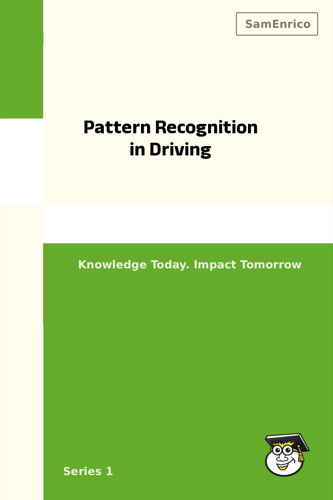
Pattern Recognition in Driving eBook
Anticipate traffic flows and hazard patterns for s
by Simpson Earl
Anticipate traffic flows and hazard patterns for safety.
Formats
Free sample
Chapter 1: The Deadliest Weather--–- On a clear, dry Tuesday afternoon in July, a forty-three-year-old accountant named Michael did everything his driver's education manual had taught him. He checked his mirrors every eight seconds. He signaled three full seconds before changing lanes. He left a two-second following distance between his sedan and the minivan ahead. The sun was high, the asphalt was warm, and visibility stretched for miles in every direction.
By every objective measure, Michael was a safe driver. By every statistical measure, he was driving in the most dangerous conditions possible.The crash happened at 2:47 PM. The minivan ahead braked gently—not sharply, not suddenly, but with the casual deceleration of a driver who had just noticed a police cruiser on the shoulder. Michael braked too. He braked at exactly the same intensity as the minivan, maintaining his two-second gap.
The car behind him, a delivery truck whose driver had been scanning his GPS for the past four seconds, did not brake at all. The impact folded Michael's trunk into his back seat. His neck snapped forward and then back. He survived, but he would spend the next eleven weeks in a cervical collar, missing work, missing his daughter's birthday, missing the simple act of turning his head to check his blind spot without wincing.The police report cited the truck driver for following too closely. The insurance companies called it an accident.
But Michael, lying in his hospital bed staring at a ceiling he could not turn his head to fully see, knew the truth had little to do with the truck driver's following distance. The truth was that no one had seen the crash coming. Not Michael, who had done everything right. Not the minivan driver, who had braked for a perfectly legal reason. Not the truck driver, who had glanced at his GPS for exactly the same amount of time that every driver glances at their navigation screen.
The crash happened because three drivers, each behaving normally, each making the same small errors that drivers make every day, had failed to see a pattern that was visible for a full twelve seconds before impact.This book exists because of Michael. And because of you. And because every driver who has ever been rear-ended, every driver who has ever merged into someone's blind spot, every driver who has ever sat in stop-and-go traffic wondering why it started and when it would end, has been a victim of the same fundamental problem: human beings are terrible at predicting traffic, and we have never been taught otherwise.The Great Lie of Driver's Education Every driver's education program in the United States, Canada, the United Kingdom, Australia, and most of Europe teaches the same core curriculum. You learn the rules of the road. You learn the meaning of signs and signals.
You learn the mechanics of steering, braking, and parking. You learn defensive driving—the art of anticipating that the other driver might do something stupid. You take a written test, pass a road exam, and receive a license that certifies you as qualified to operate two tons of steel at seventy miles per hour in close proximity to other human beings.Here is what driver's education does not teach you. It does not teach you that your brain is wired to see patterns that aren't there and miss patterns that are. It does not teach you that the safest conditions—clear skies, dry roads, good visibility—are actually the most dangerous because they breed overconfidence.
(We will explore this paradox in depth in Chapter 10, where the full statistical evidence for the Sunny Day Paradox is laid out.) It does not teach you that traffic jams emerge from mathematical rules of human reaction time, not from the number of cars on the road. It does not teach you that you can read a car's body language—its pitch, its roll, its micro-accelerations—to predict its driver's next move before the turn signal blinks.And most critically, driver's education does not teach you the central skill that separates average drivers from expert drivers: pattern recognition. The ability to see the invisible. The ability to look at a seemingly ordinary traffic situation and see, with the clarity of a chess grandmaster examining a board, the cascade of events that is about to unfold.This book is not a defense of driver's education. Driver's education saves lives, and you should take it seriously.
But driver's education is to predictive driving what learning the alphabet is to writing poetry. It gives you the basic symbols. It does not teach you how to arrange them into meaning.Why Your Brain Is Lying to You Right Now Before we can train your brain to see patterns, you need to understand why your brain is so bad at seeing them in the first place. The answer lies in the evolutionary history of the human species.For 99.9 percent of human existence, our ancestors lived in small bands of hunter-gatherers. The threats they faced were immediate and local: a predator in the tall grass, a rival tribe over the next ridge, a sudden change in weather.
The human brain evolved to respond to threats that are close, visible, and urgent. It did not evolve to respond to threats that are distant, invisible, and probabilistic. It did not evolve to anticipate the behavior of dozens of other agents moving at high speed in a complex, semi-coordinated system.This evolutionary mismatch is the source of almost every cognitive error drivers make. Consider the most common cognitive blind spot: the illusion that the adjacent lane is moving faster than your own. You have experienced this.
You are driving in heavy but moving traffic, and the lane to your left seems to be flowing more freely. You check your mirrors, signal, change lanes, and immediately—immediately—the lane you just left begins moving faster while the lane you entered slows to a crawl. This is not bad luck. This is not a statistical anomaly. This is your brain's pattern-recognition system misfiring.Here is what is actually happening.
When you are in a moving lane, you spend most of your visual attention on the car directly ahead of you. You notice every time that car brakes, every time it slows, every time a gap opens and closes. But when you look at the adjacent lane, you are not watching a single car. You are watching an entire stream of traffic, and your brain instinctively compares the average speed of that stream to the momentary speed of the car in front of you. The adjacent lane always appears to be moving faster because you are comparing a moving average to a single data point.
The moment you change lanes, you become the single data point, and the lane you left becomes the stream. The illusion reverses. Your brain has not changed. The physics of traffic has not changed. Only your perspective has changed.This is not a failure of intelligence.
It is a failure of evolutionary design. Your brain is optimized for hunting mammoths, not for navigating multi-lane highways. The good news—and the entire premise of this book—is that you can train your brain…
This is the end of the free sample. Get the eBook to keep going. Buy now
About this book
Details
- Author
- Simpson Earl
- Publisher
- SamEnrico
- Language
- English
- Genre
- Non-Fiction, Self-Help, Driving
- Released
- 2026-06-07
- Pages (approx.)
- 146
- Available as
- eBook, Audiobook

Read better in the ZLOADR app
Your eBooks on your phone or tablet. Sign in with your SamEnrico account and start reading.
More by Simpson Earl
 Meditation for Chronic Pain BeginnersSimpson Earl$11.99
 Parenting Stress for Adoptive ParentsSimpson Earl$11.99
 Growth Hormone Sexual HealthSimpson Earl$11.99
 The Beast of Gévaudan: France's 18th-Century MonsterSimpson Earl$11.99
 How to Produce Brass Instrument Care KitsSimpson Earl$11.99
 Chinese New Year Contingency for DropshippersSimpson Earl$12.99
 Ultimate Handbook Guide to Hyderabad : (India) Travel GuideSimpson Earl$11.99
 CRM Marketing ManagerSimpson Earl$11.99
You may also like
 Hong Kong Handover 1997Dunn Johnnie$11.99
 Zumba For Postnatal Recovery CourseNeal Christian$11.99
 Zumba for BeginnersLadner Nikia$11.99
 YouTube Comment Mining GuideHumes Pandora$12.99
 Worry Box MeditationCarlin Rudy$11.99
 Workplace Stress MeditationNguyen Lynn$11.99
 Workplace Stress and Sleep RepairHawley Ivory$11.99
 Workplace Perfectionism CureDelaney Jeffry$11.99
 Workplace Injustice Anger GuideWallen Isabelle$11.99
 Work Addiction and Burnout LinkGreenwood Ester$11.99
 Women in Yoga and WellnessBeattie Galina$11.99
 Women in Stand Up ComedyChun Evangeline$11.99