
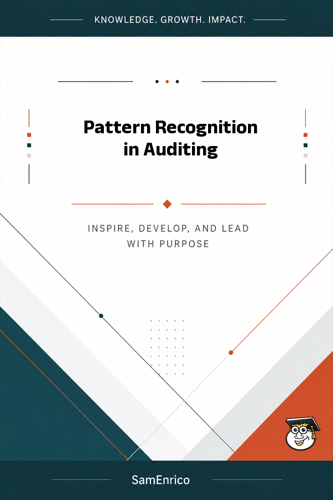
Non-FictionSelf-HelpAccounting
Pattern Recognition in Auditing eBook
Spot accounting anomalies and fraud indicators.
by Cox Clay
Spot accounting anomalies and fraud indicators.
Formats
Free sample
Chapter 1: The Billion-Dollar Blindness...--–- The email arrived at 11:47 PM on a Tuesday. Sarah, a mid-level auditor at a regional firm, almost deleted it. The subject line was generic: “Q2 Adjustment – Confidential.” But something made her open it. Inside was a single journal entry. Revenue: $14.2 million.
Receivables: $14.2 million. Posted at 2:00 AM on the last day of the quarter. No supporting documentation. No contract attached. No approval signature.
Just a number. A big, round, convenient number. She forwarded it to her manager. “Looks fine,” came the reply. “They’re a growing company.
Just sign off.” She almost did. But she couldn’t shake the feeling that something was wrong. Not a mathematical error. Not a missing decimal point. Something deeper.
A pattern.That company was Wirecard. The $14.2 million journal entry was one of thousands. Two years later, the German payments giant collapsed, revealing $2 billion missing from its balance sheet. The auditors had missed it. Not because they were stupid or lazy.
Because they were looking for errors. Sarah was looking for a pattern. That is the only difference between the auditor who gets defrauded and the auditor who catches the fraud.This book is about teaching you to see what Sarah saw: the shape of a lie before you have the proof. It is not a textbook of accounting rules. It is a field guide to anomalies.
Because fraud has a fingerprint. It has a rhythm. It has a signature written in journal entries posted at midnight, in numbers that are too round, in trends that are too perfect, and in executives who talk too much while saying nothing at all.Welcome to pattern recognition in auditing.The Expectation Gap: Why Most Auditors Never Find Fraud Let us start with an uncomfortable truth. The vast majority of auditors will go their entire careers without ever finding a material fraud. Not because fraud is rare—the Association of Certified Fraud Examiners estimates that the typical organization loses 5% of its revenue to fraud each year.
Not because auditors are incompetent—most are brilliant with detail. They miss fraud because they are trained to look for something else.Most auditing is designed to detect errors. Errors are mistakes. A transposed digit. A missing signature.
A calculation that doesn’t foot. Errors are random, innocent, and statistically predictable. Fraud is none of those things. Fraud is intentional, concealed, and designed specifically to fool you.This is the Expectation Gap. You expect to find misstatements.
Fraud expects you to look for misstatements. So fraud hides in plain sight, not as an error, but as an anomaly. An anomaly is not a mistake. An anomaly is a deviation from an expected pattern. And you cannot spot a deviation if you never established the pattern in the first place.Consider a simple example.
You are reviewing a company’s expense reports. You see a $999 reimbursement for “client dinner – New York.” No red flag, right? Within policy. Now consider that the same employee has submitted a $999 expense every Friday for 18 consecutive months. Same amount.
Same description. Different cities. That is a pattern. A pattern of just-below-threshold expenses that perfectly align with the employee’s weekend travel. That is not an error.
That is a fraud waiting to be connected.The error-seeking auditor sees a compliant expense report. The pattern-seeking auditor sees a $93,000 annual skimming operation disguised as client entertainment.This chapter closes the Expectation Gap. It reframes your entire approach to audit evidence. From this point forward, you will not ask, “Is this number correct?” You will ask, “Does this number fit the pattern of correct numbers?” The difference is everything.The Four-Stage Lifecycle of Fraud Every fraud, from a $50 petty cash theft to a $50 billion accounting conspiracy, follows the same four-stage arc. Think of it as the grammar of deception.
Once you learn the grammar, you stop being surprised by the sentences.Stage 1: The Pressure Fraud does not begin with a journal entry. It begins with a problem. A problem that cannot be solved by legitimate means. The pressure can be personal: a gambling addiction, a divorce, a lifestyle that exceeds salary, a child’s medical bill. Or it can be organizational: a debt covenant that will trigger default if earnings fall by 1%, a compensation plan that pays 200% of bonus only if revenue grows by 15%, a stock price that must hit $50 by year-end or the CEO’s options expire worthless.Pressure is the fuel.
Without pressure, most people do not commit fraud. They might be unhappy, overworked, or underpaid. But they do not fabricate invoices or inflate inventory. Pressure turns a rational person into a rationalizing person. And rationalization is the doorway.The Pattern to Watch: Sudden, inexplicable performance spikes at the exact moment pressure would peak.
Earnings that precisely hit a bonus threshold—not a dollar more, not a dollar less. A company that reports 15% growth when the industry average is 3% and the guidance was 5%. Pressure creates desperation. Desperation creates visible strain on the numbers.Stage 2: The Act This is the moment of transaction. The fraudster does something.
They post a false journal entry. They create a fake vendor. They inflate inventory counts. They ship empty boxes to a warehouse and call it revenue. They wire money to a personal account coded as “consulting fees.”The Act is surprisingly small.
Most frauds are not elaborate heists. They are ordinary transactions with one lie embedded. A shipping document with a fake signature. An invoice from a real vendor but for services never rendered. A timesheet that says 40 hours when the employee worked 20 and spent the other 20 at the beach.The Pattern to Watch: The Act leaves the clearest digital fingerprints.
Journal entries posted outside normal hours. Invoices with consecutive numbers (real invoices are interleaved with other documents). Round-dollar amounts in a sea of cents. Transactions that occur just below approval thresholds. The Act is where the fraudster is most visible—because they have to interact with the system.Stage 3: The Concealment The Act creates an imbalance.
Money leaves. An asset is overstated. A liability is understated. If the fraudster does nothing else, the fraud will be discovered in the next reconciliation. So they build a concealment structure.Concealment can be simple: rolling a fraudulent payable from one month to the next so it never ages.
Or staggeringly complex: creating dozens of special purpose entities (SPVs) that exist only on paper, like Enron did, to hide debt in places no auditor thought to look.Concealment is the fraudster’s full-time job. The Act takes five minutes. Concealment takes five years. And concealment is where most fraudsters make their first mistake—because hiding something requires constant creativity, and creativity runs out.The Pattern to Watch: Concealment creates ghosts. Vendors that exist in the system but have no phone number.
Employees whose address matches a vendor’s address. Adjusting entries that reverse prior adjusting entries. A balance sheet account that never changes—no matter what the business does. Concealment is the art of making something look normal. And “normal” has a statistical signature.
When something is too normal, too smooth, too consistent, you are looking at concealment.Stage 4: The Explosion Every fraud ends. Not because fraudsters get caught—many do not.…
This is the end of the free sample. Get the eBook to keep going. Buy now
About this book
Details
- Author
- Cox Clay
- Publisher
- SamEnrico
- Language
- English
- Genre
- Non-Fiction, Self-Help, Accounting
- Released
- 2026-06-06
- Pages (approx.)
- 149
- Available as
- eBook, Audiobook

Read better in the ZLOADR app
Your eBooks on your phone or tablet. Sign in with your SamEnrico account and start reading.
More by Cox Clay
 The Beginner's Guide to MantrasCox Clay$11.99
 Hearst Castle SecretsCox Clay$11.99
 Middle Passage DNA LegacyCox Clay$11.99
 The Last Oracle: When Prophecy Met ScienceCox Clay$11.99
 Cash Flow Management for Cross-Border DropshippingCox Clay$12.99
 Customer Care SupervisorCox Clay$11.99
 How to Produce Brass Instrument MouthpiecesCox Clay$11.99
 Ultimate Handbook Guide to Huazhou : (China) Travel GuideCox Clay$11.99
You may also like
 Hong Kong Handover 1997Dunn Johnnie$11.99
 Zumba For Postnatal Recovery CourseNeal Christian$11.99
 Zumba for BeginnersLadner Nikia$11.99
 YouTube Comment Mining GuideHumes Pandora$12.99
 Worry Box MeditationCarlin Rudy$11.99
 Workplace Stress MeditationNguyen Lynn$11.99
 Workplace Stress and Sleep RepairHawley Ivory$11.99
 Workplace Perfectionism CureDelaney Jeffry$11.99
 Workplace Injustice Anger GuideWallen Isabelle$11.99
 Work Addiction and Burnout LinkGreenwood Ester$11.99
 Women in Yoga and WellnessBeattie Galina$11.99
 Women in Stand Up ComedyChun Evangeline$11.99