
Non-FictionSelf-HelpCreator Economy
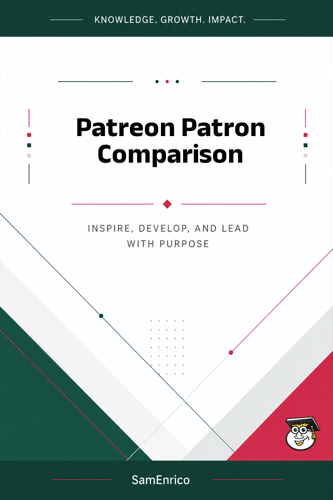
Patreon Patron Comparison eBook
Stop measuring your creative worth against patron
Stop measuring your creative worth against patron counts on crowdfunding platforms.
Formats
Free sample
Chapter 1: The Dashboard Trap--–- Jack Conte stared at his You Tube dashboard. The number on the screen read 2.4 million views. That was the number that should have meant something. That was the number that, in every rational economic model, should have translated into rent money, grocery money, the ability to keep making music without sleeping on a friend’s sofa. Instead, his bank account hovered near empty.
The dashboard showed him a parade of success metrics—views, likes, subscribers, estimated revenue—and yet the only number that actually paid his bills, the one that appeared on his bank statement at the end of the month, told a completely different story. He had millions of fans, in the technical sense of people who had watched his content. He had almost no patrons, in the sense of people who had decided his work was worth sustaining.This paradox did not just confuse Jack Conte. It broke something in him. He had built a career on creating music that moved people, that made them laugh and think and feel less alone.
The metrics told him he was succeeding at that mission. The bank account told him he was failing at the basic human necessity of survival. And somewhere in the gap between those two numbers, Conte began to suspect that the entire system of creative measurement had been designed to benefit someone else—not the artist, not the audience, but the platform itself.That suspicion became Patreon. But this book is not the origin story of a company. It is the story of what happens when every creator, whether they realize it or not, sits alone in a room staring at their own dashboard, comparing their patron count to strangers on the internet, and quietly concluding that they are not enough.The Invisible Scale Here is the first truth that no dashboard will ever show you: comparison is not a choice.
It is a reflex. And like any reflex, it can be hijacked, amplified, and weaponized against your own well-being.Social Comparison Theory, first formalized by psychologist Leon Festinger in 1954, posits that human beings have an innate drive to evaluate themselves by comparing their abilities, opinions, and achievements to those of others. Festinger argued that in the absence of objective measures—what does “good” even mean in the context of art?—we turn to social comparisons. We look left. We look right.
We ask: am I ahead or behind?In the pre-internet era, this comparison pool was limited. A painter in a small town compared themselves to the other two painters in that town. A musician compared their local following to the band that played the same dive bar on Thursday nights. The pool was small, local, and forgiving.The crowdfunding dashboard exploded that pool into an ocean. Suddenly, any creator with an internet connection could see the patron count of any other creator on the platform.
Not just their friends, not just their local peers, but strangers in different countries, different genres, different economic realities. A watercolorist in rural Ohio could compare themselves to a digital animator in Seoul who had been building their audience for a decade. A poet with fifty patrons could stare at a gamer with fifty thousand and feel the full weight of that numerical chasm.Here is what the dashboard does not tell you: those numbers are not comparable. They are not apples and oranges. They are apples and automobiles.
The gamer with fifty thousand patrons might have a team of six people, production costs of forty thousand dollars per month, and a churn rate that requires constant adrenaline-pumping content creation just to stay afloat. The poet with fifty patrons might have near-zero expenses, a deeply engaged community that sends handwritten letters, and the time to write slowly and well. The dashboard presents both numbers as if they exist on the same scale. They do not.The dashboard is a liar, but it is a seductive liar. It shows you the number.
It shows you the little green arrow pointing up or the little red arrow pointing down. It feeds you the dopamine hit of a new patron alert, followed by the cortisol crash of a cancellation notification. And in between those hits, it leaves you alone with the most dangerous question a creator can ask: why am I not them?The Transaction They Don't Show You To understand why the dashboard deceives, we must first understand what a patron count actually represents. Most creators treat it as a popularity score. More patrons means more people like me.
Fewer patrons means fewer people like me. This is the comparison trap in its purest form: the conflation of numerical support with personal worth.But a patron count is not a popularity score. It is a record of completed transactions. Each patron has made a decision—a specific, context-dependent, often emotionally complex decision—to exchange money for access to your creative work. That decision is influenced by at least a dozen factors that have nothing to do with your talent: the patron’s disposable income that month, the day of the week they saw your post, whether their credit card was expired, whether they were already supporting ten other creators, whether they had just been paid, whether they were in a generous mood or a distracted one.A patron count is not a referendum on your worth as an artist.
It is a snapshot of a thousand tiny logistical and emotional variables, only one of which is the quality of your work.This is where the concept of Creative Transactions enters. A Creative Transaction is not the pledge itself. It is the moment before the pledge, the invisible moment of valuation where a potential patron asks themselves: does this work matter enough to me to open my wallet? That moment is shaped by trust, by familiarity, by the patron’s sense of their own identity as a supporter of the arts. It is shaped by whether you have shown them not just your polished final product, but the human being behind it.The dashboard only shows you the result of that transaction.
It does not show you the transaction itself. And without understanding the transaction, you cannot possibly interpret the number.Let us follow a single Creative Transaction from start to finish. A listener named Sarah discovers a podcast about obscure historical events. She listens to three episodes while driving to work. She laughs.
She learns. She feels a strange affection for the host, who mentions his cat and his student loans and his fear that no one is listening. On the fourth episode, the host asks for patrons. Sarah thinks: I should do that. She clicks the link.
She sees three tiers: $3 for early access, $8 for bonus episodes, $15 for a monthly Q&A. She hesitates. She has a dentist bill coming up. She closes the tab.Two weeks later, she listens to another episode. The host mentions a patron-only episode about the history of her own hometown.
She laughs again. She remembers the dentist bill is paid. She opens the tab, chooses the $8 tier, and becomes a patron.The dashboard registers this as a single data point…
This is the end of the free sample. Get the eBook to keep going. Buy now
About this book
Details
- Author
- Simpson Karla
- Publisher
- SamEnrico
- Language
- English
- Genre
- Non-Fiction, Self-Help, Creator Economy
- Released
- 2026-06-09
- Pages (approx.)
- 123
- Available as
- eBook, Audiobook

Read better in the ZLOADR app
Your eBooks on your phone or tablet. Sign in with your SamEnrico account and start reading.
More by Simpson Karla
 PR Merge Time GuideSimpson Karla$11.99
 Alibaba Product Sourcing GuideSimpson Karla$11.99
 The Governor's Pardon ScandalSimpson Karla$11.99
 Parental Self Care Weekend GuideSimpson Karla$11.99
 The Financial Grief WorkbookSimpson Karla$11.99
 Thyroid and CholesterolSimpson Karla$11.99
 Sleep And Episodic MemorySimpson Karla$11.99
 Manufacturing Plant CrisisSimpson Karla$11.99
 The Siege of the USS Boxer: The First Carrier Hostage Crisis (1898)Simpson Karla$11.99
 The Man Who Taught Machines to Dream: The Untold Story of Joseph EngelbergerSimpson Karla$11.99
 The Steam Barons: A Revolution UnchainedSimpson Karla$11.99
 Growing GazaniaSimpson Karla$11.99
You may also like
 Hong Kong Handover 1997Dunn Johnnie$11.99
 Zumba For Postnatal Recovery CourseNeal Christian$11.99
 Zumba for BeginnersLadner Nikia$11.99
 YouTube Comment Mining GuideHumes Pandora$12.99
 Worry Box MeditationCarlin Rudy$11.99
 Workplace Stress MeditationNguyen Lynn$11.99
 Workplace Stress and Sleep RepairHawley Ivory$11.99
 Workplace Perfectionism CureDelaney Jeffry$11.99
 Workplace Injustice Anger GuideWallen Isabelle$11.99
 Work Addiction and Burnout LinkGreenwood Ester$11.99
 Women in Yoga and WellnessBeattie Galina$11.99
 Women in Stand Up ComedyChun Evangeline$11.99