
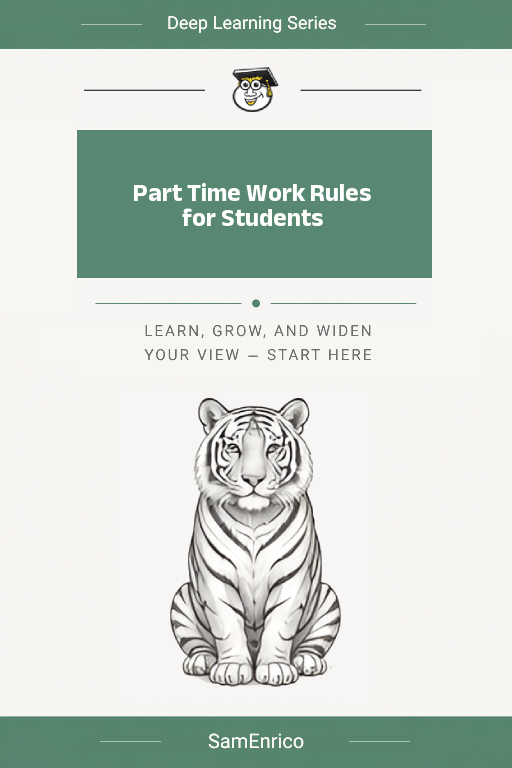
Non-FictionStudent's ShortcutEmployment RulesStudent Work
Part Time Work Rules for Students eBook
Work up to 15 hours weekly during term and full-ti
Work up to 15 hours weekly during term and full-time during breaks with a no-objection certificate from your university.
Formats
Free sample
Chapter 1: The Goldilocks Trap...--–- Maria was crying in the campus library bathroom. It was 11:47 PM on a Tuesday, she had a macroeconomics final in nine hours, and she had just finished a six-hour shift at a downtown restaurant where her manager yelled at her for messing up a table’s order. She had made 94aftertips.Shewouldspend94 after tips. She would spend 94aftertips.Shewouldspend12 on an Uber home because the buses had stopped running, another $8 on coffee to stay awake, and she would sleep exactly four hours before her exam. She had worked twenty-three hours that week—eight over the limit on her student visa.
She did not know that she had just violated the terms of her No Objection Certificate. She would not find out until three months later, when her study permit renewal was denied.Maria is not real. But her story happens thousands of times every semester. Students who believe that working more hours equals earning more money. Students who think that “pushing through” is a virtue.
Students who have never been told that there is a scientific, legal, and psychological maximum to how many hours a student can work while still succeeding academically.This chapter is called The Goldilocks Trap because the truth about student work is painfully simple and brutally ignored: there is a number of weekly work hours that is too few to matter, a number that is too many to survive, and a narrow range in the middle that actually works. Most students never find that range. They bounce between financial desperation and academic collapse, never realizing that the solution is not working harder or longer—it is working smarter and within strict boundaries.The Goldilocks Trap is the belief that you can keep adding work hours without consequences. You cannot. The research is overwhelming.
The legal framework is unforgiving. And the students who succeed are not the ones who work the most—they are the ones who understand that fifteen hours is not a suggestion. It is a ceiling.This chapter will give you three things. First, the actual data on how many hours you can work before your grades collapse. Second, a step-by-step guide to getting your No Objection Certificate and understanding exactly what it permits and forbids.
Third, the psychological reframe that separates successful working students from those who burn out and drop out. By the end of this chapter, you will know whether you should work at all, how many hours you should work, and what to do if fifteen hours is not enough to cover your expenses.Let us start with the number that changes everything.The Scientific Tipping Point For decades, educational psychologists have tracked one variable more closely than almost any other: the relationship between student employment and academic performance. The findings are remarkably consistent across countries, university types, and student demographics. There is a clear threshold. Below it, work is neutral or even beneficial.
Above it, work becomes destructive.The National Center for Education Statistics in the United States conducted a longitudinal study following over fifteen thousand students from freshman year to graduation. They found that students working one to fifteen hours per week had grade point averages that were statistically indistinguishable from students who did not work at all. In some subsamples, the working students actually had slightly higher GPAs—a finding that has been replicated in Canadian, Australian, and British studies.The mechanism is not mysterious. Work imposes structure. A student who works ten hours a week cannot afford to waste time scrolling through social media for two hours between classes.
They have to plan. They have to prioritize. They have to say no to distractions. Non-working students, paradoxically, often have worse time management because they believe they have infinite time.But here is where the data turns dark. At sixteen hours per week, grades begin to decline.
At eighteen hours, the decline becomes statistically significant. At twenty-one hours or more, the risk of dropping out of university increases by over three hundred percent compared to students working fifteen hours or fewer.Three hundred percent.Let me say that differently. A student working twenty-one hours per week is three times more likely to leave university without a degree than a student working fifteen hours. Not slightly more likely. Three times.Why does this happen?
The answer is not mysterious. Sleep is the first casualty. At fifteen hours of work, students still get seven to eight hours of sleep on average. At twenty hours, average sleep drops to six hours. At twenty-five hours, it drops below five.
You cannot learn effectively on five hours of sleep. Memory consolidation happens during deep sleep. Without it, you are essentially pouring information into a bucket with a hole in the bottom.Social connection is the second casualty. Humans need unstructured time with peers to regulate stress. Work replaces that time.
Students who work more than twenty hours report feeling isolated, lonely, and resentful of their friends who have more free time. That resentment turns into stress. Stress turns into poor sleep. Poor sleep turns into poor grades. It is a downward spiral.Study time is the third casualty.
This seems obvious, but the math is brutal. A full-time student taking fifteen credit hours needs approximately thirty hours of study time per week to earn A’s and B’s. That is the standard two-to-one ratio recommended by every university advising office. Fifteen hours of work plus thirty hours of study plus fifteen hours of class time equals sixty hours. There are one hundred sixty-eight hours in a week.
After accounting for meals, hygiene, commuting, and basic life maintenance, that leaves approximately seven hours per day for sleep and leisure. That is tight, but it is possible.Now add sixteen hours of work. Total weekly commitments become sixty-one hours. That does not sound like much of a difference. But the extra hour has to come from somewhere.
It comes from sleep. Or from study. Or from the tiny margin of leisure time that keeps you sane. At twenty hours of work, total commitments reach sixty-five hours. Something breaks.The research is clear.
Fifteen hours is not an arbitrary number. It is the tipping point.The Legal Framework: Your No Objection Certificate Now let us talk about the document that most international students have heard of but almost no one fully understands: the No Objection Certificate, or NOC.If you are an international student studying outside your home country, your ability to work is not guaranteed. It is a privilege granted by your host country’s immigration authorities, and that privilege comes with strict conditions. The NOC is the document issued by your university—not the government—that confirms the university has no objection to you working off-campus while enrolled.Here is what most students get wrong. They assume that once they have a student visa, they can work any job, anywhere, for any number of hours.
This is dangerously false. In almost every major study destination—the United States, Canada, the United Kingdom, Australia, and New Zealand—off-campus work is capped at fifteen to twenty hours per week during academic terms. The exact number varies by country, but fifteen…
This is the end of the free sample. Get the eBook to keep going. Buy now
About this book
Details
- Author
- Shinn Carolynn
- Publisher
- SamEnrico
- Language
- English
- Genre
- Non-Fiction, Student's Shortcut, Employment Rules, Student Work
- Released
- 2026-05-30
- Pages (approx.)
- 146
- Available as
- eBook, Audiobook

Read better in the ZLOADR app
Your eBooks on your phone or tablet. Sign in with your SamEnrico account and start reading.
More by Shinn Carolynn
 Calming Breath TranquilizerShinn Carolynn$11.99
 Listening In Research GuideShinn Carolynn$11.99
 Cultivating Joy at Work GuideShinn Carolynn$11.99
 Stress and Sex Drive RepairShinn Carolynn$11.99
 Usain Bolt LightningShinn Carolynn$11.99
 The Strawberry Field SlaveryShinn Carolynn$11.99
 The Cuban Sandwich ManShinn Carolynn$11.99
 Morning Dream Recall RitualShinn Carolynn$11.99
 Mental Health Advocacy GuideShinn Carolynn$11.99
 The Van Gogh Vanishment: A Masterpiece Lost in the ShadowsShinn Carolynn$11.99
 The Roman Wall: Hadrian's Last Stand Against the BarbariansShinn Carolynn$11.99
 Jan van Eyck: The Alchemy of Light and the Birth of Northern RenaissanceShinn Carolynn$11.99
You may also like
 Hong Kong Handover 1997Dunn Johnnie$11.99
 Zumba For Postnatal Recovery CourseNeal Christian$11.99
 Zumba for BeginnersLadner Nikia$11.99
 YouTube Comment Mining GuideHumes Pandora$12.99
 Worry Box MeditationCarlin Rudy$11.99
 Workplace Stress MeditationNguyen Lynn$11.99
 Workplace Stress and Sleep RepairHawley Ivory$11.99
 Workplace Perfectionism CureDelaney Jeffry$11.99
 Workplace Injustice Anger GuideWallen Isabelle$11.99
 Work Addiction and Burnout LinkGreenwood Ester$11.99
 Women in Yoga and WellnessBeattie Galina$11.99
 Women in Stand Up ComedyChun Evangeline$11.99