
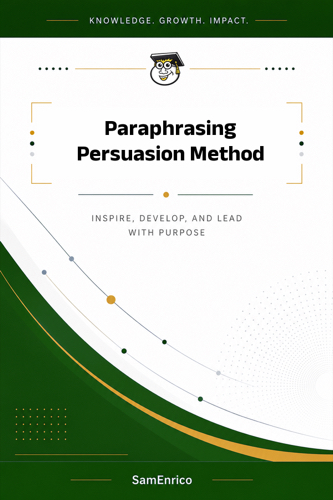
Non-FictionSelf-HelpParaphrasingReflection
Paraphrasing Persuasion Method eBook
Restate others' points to show understanding and b
by Baum Elly
Restate others' points to show understanding and build rapport.
Formats
Free sample
Chapter 1: The Amen Corner...--–- Every argument you have ever lost, you lost before you opened your mouth. Not because you were wrong. Not because the other person was unreasonable. Not because you failed to find the perfect combination of words that would finally make them see your side. You lost because they never felt safe enough to change their mind.
And safety has nothing to do with logic.Think about the last time you were in a real argument. Not a casual disagreement about where to eat dinner, but the kind of argument that left you feeling drained, frustrated, and somehow further apart than when you started. Maybe it was with a partner who seemed determined to misunderstand you. Maybe it was with a colleague who kept interrupting with counterpoints before you could finish a sentence. Maybe it was with a teenager who responded to every reasoned explanation with a blank stare or an eye roll.
In that moment, what did you do? If you are like most people, you did the one thing that guarantees failure: you explained yourself louder, slower, and with more evidence.You thought, If I could just make them see the facts. If I could just find the right analogy. If I could just repeat myself one more time with slightly different wording, they would finally get it.They did not get it. They got angrier.
Or they shut down. Or they changed the subject. Or they walked away. And you were left wondering what magical combination of words you failed to discover.Here is the truth that will transform every conversation you have from this point forward: The problem was never your words. The problem was their nervous system.The Persuasion Myth That Keeps You Stuck We have been sold a lie about persuasion.
From Aristotle's rhetoric to modern sales training, the dominant message is that persuasion is about crafting better arguments. Find the right evidence. Structure your points logically. Use emotional appeals strategically. Deliver with confidence.
These things matter, of course. But they matter only after a prerequisite has been met—a prerequisite that almost everyone ignores.The prerequisite is safety.Before the human brain can process logic, before it can evaluate evidence, before it can even hear your words as words rather than as threats, it must answer one question: Am I safe? If the answer is no, the reasoning centers of the brain literally shut down. Not metaphorically. Not "as if." Literally.
The prefrontal cortex—the part of your brain responsible for executive function, impulse control, logical reasoning, and empathy—goes offline when your nervous system detects a threat. And in a heated argument, your nervous system and the other person's nervous system both detect a threat.This is not a character flaw. It is not a sign of weakness or irrationality. It is biology. It is the same biology that kept your ancestors alive when a rustle in the bushes might have been a predator.
The brain does not distinguish between a physical threat (a tiger) and a social threat (someone disagreeing with you in a way that feels like an attack on your identity, your competence, or your belonging). To the amygdala—the brain's alarm system—both are emergencies. And in an emergency, you do not reason. You react.This is why explaining yourself louder never works. When someone is in a threat state, increasing the volume or intensity of your message only registers as an escalation of the threat.
You are not clarifying; you are shouting. They are not listening; they are bracing. The gap between you does not shrink. It widens.The Amen Corner: Where Good Conversations Go to Die There is a phenomenon that occurs in nearly every disagreement, from kitchen-table arguments to boardroom battles to international negotiations. I call it the Amen Corner.Picture this: You are in a conversation.
The other person is speaking. You are nodding. You are making eye contact. You are even making small sounds of acknowledgment—"mm-hmm," "right," "I see." To an outside observer, you appear to be listening. But here is the question: Are you listening to understand, or are you listening to prepare your response?The Amen Corner is that mental space where you wait for the other person to finish speaking so you can say what you already decided to say thirty seconds ago.
You are not actually processing their words. You are scanning their sentences for weaknesses, for gaps, for the moment when you can jump in with your counterpoint. You are listening for the "amen" that signals your turn to speak.And here is the brutal truth: they are doing the exact same thing.So you have two people, both convinced they are right, both waiting for the other to stop talking, both treating the conversation as a competition rather than a collaboration. Neither feels heard. Neither feels safe.
Both are rehearsing their next point instead of absorbing the current one. This is not a dialogue. It is two monologues colliding.The Amen Corner is the graveyard of understanding. It is where relationships go to die slowly, one misunderstood sentence at a time. And the tragedy is that most people never realize they are standing in it.The Validation Loop: A Different Way Now consider an alternative.
Imagine a conversation where, before you say what you think, you prove that you understand what they think. Not that you agree with it. Not that you endorse it. Not that you will concede to it. Simply that you can restate their position back to them in a way that makes them say, "Yes, that's exactly what I mean."This is the Validation Loop.
It has three steps, and they are deceptively simple:Listen without rehearsing your response.Paraphrase what you heard, focusing on both content and emotion.Ask if you got it right. If not, try again.That is it. That is the entire method distilled to its essence. And yet, this simple loop has the power to end arguments that have lasted for decades. Because when someone hears their own perspective reflected back to them accurately—without distortion, without mockery, without interruption—something remarkable happens in their nervous system.
The threat response begins to subside. The cortisol that was flooding their bloodstream starts to drop. And in its place, oxytocin—the neurochemical associated with safety, bonding, and trust—begins to flow.They do not suddenly agree with you. That is not the goal. The goal is to create the conditions where agreement becomes possible.
You cannot logic someone out of a position they did not logic themselves into. But you can listen them into a place where they are willing to reconsider.Why "Being Right" Is the Enemy of Persuasion One of the hardest lessons in this book is also one of the most liberating: being right is less persuasive than making someone feel safe.Think about your own experience. When was the last time someone won an argument with you by proving you were wrong? Not by helping you see something you had missed, but by demonstrating, with evidence and logic, that your position was factually incorrect. Did you thank them?
Did you embrace their superior reasoning? Or did you feel defensive, irritated, and even more committed to your original position?Most…
This is the end of the free sample. Get the eBook to keep going. Buy now
About this book
Details
- Author
- Baum Elly
- Publisher
- SamEnrico
- Language
- English
- Genre
- Non-Fiction, Self-Help, Paraphrasing, Reflection
- Released
- 2026-06-07
- Pages (approx.)
- 116
- Available as
- eBook, Audiobook

Read better in the ZLOADR app
Your eBooks on your phone or tablet. Sign in with your SamEnrico account and start reading.
More by Baum Elly
 The Restless Leg Syndrome Relief HandbookBaum Elly$11.99
 Reddit FIRE Movement PressureBaum Elly$11.99
 Time Blocking with NotionBaum Elly$11.99
 General Purpose AI Obligations BriefBaum Elly$11.99
 The Gambit That Changed the Game: The 1983 NFL Draft HeistBaum Elly$11.99
 Recherche Aide SoignantBaum Elly$11.99
 Post Presentation Anxiety Crash FixBaum Elly$12.99
 Latin America Talent FlowsBaum Elly$12.99
 Understanding Karandikar–Maria–kamble SyndromeBaum Elly$17.99
 How to Start a Burglar Alarms Electronic Sound Signalling for Motor Vehicles Business (Beginners GuiBaum Elly$11.99
You may also like
 Hong Kong Handover 1997Dunn Johnnie$11.99
 Zumba For Postnatal Recovery CourseNeal Christian$11.99
 Zumba for BeginnersLadner Nikia$11.99
 YouTube Comment Mining GuideHumes Pandora$12.99
 Worry Box MeditationCarlin Rudy$11.99
 Workplace Stress MeditationNguyen Lynn$11.99
 Workplace Stress and Sleep RepairHawley Ivory$11.99
 Workplace Perfectionism CureDelaney Jeffry$11.99
 Workplace Injustice Anger GuideWallen Isabelle$11.99
 Work Addiction and Burnout LinkGreenwood Ester$11.99
 Women in Yoga and WellnessBeattie Galina$11.99
 Women in Stand Up ComedyChun Evangeline$11.99