
Non-FictionHealth & WellnessPeer Support
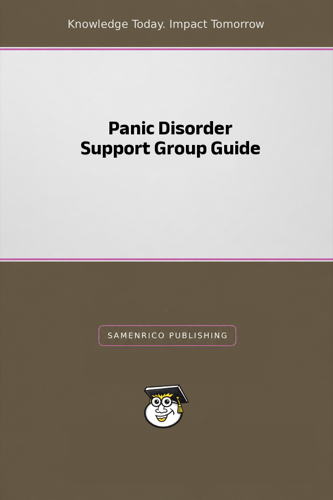
Panic Disorder Support Group Guide eBook
Lead or join peer support groups for shared recove
Lead or join peer support groups for shared recovery experiences.
Formats
Free sample
Chapter 1: The Alone Lie--–- The first time Maria’s heart raced for no reason, she was standing in the dairy aisle of a grocery store, reaching for a gallon of milk. Nothing remarkable preceded it. No argument, no near-miss car accident, no bad news. Just the hum of fluorescent lights, the cold seeping through the refrigerator door, and suddenly—a sensation like a trapped bird beating against her ribcage. Her palms went slick.
The floor tilted. The word “stroke” flashed through her mind, then “heart attack,” then “you are dying right here between the yogurt and the cottage cheese.” She abandoned her cart, walked—not ran, because running would draw attention—to her car, and sat in the parking lot for forty-five minutes waiting for the heart attack that never came.She did not tell anyone. Not her husband, who would worry. Not her sister, who would overreact. Not her doctor, because she was certain the doctor would confirm her worst fear: something was deeply, secretly wrong.
So Maria did what millions of people with panic disorder do first. She hid. She stopped going to that grocery store. Then she stopped going to any grocery store. Then she stopped driving on the highway.
Then she stopped driving at all. Her world contracted like a photograph burning from the edges inward, and the entire time, she believed one thing with absolute certainty: I am the only person in the world who feels this way.This chapter is about that belief. It is about the most powerful weapon panic disorder possesses—not the racing heart, not the shortness of breath, not even the fear of death. Those are symptoms. The weapon is isolation.
Panic disorder convinces you that you are uniquely broken, uniquely fragile, uniquely alone. And the only way to disarm that weapon is to do the one thing every instinct tells you to avoid: you must speak your fear aloud in the presence of another human being who already knows it.The Secret That Panic Disorder Keeps Let us name something immediately. Panic disorder is not a character flaw. It is not a weakness. It is not a sign that you are too sensitive, too dramatic, or too something.
It is a neurobiological condition with a predictable pattern, a known mechanism, and—this is crucial—a proven treatment pathway. But the condition itself has a survival strategy. Like a parasite that convinces its host to avoid light, panic disorder convinces you to avoid witness. It whispers: If anyone knew how afraid you really are, they would be horrified. They would leave.
They would commit you. They would see the truth—that you are fundamentally broken.This is the Alone Lie.The Alone Lie has three components, and understanding them is the first step toward breaking their grip. First, the Lie of Uniqueness: the belief that your specific flavor of panic—the exact constellation of racing heart, derealization, fear of losing control, fear of vomiting, fear of fainting, fear of dying—is so strange and so shameful that no one else could possibly understand it. Second, the Lie of Contagion: the fear that if you speak your panic aloud, you will somehow transmit it to others, or worse, they will catch your fear and blame you for it. Third, the Lie of Permanent Damage: the belief that this state is now your permanent identity, that you have crossed some invisible line from “person who had a panic attack” to “panicky person,” and that label can never be removed.These three lies form a prison.
And like most prisons, they are built from the inside. No one locks you in. You lock yourself in, one avoided grocery store at a time, one cancelled plan at a time, one unshared secret at a time.Here is what Maria discovered when she finally, desperately, after three years of hiding, walked into a church basement where seven strangers sat in folding chairs: the first person who spoke described a racing heart in the dairy aisle. The second person described derealization in a pharmacy. The third person described the exact same fear of dying—not metaphorically, but the concrete, somatic certainty that death was seconds away.
Maria cried. Not from sadness. From the bone-deep relief of hearing her own private nightmare spoken aloud in someone else’s voice.That relief has a name. It is called universality.Universality: The Antidote to the Alone Lie In 1970, psychiatrist Irvin Yalom published The Theory and Practice of Group Psychotherapy, distilling decades of clinical observation into a set of “therapeutic factors” that make groups healing. At the top of that list was universality: the realization that you are not alone in your suffering, that others share your “most dreadfully shameful secrets.” Yalom observed that patients often enter group therapy believing their problems are unique, monstrous, and unforgivable.
The moment another member describes the same fear—the same intrusive thought, the same compulsive ritual, the same panic trigger—something shifts. The shame that kept the problem locked inside begins to dissolve.Universality is not simply “misery loves company.” Misery loves company is passive—it says, at least I am not suffering alone. Universality is active. It rewires the threat assessment system in the brain. When you hear another person describe a panic attack that sounds exactly like yours, your brain receives two pieces of contradictory data.
First, the old data: this sensation means death. Second, the new data: that person had the same sensation and is alive, speaking, sitting in a folding chair, drinking bad coffee. The brain must resolve the contradiction. It cannot hold both “this is lethal” and “that person survived it” without adjusting the threat level downward.This is not poetry. This is neurobiology.
The anterior cingulate cortex, which detects conflict between expectations and reality, signals the amygdala to decrease its threat response when social evidence contradicts the fear. In plain English: watching someone else survive what terrifies you literally recalibrates your own fear circuitry.But universality requires a precondition. You have to be in a room—physical or virtual—with people who already know the territory. You have to hear the words. And that means you have to overcome the second weapon panic disorder uses against you: the secrecy-shame loop.The Secrecy-Shame Loop: How Panic Disorder Maintains Itself Here is the pattern.
A person experiences their first panic attack. It is terrifying, disorienting, and physically overwhelming. They do not know what happened. They suspect—as most do—that something is medically wrong. They may go to the emergency room, receive reassurance that they are not having a heart attack, and leave with a prescription for a benzodiazepine and a referral to a primary care physician.
But no one explains panic disorder to them. No one says, “You just experienced a misfiring of your amygdala. Here is what that means. Here is how it works. Here is how to make it stop.”So they hide it.
They tell themselves it was a fluke. They adjust their life slightly—avoid the place where it happened, avoid the circumstances, avoid anything that might trigger a recurrence. And because avoidance temporarily reduces anxiety, the brain learns a dangerous lesson: avoidance keeps…
This is the end of the free sample. Get the eBook to keep going. Buy now
About this book
Details
- Author
- Alderman Bridgette
- Publisher
- SamEnrico
- Language
- English
- Genre
- Non-Fiction, Health & Wellness, Peer Support
- Released
- 2026-06-06
- Pages (approx.)
- 118
- Available as
- eBook, Audiobook

Read better in the ZLOADR app
Your eBooks on your phone or tablet. Sign in with your SamEnrico account and start reading.
More by Alderman Bridgette
 Performance Review Self TalkAlderman Bridgette$11.99
 The Pleasant Events Schedule WorkbookAlderman Bridgette$11.99
 Neural Style Transfer for VideoAlderman Bridgette$11.99
 Hostage Poetry CollectionAlderman Bridgette$11.99
 Breakaway: The Unfinished Story of Catalonia's Independence BidAlderman Bridgette$11.99
 Plastic Pioneers: The Secret War of the Toy TycoonsAlderman Bridgette$11.99
 Understanding Brachydactyly Type A3Alderman Bridgette$17.99
 Sustainable Ecommerce OutlookAlderman Bridgette$12.99
 Self Taught Vs Bootcamp Vs DegreeAlderman Bridgette$12.99
 FacebookingAlderman Bridgette$11.99
 10 Ways to Use Citron (Recipe Book)Alderman Bridgette$11.99
You may also like
 Hong Kong Handover 1997Dunn Johnnie$11.99
 Zumba For Postnatal Recovery CourseNeal Christian$11.99
 Zumba for BeginnersLadner Nikia$11.99
 YouTube Comment Mining GuideHumes Pandora$12.99
 Worry Box MeditationCarlin Rudy$11.99
 Workplace Stress MeditationNguyen Lynn$11.99
 Workplace Stress and Sleep RepairHawley Ivory$11.99
 Workplace Perfectionism CureDelaney Jeffry$11.99
 Workplace Injustice Anger GuideWallen Isabelle$11.99
 Work Addiction and Burnout LinkGreenwood Ester$11.99
 Women in Yoga and WellnessBeattie Galina$11.99
 Women in Stand Up ComedyChun Evangeline$11.99