
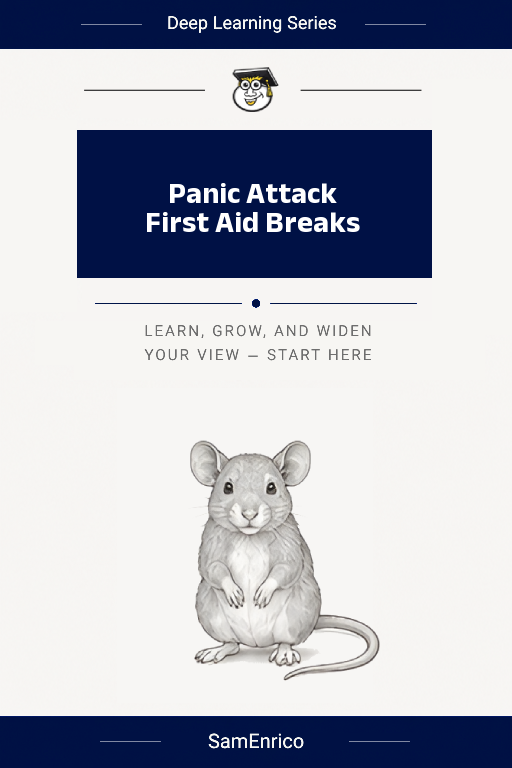
Panic Attack First Aid Breaks eBook
Applies micro-break techniques when panic begins i
by Dow Christen
Applies micro-break techniques when panic begins including grounding, breath holds, and temperature changes to interrupt the panic cycle.
Formats
Free sample
Chapter 1: The 90-Second Lie--–- You are not dying.Let me say that again, because when the first wave of panic hits—when your heart slams against your ribs like a trapped animal, when the air turns to concrete in your lungs, when the room tilts and your skin goes cold and every cell in your body screams something is terribly wrong—you will not believe me. You will be certain, absolutely certain, that this is the end. A heart attack. A stroke. Suffocation.
Insanity. The final curtain.You are wrong.You are experiencing a biological misfire, not a medical emergency. The most terrifying sensation a human being can experience is, paradoxically, the most harmless. Panic attacks cannot stop your heart. They cannot make you stop breathing.
They cannot make you faint (in fact, your blood pressure rises during panic, making fainting extremely unlikely). They cannot make you "go crazy" or lose touch with reality permanently. They are false alarms—your brain’s smoke detector going off because you burned toast, not because the house is on fire.But try telling that to someone in the middle of a panic attack.This book will not ask you to talk yourself out of panic. That is a fool’s errand. When your amygdala—the ancient, almond-shaped threat detector buried deep in your brain—decides there is danger, it does not wait for permission from your logical prefrontal cortex.
It hijacks your entire nervous system in milliseconds. You cannot reason with a hijacker. You cannot negotiate with a false alarm. You can only interrupt the signal.That is what this book teaches: First Aid Breaks. Micro-interventions lasting 15 seconds to two minutes that physically force your nervous system to downshift from panic to rest.
No analysis of your childhood. No journaling about your feelings. No expensive therapy app. Just immediate, practical, physiology-based tools that work in the grocery store, in your car, in a meeting, or in the middle of the night.But before we get to the tools, you need to understand the enemy. And the enemy is not you.
The enemy is not your anxiety. The enemy is a 90-second lie that your brain tells your body—and this chapter will teach you exactly how that lie works and why you have never been in real danger.The Anatomy of a False Alarm Let us walk through a typical panic attack. Not the gradual, low-grade anxiety that buzzes in the background for hours. The real thing. The sudden, out-of-nowhere, "I was fine five seconds ago and now I am calling an ambulance" version.You are going about your day.
Maybe you are driving. Maybe you are in a grocery store. Maybe you are lying in bed, perfectly calm, about to fall asleep. Then—nothing. There is no trigger.
No threat. No lion on the savanna. But your brain decides otherwise.Second 1-5: You notice something. A skipped heartbeat. A slight dizziness.
A feeling of "offness." Your brain, ever the pattern-matcher, scans its threat database. This feels like that other time, it decides. Remember that time? That was bad.Seconds 5-15: Your amygdala fires. The amygdala does not think.
It does not analyze context. It does not ask, "Is there actually a tiger or did you just stand up too fast?" It simply sounds the alarm. In response, your hypothalamus activates the sympathetic nervous system—the fight-or-flight switch. Adrenaline and noradrenaline flood your bloodstream. Your heart rate jumps from 70 to 120, then 140, then higher.
Your breathing shifts from slow and diaphragmatic to fast and shallow, originating in your upper chest.Seconds 15-30: The physical symptoms escalate. You feel your heart pounding—not just beating, but pounding, as if it might punch through your sternum. Your chest feels tight. This is not a heart attack; it is the result of rapid breathing (hyperventilation) causing your chest muscles to tense and your blood vessels to constrict. You begin to sweat.
Your hands tremble. Your mouth goes dry. Your vision may seem to narrow or brighten. You feel an overwhelming urge to escape, to run, to get out of wherever you are.Seconds 30-60: The cognitive catastrophe begins. You notice the physical symptoms, and your brain interprets them as confirmation of danger.
My heart is racing. That means something is wrong with my heart. I am having a heart attack. Or: I cannot breathe. That means my throat is closing.
I am suffocating. Or: I feel dizzy and unreal. That means I am losing my mind. Each catastrophic interpretation releases another wave of adrenaline, which worsens the physical symptoms, which fuels more catastrophic thoughts. This is the panic spiral—a feedback loop that can feel endless.Seconds 60-90: The spiral reaches its peak.
You may experience depersonalization (feeling detached from your own body) or derealization (the world feels fake, like a movie set). You may have an overwhelming conviction that you are about to die, pass out, or lose control completely. Some people cry. Some people freeze. Some people flee.
This is the point where many panic sufferers call 911 or beg someone to take them to the emergency room.Second 90 and beyond: Here is the truth that changes everything. The chemical cascade that creates a panic attack—the release of adrenaline, the activation of the sympathetic nervous system—cannot sustain itself indefinitely. The human body is designed to return to homeostasis. By approximately 90 seconds after the initial alarm, the surge of adrenaline has been metabolized. Your parasympathetic nervous system (the "rest and digest" branch) begins to reassert itself.
Your heart rate starts to decrease. Your breathing begins to slow.But here is the catch: the panic spiral continues if you keep adding fuel. And the fuel is catastrophic thinking. If you look at your racing heart and think, It is still racing, something is still wrong, your brain will release more adrenaline. If you fight the panic, trying to force it away, your brain interprets that struggle as evidence of threat.
The 90-second chemical loop resets. And another 90 seconds begins. And another. This is why panic attacks can feel like they last for twenty minutes or an hour. They are not one panic attack.
They are a series of 90-second loops stacked on top of each other, each one fed by the fear of the previous one.The goal of a First Aid Break is simple: break the loop before it resets. Interrupt the spiral in the first 90 seconds, and you prevent the second loop from forming. You do not have to stop the panic attack entirely—you just have to stop it from renewing itself.The Amygdala Hijack: Why Your Brain Bypasses Logic Let us talk about your amygdala. It is a small, almond-shaped cluster of nuclei located deep within your temporal lobe. You have two of them, one on each side of your brain.
They are ancient. They are fast. And they do not care about your opinions.The amygdala evolved to solve one problem: detecting threats and responding before you have time to think. Imagine you are a hominid on the savanna 200,000 years ago. You are picking berries.
A rustle in the grass. Your amygdala fires. Your body springs into action—heart racing, muscles tensing, breathing quickening—before your cortex…
This is the end of the free sample. Get the eBook to keep going. Buy now
About this book
Details
- Author
- Dow Christen
- Publisher
- SamEnrico
- Language
- English
- Genre
- Non-Fiction, Mental Wealth, Panic Relief
- Released
- 2026-05-30
- Pages (approx.)
- 160
- Available as
- eBook, Audiobook

Read better in the ZLOADR app
Your eBooks on your phone or tablet. Sign in with your SamEnrico account and start reading.
More by Dow Christen
 Submarine War Memorial GuideDow Christen$11.99
 Workaholism and MarriageDow Christen$11.99
 Anger for First RespondersDow Christen$11.99
 Forgiving The World For CrueltyDow Christen$11.99
 The EV Industry Capital StrategyDow Christen$11.99
 The Devil's Interval: Paganini and the Dark Art of the ViolinDow Christen$11.99
 How to Become a Pipe FitterDow Christen$11.99
 Health Cooperative GuideDow Christen$12.99
 Apartment Maintenance SupervisorDow Christen$11.99
 Understanding Spondylodysplasia BrachyolmiaDow Christen$17.99