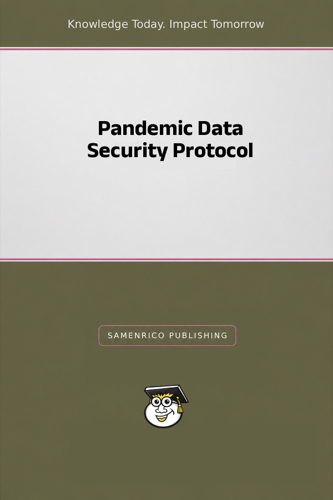
Pandemic Data Security Protocol eBook
Lock down remote access endpoints and prevent phis
Lock down remote access endpoints and prevent phishing attacks exploiting outbreak fears.
Formats
Free sample
Chapter 1: The Morphing Threat...–- The first casualty of a pandemic is not a body but a boundary. When a global health crisis strikes, the carefully constructed perimeter that separates your corporate network from the hostile internet dissolves overnight. Thousands of endpoints that were never designed to live outside the office suddenly find themselves scattered across living rooms, kitchen tables, and makeshift bedrooms, connected through routers that haven't been patched in years, protected by family members who click on everything, and operated by employees whose primary concern is no longer security but survival. This is the moment attackers have been waiting for.The convergence of a health crisis and a cybersecurity crisis creates something far more dangerous than the sum of its parts. It creates the Morphing Threat—an adversary that changes its tactics, targets, and tools as rapidly as the pandemic itself evolves.
Understanding this shape-shifting nature is the first and most critical step in building a defense that does not crumble under the weight of chaos. This chapter dissects the anatomy of a crisis-driven attack, revealing how threat actors abandon their standard playbooks, exploit remote access vulnerabilities, and weaponize fear itself. By the end, you will understand not just what attackers do during a pandemic, but why they do it, and how to anticipate their next morph.The Strategic Pivot: From Stealth to Speed In normal times, cybercriminals behave like pickpockets in a crowded market. They seek to remain invisible, extracting value slowly and methodically over weeks or months. Data theft—credit card numbers, personal identities, trade secrets—is the preferred currency because it can be monetized quietly.
Ransomware, while loud, is a calculated risk. Attackers dwell inside networks, mapping infrastructure, escalating privileges, and exfiltrating data long before any encryption occurs. The average dwell time in 2019 was over 200 days before detection. That model shatters during a pandemic.When a health crisis erupts, attackers undergo a strategic pivot. Speed replaces stealth.
Noise becomes acceptable. The goal shifts from prolonged access to immediate payout. Why this radical change? Because the window of opportunity is suddenly compressed. Organizations are in chaos.
IT teams are overwhelmed. Users are confused. Security monitoring is degraded. Attackers know that normal operations will eventually resume, patches will be applied, and lessons will be learned. They have weeks, not months, to strike.This pivot manifests in three distinct ways.
First, ransomware attacks surge dramatically. Between February and March 2020, as COVID-19 spread globally, ransomware attacks against healthcare organizations increased by over 150 percent. Attackers calculated—correctly—that hospitals overwhelmed by patients would be more likely to pay ransoms than to endure extended downtime. Second, phishing campaigns shift from generic lures to hyper-specific, emotionally charged baits. Emails about vaccine side effects, mandatory testing, and emergency policy changes replace the tired "your account has been compromised" templates.
Click-through rates double or triple because the messages tap into genuine anxiety. Third, misinformation becomes a weapon. Attackers deploy fake CDC and WHO alerts, not merely to steal credentials, but to create confusion that weakens overall security posture. A distracted workforce is a compliant workforce.The most dangerous aspect of this strategic pivot is its mirroring of legitimate organizational behavior. Just as companies scramble to enable remote work, attackers scramble to exploit that scramble.
Just as HR departments send urgent policy updates, attackers send indistinguishable forgeries. The attacker's goal is to become invisible not by hiding, but by blending into the noise of the crisis itself.Case Studies: When Remote Access Became a Weapon Theory is useful. Evidence is essential. This section examines three real-world breaches where pandemic-era remote access vulnerabilities led to catastrophic outcomes. Names and specific dates have been obscured where confidentiality agreements apply, but the technical details are drawn from incident response reports, forensic analyses, and legal disclosures.Case Study One: The Unpatched VPN Gateway A mid-sized healthcare network serving 200,000 patients had deployed a remote access VPN solution three years prior to the pandemic.
The device was configured, tested, and largely forgotten. When the stay-at-home order arrived, the VPN, designed for 20 percent concurrent usage, was suddenly handling 95 percent of all employees. Performance degraded. Users complained. The overworked IT team, already managing a flood of help desk tickets, made a fateful decision: they disabled several security features, including certificate validation and multi-factor authentication, to speed up connections and reduce friction.Within 72 hours, an attacker scanning the internet for vulnerable VPN gateways discovered the device, which was running firmware that was 18 months out of date and contained a known remote code execution vulnerability.
The attacker gained administrative access, pivoted to the internal network, and deployed ransomware across three data centers. The hospital network was completely offline for 11 days. Patient records were inaccessible. Surgeries were canceled. The ransom demand was $5 million.
The organization paid $3.5 million after negotiation.The post-incident forensic analysis revealed that the attacker had been inside the network for only 36 hours before deploying the ransomware. There was no dwell time, no patient reconnaissance, no stealth. The attacker simply exploited the VPN, escalated privileges, and executed. The entire attack chain took less time than a weekend shift change.Case Study Two: The RDP Backdoor A financial services firm with 500 employees had a small IT department that relied on Remote Desktop Protocol (RDP) for server management. When the pandemic forced everyone home, the IT team needed a way to support users remotely.
They enabled RDP on several workstations, opened the required ports on the corporate firewall, and set up a simple Virtual Private Network (VPN) for employees. What they did not realize was that several workstations had been configured with local administrator accounts that used weak passwords—in two cases, "Password123" and "Welcome2020."Attackers scanning for open RDP ports found the firm within 24 hours. Using a technique called "credential stuffing" combined with brute-force attacks, they gained access to a workstation belonging to a junior accountant. From there, they used a tool called Mimikatz to extract password hashes from memory, moved laterally to a domain controller, and created a new domain admin account. Over the next two weeks, they methodically exfiltrated customer data, including Social Security numbers and financial account details.
The breach was discovered not by the firm's security tools, but by a customer who noticed unauthorized transactions on their account.The total cost, including regulatory fines, legal settlements, and customer restitution, exceeded $12 million. The firm's cyber insurance policy had a pandemic exclusion clause, leaving them to bear the full cost. The chief information officer resigned. The company lost 40 percent of its clients within 18 months.Case Study Three: The Help Desk Impersonation A global manufacturing company had a relatively mature security program, including endpoint detection, multi-factor authentication, and security awareness training. When the pandemic hit, they activated their business continuity plan, issued laptops to all knowledge workers, and configured a Zero Trust Network Access solution.
By most measures, they were ahead of their peers. They still suffered a breach.The attack began not with a technical exploit but with a phone call. An employee received a call from someone claiming to be from the IT help desk. The caller had the employee's name, department, and manager's name. The caller explained that due to the pandemic, there had been a "security refresh" and all employees needed…
This is the end of the free sample. Get the eBook to keep going. Buy now
About this book
Details
- Author
- Medlock Leota
- Publisher
- SamEnrico
- Language
- English
- Genre
- Non-Fiction, Crisis Management, Cybersecurity
- Released
- 2026-06-10
- Pages (approx.)
- 155
- Available as
- eBook, Audiobook

Read better in the ZLOADR app
Your eBooks on your phone or tablet. Sign in with your SamEnrico account and start reading.
More by Medlock Leota
 Pull Up for GripMedlock Leota$11.99
 Nobel Laureates in Cell BiologyMedlock Leota$11.99
 Macro Friendly SnacksMedlock Leota$11.99
 The Foster Care TherapistMedlock Leota$11.99
 Uber Vehicle Selection GuideMedlock Leota$11.99
 Grief and Young ChildrenMedlock Leota$11.99
 Emotional Regulation for DepressionMedlock Leota$11.99
 The Unseen War: The Secret Cold War Space RaceMedlock Leota$11.99
 The Fall of Granada: Blood and Roses in the Last Moorish Stronghold (1492)Medlock Leota$11.99
 How to Produce White CoatsMedlock Leota$11.99
 Indian Agent Technology SkillsMedlock Leota$12.99
 Face to Face Priority in Arab SalesMedlock Leota$12.99