
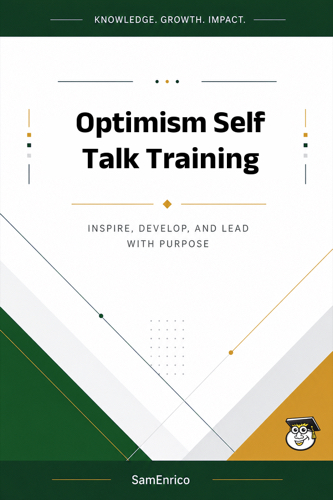
Optimism Self Talk Training eBook
Provides scripts to reinterpret setbacks as tempor
Provides scripts to reinterpret setbacks as temporary and specific.
Formats
Free sample
Chapter 1: The Unheard Narrator--–- Every morning, before you brush your teeth, before you check your phone, before you speak a single word out loud, you have already been talking to yourself for hours. You have narrated the quality of your sleep, predicted the difficulty of the day ahead, judged the shape of your body in the mirror, and assigned meaning to the silence of the person next to you. This voice is so constant, so seamless, so utterly woven into the fabric of your consciousness that you do not hear it as a voice at all. You hear it as reality.This chapter is about making the invisible visible. It is about learning, for the first time, to hear the narrator who has been speaking inside your head since childhood.
And it is about discovering that this narrator is not you—not the whole of you—but a habit. A learned pattern of explaining why things happen. And like any habit, it can be unlearned and rewritten.The Quiet Catastrophe of Automatic Explanation Consider two people stuck in the same traffic jam, both arriving thirty minutes late to work. Person A sits in the driver’s seat, jaw clenched, thinking: I am always late. I have no self-discipline.
My boss is going to think I am completely unreliable. This is just who I am. Person B sits in the same traffic, thinking: There was an accident on the highway. That is unusual for a Tuesday. I will send a quick message to my boss, and tomorrow I will take the earlier train just in case.The external event is identical.
The traffic jam does not care which person is sitting in which car. Yet Person A will arrive at work feeling ashamed, defeated, and convinced that they are fundamentally flawed. Person B will arrive feeling mildly inconvenienced, slightly annoyed at the traffic, but entirely intact. The difference is not in the event. The difference is in the narrator.This is the single most important insight of modern cognitive psychology: the story you tell yourself about why something happened determines your emotional and behavioral response far more than the event itself.
Psychologists call this your explanatory style—the automatic, habitual pattern of explaining the causes of events, particularly bad events.What Is Explanatory Style?Explanatory style is the grammar of your internal monologue. It is the set of rules your brain follows, unconsciously, to answer the question “Why did that happen?” Every time something goes wrong—a spilled coffee, a rejected proposal, a snide comment, a failed test, a lost game—your brain immediately produces an explanation. This explanation happens in milliseconds, long before conscious thought intervenes. And that explanation has three dimensions.The first dimension is permanence. Does your brain explain this event as temporary or permanent?
The pessimistic narrator says: “This always happens. This will never change. This is forever.” The optimistic narrator says: “This is happening now. This will pass. This is temporary.”The second dimension is pervasiveness.
Does your brain explain this event as specific or universal? The pessimistic narrator says: “This one failure means everything is ruined. I am bad at everything.” The optimistic narrator says: “This is one area. This specific task went wrong. The rest of my life remains untouched.”The third dimension is personalization.
Does your brain explain this event as internal (your fault) or external (the situation’s fault)? But here we must make a crucial distinction that many self-help books get dangerously wrong. There are two kinds of internal explanations: characterological (“I am a failure”) and behavioral (“I made a specific mistake”). The healthy optimist does not deny responsibility. The healthy optimist takes behavioral responsibility for controllable actions while refusing to take characterological blame for their entire self.Let us clarify this with precision because it will save you years of confusion.The Critical Clarification: Internal-Specific vs.
External Attribution Many popular books on optimism suggest that optimists always blame external circumstances. “I lost the sale because the market is tough” is presented as the optimistic script, while “I lost the sale because I am incompetent” is the pessimistic script. This is partially correct but dangerously incomplete.If you consistently blame external circumstances for every failure, you will never improve. You will become passive, entitled, and helpless—the opposite of resilience. The market is tough?
Then you have no agency. The teacher was unfair? Then studying is pointless. The boss was in a bad mood? Then your performance doesn’t matter.
This is not optimism. This is victimhood.The corrected model—the one that actually works and is supported by decades of cognitive behavioral research—is this: For events within your control, use internal-specific attributions. For events outside your control, use external attributions.Internal-specific means you take responsibility for your specific actions without condemning your entire self. “I lost the sale because I did not prepare the third-quarter data carefully enough” (internal to you, specific to that action) is healthy. “I lost the sale because I am incompetent” (internal to you, global to your character) is destructive.
The first statement leads to improvement: you will prepare the data next time. The second statement leads to despair: you cannot change being incompetent because you believe incompetence is who you are.External attribution means you recognize genuine external causes without denying your agency where it exists. “The flight was canceled because of a thunderstorm” is accurate. “The flight was canceled because the universe hates me” is paranoia.This chapter establishes the attribution rule that will guide the entire book: Take specific, behavioral ownership of your actions. Do not take characterological ownership of your self.
Reserve external attribution for events genuinely beyond your control.The Origins of Your Narrator Where does this narrator come from? You were not born with an explanatory style. Infants do not wake up thinking, “I dropped my rattle again; I am so clumsy; this always happens to me.” Explanatory style is learned, and it is learned primarily from three sources.The first source is repeated feedback from caregivers. When a child falls off a bike and a parent says, “You are so careless,” the child learns a characterological explanation. When a parent says, “You didn’t watch the curb that time; let’s try looking down next time,” the child learns a behavioral, specific explanation.
These repeated statements become internalized as the child’s own voice.The second source is modeling. Children absorb the explanatory style of the adults around them by osmosis. A parent who says, “I am so stupid, I lost my keys again” is teaching the child that setbacks are permanent and personal. A parent who says, “I was distracted when I put my keys down; let me retrace my steps” is teaching that setbacks are temporary and specific.The third source is early adversity. Children who experience unpredictable, uncontrollable negative events—erratic parenting, sudden moves, inconsistent discipline—tend to develop a pessimistic explanatory style because their brains learn that effort does not matter.
This is called learned helplessness, and it is the opposite of resilience.The good news is that because explanatory style is learned, it can be unlearned. Your brain is plastic. The neural pathways…
This is the end of the free sample. Get the eBook to keep going. Buy now
About this book
Details
- Author
- Rhoads Carletta
- Publisher
- SamEnrico
- Language
- English
- Genre
- Non-Fiction, Self-Help, Optimism
- Released
- 2026-06-10
- Pages (approx.)
- 154
- Available as
- eBook, Audiobook

Read better in the ZLOADR app
Your eBooks on your phone or tablet. Sign in with your SamEnrico account and start reading.
More by Rhoads Carletta
 Parent Loss and Faith GuideRhoads Carletta$11.99
 The Twelve Steps And Spiritual Awakening CourseRhoads Carletta$11.99
 Addressing A Child's School IssueRhoads Carletta$11.99
 Goal Setting for Weight LossRhoads Carletta$11.99
 Yahoo Breach Class Action SettlementRhoads Carletta$11.99
 V S Ramachandran BioRhoads Carletta$11.99
 Suicide and DoubtRhoads Carletta$11.99
 The Colonial Elegance of Elizabeth Bayly: Australia’s Forgotten Design PioneerRhoads Carletta$11.99
 How to Produce Wrestling UniformsRhoads Carletta$11.99
 Happay AI Expense ApprovalsRhoads Carletta$12.99
 Ransomware Timeline Management GuideRhoads Carletta$12.99
 How to Start a Cloth Mercerising Business (Beginners Guide)Rhoads Carletta$11.99
You may also like
 Hong Kong Handover 1997Dunn Johnnie$11.99
 Zumba For Postnatal Recovery CourseNeal Christian$11.99
 Zumba for BeginnersLadner Nikia$11.99
 YouTube Comment Mining GuideHumes Pandora$12.99
 Worry Box MeditationCarlin Rudy$11.99
 Workplace Stress MeditationNguyen Lynn$11.99
 Workplace Stress and Sleep RepairHawley Ivory$11.99
 Workplace Perfectionism CureDelaney Jeffry$11.99
 Workplace Injustice Anger GuideWallen Isabelle$11.99
 Work Addiction and Burnout LinkGreenwood Ester$11.99
 Women in Yoga and WellnessBeattie Galina$11.99
 Women in Stand Up ComedyChun Evangeline$11.99