
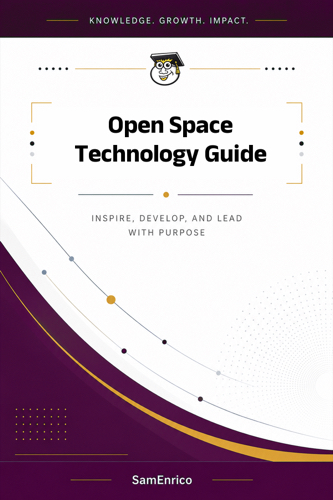
Non-FictionSelf-HelpOpen Space
Open Space Technology Guide eBook
Self organizing participant driven meetings.
Self organizing participant driven meetings.
Formats
Free sample
Chapter 1: The Coffee Break Conspiracy--–- It begins not with a gavel striking a podium, but with the quiet clink of a ceramic mug against a saucer. In the cramped, poorly lit hallway of a conference center, somewhere between the overcooked chicken lunch and the afternoon death-march of Power Point slides, something magical happens. Strangers who spent the morning pretending to listen to keynote speeches suddenly become animated. They lean in close. They argue.
They laugh. They scribble ideas on napkins. Problems that seemed unsolvable an hour ago begin to crack open. This, Harrison Owen discovered in the 1980s, was not a failure of the formal conference agenda. It was the entire point.
The formal sessions were the expensive decoration; the coffee breaks were the real meeting.This chapter reveals the conspiracy at the heart of traditional meetings—the unspoken agreement that we will sit passively while being talked at, that we will suppress our best ideas until the "appropriate time," and that we will pretend the schedule knows more than the people in the room. Open Space Technology (OST) is not a meeting technique. It is a counter-conspiracy. It says: what if we started with the coffee break? What if the hallway conversation became the agenda?
What if the people who care most about a problem were trusted to solve it, without permission slips, without gatekeepers, and without a script? This chapter introduces OST as a radical departure from everything you have been taught about meetings, and it makes a bold promise: letting go of control is the only way to get real results from complex, conflicted, urgent problems.The Day Harrison Owen Gave Up To understand Open Space Technology, you must first understand what it is not. It is not a facilitation technique. It is not a brainstorming tool. It is not a variation of World Café or Future Search or any other participatory method you have encountered.
OST is a complete inversion of the power structure of a meeting. But before we get to the inversion, we must start with the origin story—not because origin stories are cute, but because this particular story contains the entire philosophy of OST in embryonic form.In 1983, Harrison Owen was a respected organizational consultant with a thriving practice. He had written books, led retreats, and facilitated hundreds of meetings for Fortune 500 companies, government agencies, and non-profits. When he was asked to organize a large international conference on organizational transformation, he did what any responsible consultant would do: he planned meticulously. He recruited high-profile speakers.
He scheduled back-to-back sessions. He created a detailed agenda down to fifteen-minute increments. He expected brilliance.What he got was something else entirely.The formal sessions were fine. The speakers were competent. The attendees nodded politely.
But Owen noticed something troubling. During the sessions, people were distracted. They checked their watches. They doodled in their notebooks. The energy was flat.
And then, during the coffee breaks and the unstructured lunch hours, something extraordinary happened. The same people who had been zombies during the formal presentations became electric. They formed spontaneous clusters. They debated passionately. They exchanged business cards.
They made plans to collaborate after the conference. The formal agenda was producing boredom; the unstructured gaps were producing breakthroughs.Owen did something that most consultants would never do: he admitted he was wrong. He realized that the expensive, carefully planned, speaker-driven conference was mostly theater. The real work was happening in the margins, in the spaces he had not controlled, in the moments he had left unscripted. He asked himself a question that would change his life and the lives of thousands of facilitators who followed: "What would happen if we stopped pretending that the formal agenda was the main event?
What if we built a meeting that was nothing but coffee break?"That question became Open Space Technology.The Definition That Changes Everything Let us be precise. Open Space Technology is a self-organizing, participant-driven meeting methodology designed for situations of high complexity, high diversity, genuine conflict potential, and urgent need for decisions. That is the formal definition. But definitions are cold, and OST is anything but cold. Let me translate.A "self-organizing" meeting means that there is no central authority deciding what will be discussed, when it will be discussed, who will lead each discussion, or what the outcomes should be.
Instead, the participants themselves generate the agenda in real time, based entirely on what they are passionate about and willing to take responsibility for. This is not anarchy. It is a different kind of order—emergent order, like a flock of birds or a school of fish. No single bird decides where the flock goes, yet the flock moves as one. No single fish commands the school, yet the school turns simultaneously.
OST operates on the same principle: the group knows more than any individual in the group, and the group, given the right container, will organize itself more effectively than any planner ever could.A "participant-driven" meeting means that the attendees are not an audience. They are not passive recipients of information delivered from a stage. They are not there to be inspired, educated, or managed by experts. They are the experts. They are the ones who live with the problem every day.
They are the ones who have the pieces of the puzzle. And they are the ones who must implement whatever solutions emerge. In a traditional meeting, the speakers are the valuable ones; the audience is the receptacle. In OST, there is no audience. Everyone is a participant.
Everyone is responsible. Everyone has a voice, not because we are being democratic and nice, but because the problem is too complex to be solved without every perspective in the room.The "conditions" in the definition are not optional. OST is not a Swiss Army knife that works for every situation. It is a precision tool for a specific set of circumstances. Use it when: the problem is so complex that no expert has the answer; the stakeholders are so diverse that any solution must incorporate many viewpoints; there is genuine conflict because people care deeply, often in opposing directions; and there is urgency, a real need for decisions or actions soon, not in some distant planning cycle.
If these conditions are not met, do not use OST. Use a traditional meeting. Use a presentation. Use a report. But if these conditions are met, know that any other format will likely fail, because traditional meetings are designed for simple problems with known answers, and your problem is not simple.The Four Conditions Explained in Blood Let me dwell on the four conditions because they are where most facilitators go wrong.
They read about OST, get excited, and try to use it for everything. Team building? OST. Strategic planning? OST.
Weekly status update? OST. This is like using a fire hose to water a houseplant. It is technically possible, but it is also ridiculous and destructive.The first condition is high complexity. A problem is complex when cause and effect are not linear, when the same action can produce different results depending on context, and when no single person or group has all the information.
Building a bridge is complicated but not complex. You can hire a structural engineer, and she will calculate load capacities…
This is the end of the free sample. Get the eBook to keep going. Buy now
About this book
Details
- Author
- Stepp Lorriane
- Publisher
- SamEnrico
- Language
- English
- Genre
- Non-Fiction, Self-Help, Open Space
- Released
- 2026-06-07
- Pages (approx.)
- 150
- Available as
- eBook, Audiobook

Read better in the ZLOADR app
Your eBooks on your phone or tablet. Sign in with your SamEnrico account and start reading.
More by Stepp Lorriane
 Immigrant Child Sports TeamStepp Lorriane$11.99
 Remote Work Task BatchingStepp Lorriane$11.99
 Dream Nudity JournalStepp Lorriane$11.99
 Mexico Benefits NegotiationStepp Lorriane$11.99
 Conversation Starters for Online DatingStepp Lorriane$11.99
 Anger at Childs Gender IdentityStepp Lorriane$11.99
 Design Thinking for TeachersStepp Lorriane$11.99
 Magellan's Odyssey: Charting the UnknownStepp Lorriane$11.99
 How to Produce Cocktail StrainersStepp Lorriane$11.99
 How to Start a Cold Formed Steel Sections Business (Beginners Guide)Stepp Lorriane$11.99
 How to Produce an Oilseed PressStepp Lorriane$11.99
 A Collector's Handbook to the Standard Sixteen (1930-33)Stepp Lorriane$11.99
You may also like
 Hong Kong Handover 1997Dunn Johnnie$11.99
 Zumba For Postnatal Recovery CourseNeal Christian$11.99
 Zumba for BeginnersLadner Nikia$11.99
 YouTube Comment Mining GuideHumes Pandora$12.99
 Worry Box MeditationCarlin Rudy$11.99
 Workplace Stress MeditationNguyen Lynn$11.99
 Workplace Stress and Sleep RepairHawley Ivory$11.99
 Workplace Perfectionism CureDelaney Jeffry$11.99
 Workplace Injustice Anger GuideWallen Isabelle$11.99
 Work Addiction and Burnout LinkGreenwood Ester$11.99
 Women in Yoga and WellnessBeattie Galina$11.99
 Women in Stand Up ComedyChun Evangeline$11.99