
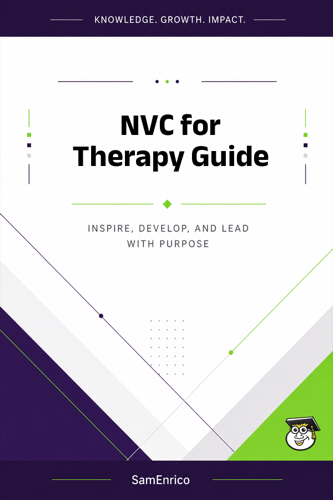
NVC for Therapy Guide
Integrates NVC into clinical mental health practic
Integrates NVC into clinical mental health practice.
Formats
About this book
Free sample
Chapter 1: The Two-Track Mind–- Every therapist knows the moment. You are sitting across from a new client, intake form in hand, DSM-5 open on your laptop. The client has just described a lifetime of fractured relationships, waves of suicidal ideation, and a gnawing sense of emptiness. Your clinical training kicks in: rule out, diagnose, code, treat. But something in you hesitates.
The label forming in your mind—borderline, narcissistic, dependent—feels both necessary and somehow violent. You need the label for insurance, for the treatment plan, for the language of your profession. Yet you also sense that if you lead with that label, you may lose something irreplaceable: the chance to meet this human being as a human being first.This chapter resolves that dilemma. It introduces the two-track framework, a way of holding diagnostic language and NVC consciousness simultaneously without contradiction. You will learn to move fluidly between the clinical track (DSM codes, insurance forms, treatment plans) and the healing track (giraffe language, needs-based listening, compassionate presence).
By the end of this chapter, you will never again feel torn between being a competent clinician and a compassionate human being. You will be both, deliberately, with a clear map for when to use which track and how to integrate them into a coherent therapeutic practice.The Violence We Are Trained to Ignore Let us begin with an uncomfortable truth. The language of mental health diagnosis, as it is commonly used, is often violent. Not violent in the sense of physical aggression, but violent in the way Marshall Rosenberg defined the term: language that separates us from our own compassion, that judges and classifies rather than connects and understands.When you write "client is manipulative" in a progress note, you have made a moral judgment disguised as a clinical observation. When you think "she's borderline" before a session, you have reduced a person to a category.
When you say to a colleague "he's a difficult patient," you have closed the door on curiosity about what unmet need might be driving the behavior that frustrates you.This is not a critique of…
This is the end of the free sample. Get the eBook to keep going. Buy now
Contents
- Chapter 1
- Chapter 2
- Chapter 3
- Chapter 4
- Chapter 5
- Chapter 6
- Chapter 7
- Chapter 8
- Chapter 9
- Chapter 10
- Chapter 11
- Chapter 12
Details
- Author
- Sawyers Mohammad
- Publisher
- SamEnrico
- Language
- English
- Genre
- Non-Fiction, Self-Help, Therapy
- Released
- 2026-06-06
- Pages (approx.)
- 145
- Available as
- eBook, Audiobook

Read better in the ZLOADR app
Your eBooks on your phone or tablet. Sign in with your SamEnrico account and start reading.
More by Sawyers Mohammad
 ABCDE For Job SeekersSawyers Mohammad$11.99
 Francis Wolf of Gubbio TaleSawyers Mohammad$11.99
 Senior Skin ConfidenceSawyers Mohammad$11.99
 Idea Evaluation MatrixSawyers Mohammad$11.99
 Cleopatra Military LeadershipSawyers Mohammad$11.99
 Alertness Medications GuideSawyers Mohammad$11.99
 Legume Nutrition GuideSawyers Mohammad$11.99
 The Ghost Truckers: South Africa's Shadowy Highway SyndicateSawyers Mohammad$11.99
 The Butcher of Birmingham: Britain's Forgotten Cannibal KillerSawyers Mohammad$11.99
 How to Become a Mangle TenderSawyers Mohammad$11.99
 A Collector's Handbook to the Honda N360Sawyers Mohammad$11.99
 Strategic Planning Time BlocksSawyers Mohammad$12.99
You may also like
 Hong Kong Handover 1997Dunn Johnnie$11.99
 Zumba For Postnatal Recovery CourseNeal Christian$11.99
 Zumba for BeginnersLadner Nikia$11.99
 YouTube Comment Mining GuideHumes Pandora$12.99
 Worry Box MeditationCarlin Rudy$11.99
 Workplace Stress MeditationNguyen Lynn$11.99
 Workplace Stress and Sleep RepairHawley Ivory$11.99
 Workplace Perfectionism CureDelaney Jeffry$11.99
 Workplace Injustice Anger GuideWallen Isabelle$11.99
 Work Addiction and Burnout LinkGreenwood Ester$11.99
 Women in Yoga and WellnessBeattie Galina$11.99
 Women in Stand Up ComedyChun Evangeline$11.99