
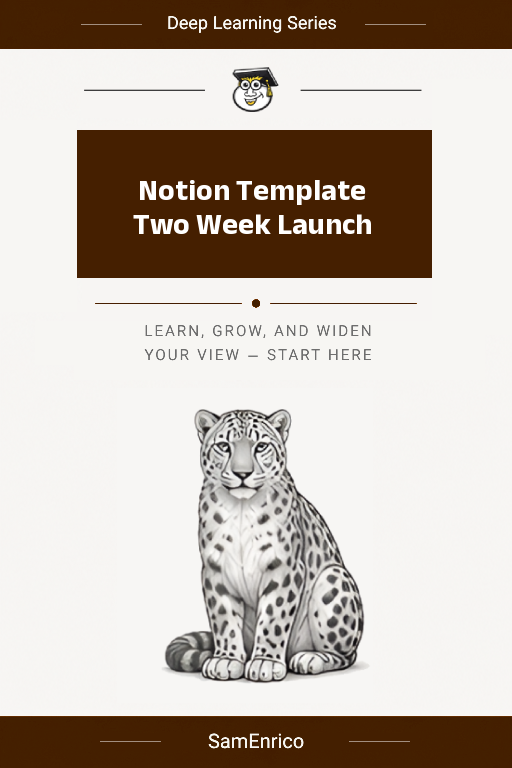
Notion Template Two Week Launch eBook
Design and sell a Notion template as a digital pro
Design and sell a Notion template as a digital product in fourteen days.
Formats
Free sample
Chapter 1: The $10,000 Mistake--–- Three years ago, I made a template so beautiful that it hurt to look at. Pastel gradients floated across every page. Custom icons glowed with soft shadows. The dashboard looked like something from a luxury fashion brand’s internal strategy deck. I had spent eleven weeks building it, working nights and weekends, convinced that beauty would be my competitive advantage.
I launched on a Tuesday, posted across five social platforms, and waited for the money to arrive.Seventy-two hours later, I had sold exactly one copy. To my mother.The buyer who was not my mother requested a refund within twenty-four hours. Her reason, copied directly from the Gumroad refund form, still stings when I think about it: “This is gorgeous but I have no idea how to use it. There are too many pages. I feel lost.”That refund taught me something that no You Tube tutorial, no Twitter thread, and no online course had ever mentioned.
Pretty does not sell. Clarity sells. Speed sells. Solving an actual problem sells. Aesthetics are the garnish, not the meal.I had made the $10,000 mistake.
Not because I lost ten thousand dollars on that template, but because I had spent eleven weeks building something that nobody wanted, when I could have spent fourteen days building something that people would have paid for. The opportunity cost of my perfectionism was ten thousand dollars in lost revenue, based on what my next template earned in its first month.This chapter is about making sure you never make the same mistake. You will learn why most template creators fail before they begin, how the top 1% of sellers think differently, and why fourteen days is not a constraint but a superpower. You will complete a revenue math worksheet that turns vague dreams into specific targets. And you will commit to a framework that has launched over two hundred successful templates.By the time you finish this chapter, you will have a revenue goal, a clear enemy (perfectionism), and a new definition of what makes a template valuable.
You will also have permission to build something ugly.The Graveyard of Pretty Dashboards Let me take you on a tour of a place I call the Graveyard of Pretty Dashboards. It exists on Gumroad, on Etsy, and in the personal Notion workspaces of thousands of burned-out creators. Every template in this graveyard shares three characteristics.First, they are visually stunning. The creators spent dozens of hours on cover images, icon sets, and color palettes. Some hired freelance designers.
Others learned Figma specifically for this project. The aesthetics are not the problem; they are the bait that hides the trap.Second, they are functionally overwhelming. The average template in the graveyard has fourteen databases, thirty-seven views, and a dashboard that requires a twenty-minute video tutorial to navigate. The creator added every feature they could imagine, convinced that more features meant more value. The opposite is true.
More features mean more confusion. More confusion means more refunds.Third, they have almost no sales. The creator launched to a cold audience, posted a few times, and then watched as the silence confirmed their worst fears. Some blame the algorithm. Others blame the market.
The truth is simpler and harder to hear: they built the wrong thing.I have interviewed over fifty creators who have templates in this graveyard. Every single one of them told a version of the same story. They started with a simple idea. They got excited. They added a feature.
Then another. Then another. They lost sight of the original problem they were trying to solve. They fell in love with the process of building and forgot that the goal was selling.The graveyard is large and growing larger every day. But you do not have to join it.The Three Myths That Kill Template Creators Before you can build a successful template, you must unlearn three myths that the internet has taught you.
These myths are dangerous because they contain small grains of truth. The grain of truth makes the myth believable. The myth makes you fail.Myth One: “Build it and they will come.”This myth comes from a movie about a baseball field, not from reality. In the real world, building a product is the easy part. Selling it is the hard part.
The creators who succeed spend at least as much time on marketing and audience building as they do on product development. The ones who fail assume that posting a link on Twitter a few times counts as a launch.The grain of truth here is that a truly exceptional product can generate word-of-mouth momentum. But “exceptional” does not mean beautiful. It means solving a painful problem so effectively that users cannot stop telling their friends. That kind of product is not built in eleven weeks of isolated design.
It is built through rapid iteration based on user feedback.Myth Two: “More features mean more value.”This myth is seductive because it feels logical. If one database is good, ten databases must be ten times as good. If three views are helpful, thirty views must be ten times as helpful. But Notion templates are not spreadsheets. They are cognitive tools.
Every additional database, every additional view, every additional relation increases the mental load on your user. At a certain point, the template stops being helpful and starts being exhausting.The grain of truth is that some users want advanced features. But those users represent a tiny fraction of the market. The vast majority want a template that solves their specific problem and then gets out of the way. They want clarity, not complexity.Myth Three: “You need a large audience to launch successfully.”This myth has discouraged more talented creators than any other.
It convinces people that they should not even try until they have ten thousand followers on social media. It is a lie. Some of the most successful template launches I have studied came from creators with fewer than one thousand followers. They succeeded not because of their audience size, but because they had built a waitlist of highly targeted potential buyers before they built anything.The grain of truth is that a large audience makes launching easier. But a small, engaged audience that is experiencing the exact problem you solve is far more valuable than a large, distracted audience that follows you for other reasons.
You will build your audience in Chapter 2. You do not need to bring one with you.The Top 1% Mindset: Utility Over Aesthetics Let me tell you about two creators. I will call them Mia and James. Both decided to build Notion templates in the same month. Both had similar skill levels.
Both worked hard.Mia spent eight weeks building a life planner template. She designed custom icons for every category. She created a color palette inspired by a Wes Anderson film. She added a habit tracker, a journal, a weekly review section, a goal setting framework, a reading list, a meal planner, and a mood log. Her dashboard had a delicate balance of whitespace and accent colors.
It looked like something you would frame and hang on a wall.James spent five days building a freelance proposal tracker.…
This is the end of the free sample. Get the eBook to keep going. Buy now
About this book
Details
- Author
- Downey Julianna
- Publisher
- SamEnrico
- Language
- English
- Genre
- Non-Fiction, First 30 Days
- Released
- 2026-05-30
- Pages (approx.)
- 123
- Available as
- eBook, Audiobook

Read better in the ZLOADR app
Your eBooks on your phone or tablet. Sign in with your SamEnrico account and start reading.
More by Downey Julianna
 Stop Comparing Start LivingDowney Julianna$11.99
 Postpartum Infant Swim GuideDowney Julianna$11.99
 Intermediate Strength ProgramDowney Julianna$11.99
 Polyvagal Trigger TheoryDowney Julianna$11.99
 Sarcopenia Omega 3 PrescriptionDowney Julianna$11.99
 Defensiveness Reduction GuideDowney Julianna$11.99
 AdTech Investment GuideDowney Julianna$11.99
 Alcohol Recovery and Sports EventsDowney Julianna$11.99
 Carter Georgia GovernorDowney Julianna$11.99
 The Trade That Changed the Game: How One Bold Move Reshaped the NBADowney Julianna$11.99
 The Forgotten Queen: Hecuba’s CurseDowney Julianna$11.99
 The Forgotten Navigators: How a Lost Tuareg Guide Rediscovered the SaharaDowney Julianna$11.99
You may also like
 Hong Kong Handover 1997Dunn Johnnie$11.99
 Zumba For Postnatal Recovery CourseNeal Christian$11.99
 Zumba for BeginnersLadner Nikia$11.99
 YouTube Comment Mining GuideHumes Pandora$12.99
 Worry Box MeditationCarlin Rudy$11.99
 Workplace Stress MeditationNguyen Lynn$11.99
 Workplace Stress and Sleep RepairHawley Ivory$11.99
 Workplace Perfectionism CureDelaney Jeffry$11.99
 Workplace Injustice Anger GuideWallen Isabelle$11.99
 Work Addiction and Burnout LinkGreenwood Ester$11.99
 Women in Yoga and WellnessBeattie Galina$11.99
 Women in Stand Up ComedyChun Evangeline$11.99