
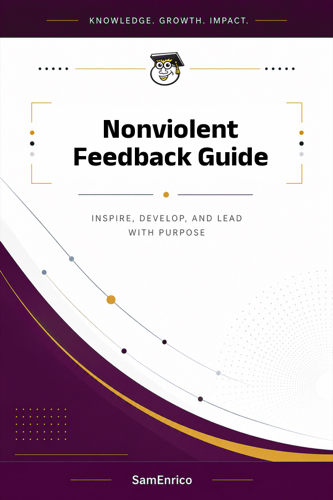
Nonviolent Feedback Guide eBook
Give performance reviews that inspire growth rathe
Give performance reviews that inspire growth rather than defensiveness.
Formats
Free sample
Chapter 1: The Judgment Trap--Most managers walk into a performance review believing they are about to help someone grow. They have good intentions. They have prepared notes. They have reminded themselves to be “constructive.” And then, within the first ninety seconds, they watch the employee’s face close like a door slamming shut. The shoulders rise.
The eyes go flat. The answers shrink to one-word sentences. The manager leaves frustrated. The employee leaves humiliated. And nothing changes.This is not a failure of character.
It is a failure of design.The annual performance review, in its current form, is structurally engineered to produce defensiveness. It is not broken because managers are cruel or employees are fragile. It is broken because the human brain perceives judgment as a threat to survival. And when the brain detects a threat, it does not learn. It does not grow.
It does not collaborate. It fights, flees, or freezes.This chapter is the autopsy of that failure. It will show you exactly why your best intentions are backfiring, how the very act of “evaluating” someone triggers a cascade of neurochemical events that shut down learning, and why the distinction between feedback and criticism is the single most important concept you will ever learn as a manager. By the end of this chapter, you will never look at a performance review the same way again.The Scene You Know Too Well Imagine a Tuesday morning. You are a mid-level manager at a marketing firm.
One of your direct reports, Sarah, has missed three deadlines in the past two months. She is talented, creative, and well-liked by the team. But her inconsistency is causing friction with the account managers who depend on her deliverables.You schedule a thirty-minute performance review. You prepare. You write down specific examples.
You remind yourself to be “fair but firm.” You even rehearse a few opening lines so you do not sound confrontational.The meeting begins. You say: “Sarah, I want to talk about your recent performance. You’ve missed a few deadlines, and we need to get that back on track.”Sarah’s face changes. It is subtle but unmistakable. Her posture shifts from open to closed.
She crosses her arms. She says: “I’ve been working really hard. The deadlines have been unreasonable.”You feel your own frustration rising. You did not expect defensiveness. You were trying to help.
So you push back: “The deadlines are the same for everyone on the team. Others are meeting them.”Sarah says nothing. She stares at the table. The rest of the conversation is a painful exercise in extracting one-word answers. You leave thinking: “She just can’t take feedback.” She leaves thinking: “He doesn’t trust me and he doesn’t understand my workload.”Two weeks later, nothing has changed.This scene plays out millions of times every day in offices around the world.
And almost everyone involved misdiagnoses the problem. The manager thinks the employee is too sensitive. The employee thinks the manager is unfair. Human resources thinks the solution is a new form or a different rating scale. But the real problem is far deeper and far more interesting than any of these explanations.The 70% Problem Let us begin with a staggering statistic that should stop every manager in their tracks.Approximately 70 percent of employees dread performance reviews.
This is not an opinion. It is a consistent finding across decades of research from Gallup, the Society for Human Resource Management, and Harvard Business Review. Seven out of ten people in your organization experience anxiety, dread, or fear at the prospect of being formally evaluated.But here is what makes that statistic truly alarming. The fear is not merely emotional. It is cognitive.
When researchers have measured brain function before, during, and after performance reviews, they have found that the fear of negative evaluation reduces working memory capacity by up to 30 percent. Problem-solving ability drops. Creative thinking collapses. The very capabilities you need from your employees during a review—self-reflection, openness to change, strategic thinking—are the first things to disappear when the brain perceives a threat.Think about what this means. You schedule a meeting specifically designed to improve performance.
Then the structure of that meeting triggers a biological response that makes performance improvement impossible. You are trying to fill a cup that has already been turned upside down.This is not a failure of technique. It is a failure of the fundamental assumption underlying traditional performance reviews: that telling someone what they are doing wrong will cause them to do more of what is right. That assumption is false. And the science of the brain explains exactly why.The Brain Cannot Tell the Difference The most important discovery in social neuroscience over the past twenty years is this: the human brain cannot reliably distinguish between a physical threat and a social threat.When you are chased by a predator, your brain releases cortisol and adrenaline.
Your heart rate increases. Your breathing quickens. Blood flows away from your digestive system and toward your large muscle groups. Your prefrontal cortex—the part of the brain responsible for complex reasoning, impulse control, and long-term planning—downregulates. You do not need to solve algebra problems when a lion is chasing you.
You need to run.Here is the astonishing part. The exact same cascade of neurochemical events occurs when you experience social rejection, criticism, or public evaluation. Being told that your work is “not quite there yet” activates the same neural pathways as being hit in the face. Being interrupted or dismissed in a meeting triggers the same brain regions as physical pain. Being rated as “below expectations” creates the same stress response as narrowly avoiding a car accident.This is not a metaphor.
It is measurable biology. Researchers at UCLA, Columbia, and the University of Michigan have used functional MRI scans to watch the brain’s pain matrix light up in response to social threats. The anterior cingulate cortex, which processes physical pain, activates powerfully when people are excluded, criticized, or judged—even by strangers in a laboratory experiment.Why would evolution create such an apparently overactive system? Because for almost all of human history, social exclusion meant death. If your tribe rejected you, you could not survive alone on the savanna.
Your brain was designed to treat social threats as life-or-death emergencies because, for millions of years, they were.Your employees’ brains are running software that is one hundred thousand years old. When you sit them down and say “Let’s review your performance,” their ancient neural hardware does not hear an opportunity for growth. It hears: “You might be about to be expelled from the tribe.”Defensiveness is not a character flaw. It is a survival instinct.The Judgment Cycle Now that you understand the biology, let us examine the behavioral pattern that most managers unknowingly trigger. This pattern is so consistent and so predictable that it deserves a name: the Judgment Cycle.The Judgment Cycle has five stages.Stage One: Observation.
The manager notices a behavior or outcome. A deadline is missed. A customer complains. A presentation goes poorly. The manager files this observation away, often without saying anything at…
This is the end of the free sample. Get the eBook to keep going. Buy now
About this book
Details
- Author
- Ibarra Laurena
- Publisher
- SamEnrico
- Language
- English
- Genre
- Non-Fiction, Self-Help, Feedback
- Released
- 2026-06-09
- Pages (approx.)
- 134
- Available as
- eBook, Audiobook

Read better in the ZLOADR app
Your eBooks on your phone or tablet. Sign in with your SamEnrico account and start reading.
More by Ibarra Laurena
 The PLEASE DBT Emotion SkillIbarra Laurena$11.99
 Liberator of DachauIbarra Laurena$11.99
 Gacy Medical Examiner ReportIbarra Laurena$11.99
 Silk and Gold: The Fashion Revolution of the Viceroyalty of PeruIbarra Laurena$11.99
 General CounselIbarra Laurena$11.99
 A Beginners Guide to Gymkhana (Volume 1)Ibarra Laurena$11.99
 AI for Automated Code Fix SuggestionsIbarra Laurena$12.99
 Learn to Play the WashintIbarra Laurena$11.99
You may also like
 The Assertive Feedback GuideStuckey Maren$11.99
 Feedback Sandwich MethodKeefer Concepcion$11.99
 Performance Reviews Without AngerHollis Garnet$11.99
 Imposter Feedback GuideThames Delmar$11.99
 Workplace Feedback ReceptionGarris Deonna$11.99
 Group Creative Feedback CourseGuevara Veronique$11.99
 Giving Feedback CreativelyBriscoe Devon$11.99
 Constructive Feedback ReceptionDewey Stephine$11.99
 The Feedback Sandwich MythWillingham Boris$11.99
 Receiving Creative FeedbackLemmon Refugio$11.99
 Giving Negative Feedback EffectivelyFlood Shandra$11.99
 Self Esteem During Performance ReviewsSchulte Alline$11.99