
Non-FictionSelf-HelpMisophonia
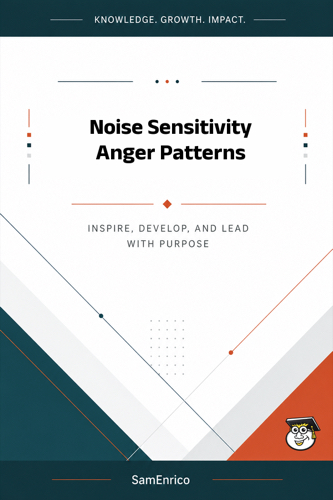
Noise Sensitivity Anger Patterns eBook
Teaches identification of specific sounds like che
Teaches identification of specific sounds like chewing or tapping that trigger misophonia anger.
Formats
Free sample
Chapter 1: The 20% Problem--–- It starts with a sound. Not a loud one. Not a frightening one. Not the screech of tires or the wail of a siren or the crash of breaking glass. It starts with something small.
Something human. Something that ninety-nine percent of the people in the room will not notice at all.A coworker three cubicles over is eating an apple. The first bite is crisp, almost satisfying in its cleanliness. But then comes the chewing. The wet, rhythmic, open-mouthed orchestration of molars grinding flesh and skin into pulp.
Your jaw tightens. Your shoulders rise toward your ears. Your heart, which had been calmly keeping time like a reliable metronome, suddenly shifts into a faster, more aggressive rhythm. Your palms begin to sweat. Your field of vision narrows.
And somewhere deep in the back of your brain, a voice that does not sound like you whispers a single, terrifying word: Run.Or perhaps it is not an apple. Perhaps it is a pen. The person beside you in the waiting room is clicking it. Click. Pause.
Click. Pause. Click-click. The rhythm is irregular, which makes it worse. Each click lands like a small electrical shock directly into your nervous system.
You have now been sitting here for forty-five seconds, and you have already counted every single click. You have also imagined, in vivid and unsettling detail, what it would feel like to snatch that pen from their hand and throw it across the room. The fantasy brings a flash of relief. Then shame rushes in to fill the space relief left behind.Or perhaps it is breathing. You are at the dinner table with your family.
Your father, whom you love, is eating soup. He is not doing anything wrong. He is not chewing with his mouth open or making any of the sounds that appear in etiquette guides. He is simply breathing through his nose while he eats, and that breath has a slight whistle to it, a tiny rasp at the end of each exhale. You have heard this sound ten thousand times in your life.
But tonight, for reasons you cannot explain, it is unbearable. Your fork is shaking in your hand. Your mother is saying something about her book club, but you cannot hear her over the sound of your father's breathing. You want to scream. You want to flee.
You want to never sit at this table again. And then you hate yourself for wanting any of those things, because he is your father, he has done nothing wrong, and you are a monster.If any of these scenes feel familiar, this book is for you. If you have ever felt your body flood with rage over a sound that no one else in the room seems to notice, this book is for you. If you have ever apologized—profusely, desperately, repeatedly—for snapping at someone you love over a noise they did not even know they were making, this book is for you. And if you have ever wondered, late at night when the guilt is heaviest, whether you are simply a bad person with a short fuse and a mean streak, this book was written specifically to answer that question with a definitive, evidence-based, neurologically grounded no.You are not a bad person.
You have a bad reflex. And that reflex can be changed.The Question That Changes Everything Before we go any further, let us name the elephant in the room. Actually, let us name the elephant, the anxiety, the shame spiral, and the small, persistent voice in your head that has been telling you for years that you are overreacting, that you should just get over it, that everyone else manages to tolerate these sounds so why can't you?That voice is wrong. But it is also very loud, and it has had years to rehearse its arguments. So let us counter it with a single, powerful question: What if your reaction to these sounds is not a character flaw but a neurological condition?This is not a rhetorical question.
This is not a metaphor. This is not a way of saying "everyone is different" or "you just have sensitive hearing." This is a literal, physiological, brain-based reality that has been documented in peer-reviewed research, replicated across multiple laboratories, and validated by clinical practice around the world. Misophonia—the term comes from the Greek words for "hatred of sound"—is a disorder in which specific, often repetitive sounds trigger an intense autonomic nervous system response. That response includes increased heart rate, elevated blood pressure, muscle tension, sweating, and the release of stress hormones like cortisol and adrenaline. In other words, your body reacts to a chewing sound the way most bodies react to a charging predator.This is not an opinion.
This is not a theory. This is the conclusion of neuroscientists who have watched misophonic brains light up on functional magnetic resonance imaging (f MRI) scans. When a person with misophonia hears a trigger sound, the anterior insula—a region deep in the brain that integrates emotional awareness with bodily sensations—becomes hyperactive. It communicates too quickly and too intensely with the amygdala, the brain's threat detection center. Together, they bypass the prefrontal cortex, which is responsible for rational thought, impulse control, and social reasoning.
By the time your logical brain realizes what is happening, the rage is already there. It did not pass through the front door of reason. It broke in through the basement window of your nervous system.That is why you cannot simply "calm down" when someone tells you to. That is why deep breathing feels impossible in the moment. That is why you have said things you regret, things that sound insane when you try to explain them later, things like "the way you are eating that bagel is making me want to leave my own marriage." You said those things not because you are cruel, but because your brain had already been hijacked by a reflex that was designed to keep you alive in the presence of a threat.
The only problem is that the threat was a bagel.The Prevalence Problem: You Are Not Alone Here is a number that may surprise you: depending on how broadly you define clinically significant symptoms, between five and twenty percent of the population may meet the criteria for misophonia.Let us pause here and let that number land. Twenty percent is one in five people. In a typical classroom of thirty students, that is six children. In an office of fifty people, that is ten coworkers. In a family gathering of fifteen relatives, that is three people sitting around the same table, all secretly white-knuckling their way through dinner, each convinced they are the only one struggling.Twenty percent is approximately the same prevalence as anxiety disorders.
It is higher than the prevalence of obsessive-compulsive disorder. It is roughly equivalent to the percentage of people who will experience a major depressive episode in their lifetime. Misophonia is not rare. It is not unusual. It is not a fringe condition that only affects a tiny, hypersensitive minority.
It is a common, recognizable, and increasingly well-understood neurological phenomenon that has been systematically ignored by the medical establishment for…
This is the end of the free sample. Get the eBook to keep going. Buy now
About this book
Details
- Author
- Spinks Tierra
- Publisher
- SamEnrico
- Language
- English
- Genre
- Non-Fiction, Self-Help, Misophonia
- Released
- 2026-06-06
- Pages (approx.)
- 151
- Available as
- eBook, Audiobook

Read better in the ZLOADR app
Your eBooks on your phone or tablet. Sign in with your SamEnrico account and start reading.
More by Spinks Tierra
 Burnout Sleep Repair GuideSpinks Tierra$11.99
 Landing Page Optimization GuideSpinks Tierra$11.99
 Collaborative Scenario Planning GuideSpinks Tierra$11.99
 Jack Nicklaus Major Wins MemoirSpinks Tierra$11.99
 The Last Mile: The Untold Story of the First Woman to Run Across AmericaSpinks Tierra$11.99
 The Frozen Frontier: Antarctica's First Explorers and the Birth of Polar ScienceSpinks Tierra$11.99
 WarrantsSpinks Tierra$11.99
 Plane Jira Alternative GuideSpinks Tierra$12.99
 Licensing to Acquisition BuyersSpinks Tierra$12.99
 Understanding Chromosome 9, Partial Monosomy 9pSpinks Tierra$17.99
 How to Start a Hobby in Reading To The ElderlySpinks Tierra$11.99
You may also like
 Hong Kong Handover 1997Dunn Johnnie$11.99
 Zumba For Postnatal Recovery CourseNeal Christian$11.99
 Zumba for BeginnersLadner Nikia$11.99
 YouTube Comment Mining GuideHumes Pandora$12.99
 Worry Box MeditationCarlin Rudy$11.99
 Workplace Stress MeditationNguyen Lynn$11.99
 Workplace Stress and Sleep RepairHawley Ivory$11.99
 Workplace Perfectionism CureDelaney Jeffry$11.99
 Workplace Injustice Anger GuideWallen Isabelle$11.99
 Work Addiction and Burnout LinkGreenwood Ester$11.99
 Women in Yoga and WellnessBeattie Galina$11.99
 Women in Stand Up ComedyChun Evangeline$11.99