
Non-FictionBiographyPhysics History
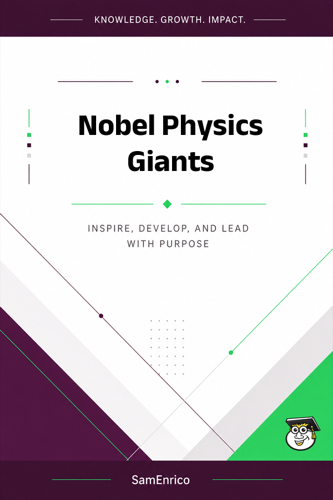
Nobel Physics Giants
Einstein, Curie, Bohr, Feynman and their immortal
Einstein, Curie, Bohr, Feynman and their immortal contributions to physics.
Formats
About this book
Free sample
Chapter 1: The Arrogance of 1900...--–- On the evening of April 27, 1900, the greatest living physicist stood before a crowded lecture hall in London and declared that the work of science was nearly finished. Lord Kelvin, a man whose name would soon adorn the absolute temperature scale, adjusted his spectacles and addressed the Royal Institution with the quiet confidence of someone who had never been spectacularly wrong. "There is nothing new to be discovered in physics now," he announced. "All that remains is more and more precise measurement."The audience nodded in solemn agreement. They had every reason to believe him.For more than two centuries, the machine of classical physics had run with breathtaking precision.
Isaac Newton's laws of motion and universal gravitation, published in his Principia Mathematica of 1687, had proven themselves capable of predicting the movement of planets, the trajectory of cannonballs, the rhythm of ocean tides, and the gentle arc of a thrown apple. When astronomers in the nineteenth century observed that the planet Uranus was not following its predicted orbit, they did not question Newton. Instead, they pointed their telescopes at the region of space where an unknown planet must be hiding—and discovered Neptune, exactly where the equations said it would be. This was not luck. This was proof.
Newton had unlocked the clockwork of the heavens.Alongside Newtonian mechanics stood a second pillar of classical physics, equally magnificent and even more recent. In the 1860s, the Scottish physicist James Clerk Maxwell had done something that still seems like magic: he had unified electricity, magnetism, and light into a single theoretical framework. Maxwell's equations, four compact lines of mathematical poetry, described how electric charges create electric fields, how moving electric charges create magnetic fields, and how changing magnetic fields create electric fields—a perpetual dance that produces self-sustaining electromagnetic waves. When Maxwell calculated the speed of these waves, he got a number that matched the known speed of light to within experimental error. Light, he realized, was an electromagnetic wave.
The connection was so beautiful, so complete, that it convinced most physicists they had glimpsed the final architecture of reality.By…
This is the end of the free sample. Get the eBook to keep going. Buy now
Contents
- Chapter 1
- Chapter 2
- Chapter 3
- Chapter 4
- Chapter 5
- Chapter 6
- Chapter 7
- Chapter 8
- Chapter 9
- Chapter 10
- Chapter 11
- Chapter 12
Details
- Author
- Barrera Shonda
- Publisher
- SamEnrico
- Language
- English
- Genre
- Non-Fiction, Biography, Physics History
- Released
- 2026-06-09
- Pages (approx.)
- 128
- Available as
- eBook, Audiobook

Read better in the ZLOADR app
Your eBooks on your phone or tablet. Sign in with your SamEnrico account and start reading.
More by Barrera Shonda
 Phil Donahue Audience Mic StoryBarrera Shonda$11.99
 Chasing Losses in GamblingBarrera Shonda$11.99
 Boss Criticism Anger Management CourseBarrera Shonda$11.99
 The Daily Time Blocking WorkbookBarrera Shonda$11.99
 The Last Gold Rush: How a 1933 Executive Order Crushed a NationBarrera Shonda$11.99
 Understanding PyaemiaBarrera Shonda$17.99
 Palantir GuideBarrera Shonda$12.99
 Paystack African Exporters GuideBarrera Shonda$12.99
 Forensic PsychologistBarrera Shonda$11.99
 How to Start a Chestnut Growing Business (Beginners Guide)Barrera Shonda$11.99
You may also like
 Hong Kong Handover 1997Dunn Johnnie$11.99
 Zumba For Postnatal Recovery CourseNeal Christian$11.99
 Zumba for BeginnersLadner Nikia$11.99
 YouTube Comment Mining GuideHumes Pandora$12.99
 Worry Box MeditationCarlin Rudy$11.99
 Workplace Stress MeditationNguyen Lynn$11.99
 Workplace Stress and Sleep RepairHawley Ivory$11.99
 Workplace Perfectionism CureDelaney Jeffry$11.99
 Workplace Injustice Anger GuideWallen Isabelle$11.99
 Work Addiction and Burnout LinkGreenwood Ester$11.99
 Women in Yoga and WellnessBeattie Galina$11.99
 Women in Stand Up ComedyChun Evangeline$11.99