
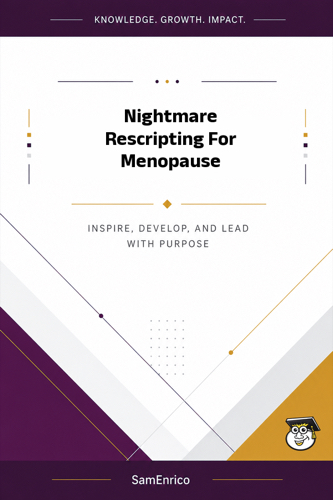
Nightmare Rescripting For Menopause eBook
Address hormonal dream changes during perimenopaus
by Levy Madison
Address hormonal dream changes during perimenopause.
Formats
Free sample
Chapter 1: The Witching Hour--–- The bedroom is dark. The clock reads 3:17 AM. Your heart is slamming against your ribcage like a trapped bird. The sheets are soaked through—not with sweat alone, but with the cold, unmistakable residue of terror. You were running.
Something was chasing you. You can still feel the heat of its breath on your neck, even though you are now awake, alone, and perfectly safe.You lie there, frozen, trying to separate what was real from what was not. Your husband sleeps soundly beside you. The dog hasn't stirred. Nothing is on fire.
No one is breaking in. And yet your body is convinced—absolutely, biologically convinced—that you just escaped death.This is not a panic attack. This is not anxiety. This is not a sign that you are losing your grip on reality. This is the perimenopause nightmare loop, and it is one of the most underreported, misunderstood, and unnecessarily suffered symptoms of hormonal transition.If you are reading this book, you already know the statistics better than any researcher.
You know that this happens several times a week. You know that the dreams are so vivid they leave a residue of fear that follows you into your morning coffee and sometimes lasts all day. You know that you have started to dread going to sleep—not because you are tired, but because you are afraid of what your brain will put you through.What you may not know is that this is not random. It is not a punishment. And it is absolutely fixable.The Most Common Complaint Nobody Is Talking About In the last decade, perimenopause has finally started to receive the attention it deserves.
Bestselling books like The Menopause Brain by Dr. Lisa Mosconi and The New Menopause by Dr. Mary Claire Haver have done extraordinary work illuminating the hormonal, neurological, and metabolic changes that occur during the transition to menopause. Hot flashes, brain fog, joint pain, mood swings, sleep disruption—these symptoms are now part of the mainstream conversation.But there is a symptom that almost every perimenopausal woman experiences and almost no one talks about. Not at dinner parties.
Not in doctors' offices. Not even in the private Facebook groups where women share everything from vaginal moisturizer recommendations to marriage counseling referrals.The symptom is the nightmare.Not the occasional bad dream—the kind where you show up to a meeting naked or realize you forgot to study for a final exam. Those are universal and generally harmless. The perimenopause nightmare is different. It is more vivid.
More physical. More memorable. And more terrifying.A 2018 study published in the journal Menopause found that women in the perimenopausal transition reported significantly higher rates of nightmare distress than premenopausal or postmenopausal women. The difference was not subtle. Perimenopausal women were nearly twice as likely to report that their nightmares interfered with daytime functioning.
Yet when researchers asked these same women whether they had discussed their nightmares with a healthcare provider, fewer than ten percent said yes.Why the silence? Partly because women have been trained to dismiss their own symptoms. Partly because doctors rarely ask about dream content during a routine physical. And partly because there is a lingering, unspoken shame attached to nightmares—as if having them means you are weak, traumatized, or secretly unstable.None of those things are true.What is true is that your brain is going through a profound biological reorganization, and the dreams are a direct, predictable consequence of that process. Understanding why this happens is the first step toward stopping it.The Hyperarousal Loop: A Biological Explanation To understand why perimenopause turns your sleep into a horror movie, you have to understand three things: your hypothalamus, your cortisol rhythm, and your amygdala.
Let us take them one at a time.The hypothalamus is a small, almond-sized structure deep in the center of your brain. Its job is to maintain homeostasis—to keep your body temperature, hunger, thirst, and sleep-wake cycles running smoothly. Think of it as the thermostat for your entire body. When it works correctly, you never notice it. When it malfunctions, you notice immediately.Estrogen is one of the hypothalamus's primary regulators.
Estrogen helps the hypothalamus maintain a stable temperature set point. When estrogen levels are stable, the hypothalamus keeps your core temperature within a narrow, comfortable range. When estrogen begins to fluctuate—as it does dramatically during perimenopause—the hypothalamus loses its anchor. It starts sending mixed signals. It thinks you are hot when you are not.
It thinks you are cold when you are not. It overcorrects. It undercorrects.The result is the hot flash. Or, more accurately, the hot flash and the cold flash and the weird sensation of being both simultaneously.Here is where the nightmare connection becomes clear. A hot flash is not just a feeling of warmth.
It is a full-body physiological event. When the hypothalamus detects a false rise in temperature, it triggers a cascade of responses designed to cool you down: blood vessels dilate, heart rate increases, sweat glands activate. And crucially, the hypothalamus signals the adrenal glands to release cortisol and adrenaline.Cortisol and adrenaline are stress hormones. They are the body's ancient, evolutionarily conserved response to threat. When a predator chased your ancestors across the savanna, cortisol and adrenaline surged, preparing muscles for fight or flight.
The heart raced. The senses sharpened. The body mobilized.But here is the problem. In perimenopause, the cortisol surge happens not because there is a predator, but because the hypothalamus misfired about your temperature. The surge happens while you are sleeping.
And it happens at the worst possible time of night.Cortisol follows a daily rhythm. It peaks in the early morning, around 8:00 AM, to help you wake up. It troughs in the middle of the night, around 2:00 AM to 3:00 AM, to allow deep, restorative sleep. This trough is biologically essential. When cortisol is low, the brain can enter the most restorative stages of sleep without interference.In perimenopause, the hot flash-induced cortisol surge obliterates that trough.
At 3:00 AM, when your brain is supposed to be resting, your body suddenly floods with stress hormones. Your heart pounds. Your temperature spikes. You wake up—not fully, not consciously, but enough for your brain to notice that something is wrong.Now enter the amygdala.The amygdala is the brain's fear processing center. It is constantly scanning the environment for threats.
When it detects a potential threat—real or imagined—it activates the sympathetic nervous system, the same fight-or-flight system that cortisol and adrenaline are already priming. The amygdala does not know that the threat is a misreading of your internal temperature. It only knows that your heart is racing and your body is hot, and in the evolutionary history of the human brain, those signals almost always meant danger.So the amygdala does what it evolved to do. It creates a narrative.This is the most important sentence in this chapter, so read it twice: Your brain does not like unexplained physiological arousal. When it experiences fear-like sensations without a clear source, it will invent a source.If you wake up suddenly with your heart pounding and you are lying in bed…
This is the end of the free sample. Get the eBook to keep going. Buy now
About this book
Details
- Author
- Levy Madison
- Publisher
- SamEnrico
- Language
- English
- Genre
- Non-Fiction, Self-Help, Menopause
- Released
- 2026-06-09
- Pages (approx.)
- 136
- Available as
- eBook, Audiobook

Read better in the ZLOADR app
Your eBooks on your phone or tablet. Sign in with your SamEnrico account and start reading.
More by Levy Madison
 ADHD Childhood Shame RecoveryLevy Madison$11.99
 Weather Related DisappearancesLevy Madison$11.99
 Home Organization MemoryLevy Madison$11.99
 Exit Strategies for ConversationsLevy Madison$11.99
 Multiple Choice Test TacticsLevy Madison$11.99
 Alcohol and Anger LinkLevy Madison$11.99
 Politician Gambling AddictionLevy Madison$11.99
 The Iron Masters: How Western Engineers Built the Modern WorldLevy Madison$11.99
 The Ballarat Gold Rush Scam: Australia's First Financial Fraud (1850s)Levy Madison$11.99
 Mastering The Art of Amateur WrestlingLevy Madison$11.99
 Freemium India Market GuideLevy Madison$12.99
 Merchant Cash Advance Rate ComparisonLevy Madison$12.99
You may also like
 Hong Kong Handover 1997Dunn Johnnie$11.99
 Zumba For Postnatal Recovery CourseNeal Christian$11.99
 Zumba for BeginnersLadner Nikia$11.99
 YouTube Comment Mining GuideHumes Pandora$12.99
 Worry Box MeditationCarlin Rudy$11.99
 Workplace Stress MeditationNguyen Lynn$11.99
 Workplace Stress and Sleep RepairHawley Ivory$11.99
 Workplace Perfectionism CureDelaney Jeffry$11.99
 Workplace Injustice Anger GuideWallen Isabelle$11.99
 Work Addiction and Burnout LinkGreenwood Ester$11.99
 Women in Yoga and WellnessBeattie Galina$11.99
 Women in Stand Up ComedyChun Evangeline$11.99