
Non-FictionSelf-HelpChild Psychology
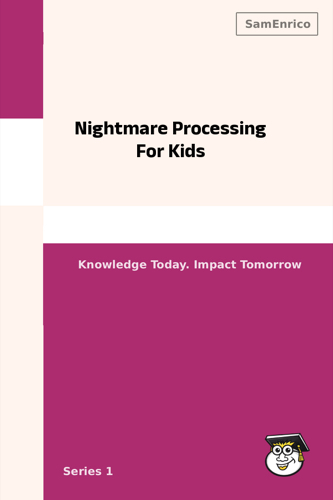
Nightmare Processing For Kids eBook
Uses drawing, storytelling, and play to help child
Uses drawing, storytelling, and play to help children rescript bad dreams.
Formats
Free sample
Chapter 1: The 2 AM Footsteps...–- The sound comes at the worst possible moment. You have just drifted off after checking the locks, brushing your teeth, and scrolling your phone for longer than you meant to. You are balanced on that fragile edge between wakefulness and sleep, the place where dreams begin. And then you hear it: small feet padding down the hallway. The floorboards creak in the exact spot they always creak.
The door opens with a soft click. A small voice, still thick with sleep and lingering fear, whispers the four words that have launched a thousand parenting books:"Mommy, I had a bad dream."You have been here before. Probably many times before. You know the script. You will offer a hug.
You will say "It was just a dream, honey, it wasn't real." You will walk them back to bed. You will tuck them in. You will sit on the edge of the mattress, promising to stay for "just five more minutes." And then, when you finally creep back to your own room and lower your exhausted body onto your pillow, you will hear it again: the creak of the floorboards, the soft click of the door, the whispered confession.This is the 2 AM loop. It is exhausting. It is frustrating.
It is making you a less patient parent and a less functional human. And I am here to tell you that it is not your fault, but it is also not inevitable.Why This Book Exists I wrote this book because I was you. I was the parent lying on the floor of a toddler's bedroom at 3:15 AM, my back already complaining, my alarm set for 6:00 AM, wondering how I had gotten here. I had read the books. I had tried the gentle reassurance.
I had repeated "it wasn't real" so many times that the phrase lost all meaning. Nothing worked. My child was still terrified. I was still exhausted. And the monsters kept coming.Then I discovered something that changed everything.
The parenting books I had read were full of comfort, empathy, and reassurance. They taught me how to make my child feel better in the moment. What they didn't teach me was how to make my child feel safer when I wasn't there. They taught me how to be a good comforter. They didn't teach me how to be a good teacher.I needed a toolkit, not just a script.
I needed to teach my child how to fight her own monsters, not just to call me to do it. I needed to move from being the solution to being the coach.This book is that toolkit.What This Book Is (And What It Is Not)Let me be clear about what you are holding.This is not a book about "gentle parenting" in the vague, aspirational sense. You will not find exercises in "validating the emotion" without action. Those approaches have their place, but they do not stop nightmares. Nightmares are not stopped by better feelings.
They are stopped by better tools.This is not a book about dream interpretation. I don't care what the monster "symbolizes." I don't need to know if the dragon represents unresolved feelings about preschool or if the shadow is a manifestation of separation anxiety. That knowledge might be interesting to a therapist, but it will not help you at 2 AM. I care about one thing: getting your child back to sleep and keeping you off the floor.This is a book about hard tools for hard problems. Drawing the monster into a box.
Rewriting the nightmare ending. Physical play that asserts dominance over the dark. Environmental design that creates a "Bedtime Fortress." A Graduation ceremony that turns a scared child into the author of their own dreams.This is a book for tired parents who don't have time for theory. You don't need to understand the neuroscience of nightmares (though I will give you the useful parts). You need to know what to say, what to do, and when to do it.
You need scripts. You need activities. You need a plan that works tonight, not after six months of therapy.The Two AM Loop: Why Everything You're Trying Isn't Working Before we can fix the problem, we need to understand why your current approach is failing. You are not a bad parent. You are not doing anything wrong.
You are using the tools you were given. The problem is that the tools are incomplete.Most parenting advice for nightmares follows the same pattern: comfort, reassure, return to bed, repeat. This approach works for the first nightmare of the week. Maybe even the second. But by the third, fourth, or fifth, you notice something troubling.
The nightmares aren't getting less frequent. Your child isn't getting more resilient. You are running a marathon with no finish line.Here is why. Comfort is essential. Hugs tell your child they are safe with you.
Your presence tells them that the world is not falling apart. But comfort alone teaches your child that only you can stop the fear. Every time you rush in, every time you sit on the edge of the bed, every time you promise "just five more minutes," you are reinforcing a dangerous lesson: I am not safe unless my parent is here.The 2 AM loop continues because your child has not learned how to be safe with themselves. They have learned how to call you. And you, because you love them, keep answering.This is not a failure of love.
It is a failure of strategy.The Bridge, Not the Destination Let me introduce you to the core philosophy of this book. It is simple enough to fit on an index card, and I want you to memorize it:Comfort is the bridge, not the destination. Hugs tell your child they are safe with you. Strategy tells them they are safe with themselves. You need both.Think of it this way.
When your child falls off their bike, you don't just hug them and send them back out. You comfort them first. You hold them. You tell them it's going to be okay. That's the bridge.
Then you teach them how to get back on the bike. You show them how to balance. You run alongside them, holding the seat. That's the strategy. You don't just comfort and stop.
You comfort and then equip.The same is true for nightmares. Comfort is the bridge. It gets your child from terror to calm. But if you stop there, you have not solved the problem. You have only postponed it.
The next nightmare is already waiting. Strategy is what gets your child from calm to capable. It teaches them that they have tools. It teaches them that they are not helpless. It teaches them that they are the author of their own dreams.Most parenting books stop at the bridge.
They give you beautiful scripts for comfort. They tell you to validate the emotion. They tell you to be present. And then they send you back to the 2 AM loop, wondering why nothing has changed.This book gives you both. The bridge and the destination.
The comfort and the strategy. The hug and the toolkit.The Critical Distinction: Nightmares vs. Night Terrors Before we go any…
This is the end of the free sample. Get the eBook to keep going. Buy now
About this book
Details
- Author
- Muniz Katerine
- Publisher
- SamEnrico
- Language
- English
- Genre
- Non-Fiction, Self-Help, Child Psychology
- Released
- 2026-06-07
- Pages (approx.)
- 126
- Available as
- eBook, Audiobook

Read better in the ZLOADR app
Your eBooks on your phone or tablet. Sign in with your SamEnrico account and start reading.
More by Muniz Katerine
 Grief Related Anger ShiftsMuniz Katerine$11.99
 Client Retention for Upwork FreelancersMuniz Katerine$11.99
 Ethiopian Highlands TrekMuniz Katerine$11.99
 NamUs Facial Comparison SoftwareMuniz Katerine$11.99
 Keynote Speech MasteryMuniz Katerine$11.99
 Thai Massage Therapist EntrepreneurMuniz Katerine$11.99
 Intuitive MovementMuniz Katerine$11.99
 The Spirit Lines: Canada's Phantom Call Fraud Ring of the 1920sMuniz Katerine$11.99
 Growing CanarinaMuniz Katerine$11.99
 How to Produce Aluminum WireMuniz Katerine$11.99
 How to Become a Laundry Worker IiMuniz Katerine$11.99
 A Collector's Handbook to the Singer Gazelle IiicMuniz Katerine$11.99
You may also like
 Hong Kong Handover 1997Dunn Johnnie$11.99
 Zumba For Postnatal Recovery CourseNeal Christian$11.99
 Zumba for BeginnersLadner Nikia$11.99
 YouTube Comment Mining GuideHumes Pandora$12.99
 Worry Box MeditationCarlin Rudy$11.99
 Workplace Stress MeditationNguyen Lynn$11.99
 Workplace Stress and Sleep RepairHawley Ivory$11.99
 Workplace Perfectionism CureDelaney Jeffry$11.99
 Workplace Injustice Anger GuideWallen Isabelle$11.99
 Work Addiction and Burnout LinkGreenwood Ester$11.99
 Women in Yoga and WellnessBeattie Galina$11.99
 Women in Stand Up ComedyChun Evangeline$11.99