
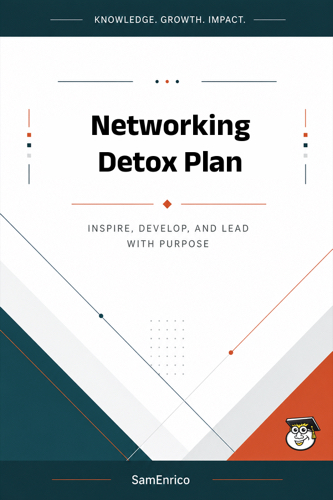
Non-FictionSelf-HelpStrategic Pause
Networking Detox Plan eBook
Take a strategic break from networking to refocus
Take a strategic break from networking to refocus relationship goals.
Formats
Free sample
Chapter 1: The Burnout Epidemic--–- Sarah had just finished her seventeenth coffee meeting of the month. It was only the fifteenth. She sat in her car outside a downtown Starbucks, the third one that week, staring at the dashboard with the hollow recognition that she had just spent forty-five minutes with someone whose name she had already forgotten. Her phone buzzed. A Linked In notification.
Someone new wanted to connect. She accepted automatically, the way you brush a hair off your shirt without thinking. Then she scrolled. Three hundred and twelve connections. Ninety-two coffee meetings in the past twelve months.
Zero job offers. Zero closed deals. Zero referrals that had turned into anything real. But she was exhausted. Genuinely, bone-tired exhausted.
And she could not figure out why doing everything the experts told her to do had produced absolutely nothing except a bloated contact list and a vague sense of dread every time her calendar pinged with another "Let's grab coffee" request.This is the quiet crisis of modern professional life. We have been sold a story. The story says that success belongs to the well-connected, that relationships are currency, that your network is your net worth. And like all stories that contain a kernel of truth, this one has been stretched, amplified, and weaponized into an exhausting performance that leaves millions of professionals burned out, anxious, and secretly ashamed that they are not better at something that feels like it should be natural. The story has a name.
Let us call it the Brute Force Myth.The Brute Force Myth is the belief that if you just attend one more event, send one more connection request, schedule one more coffee meeting, or follow up with one more polite email, your career will finally crack open. It is the logic of the slot machine dressed up as strategy. One more pull. One more handshake. One more business card collected like a trophy from a hunt that no one wins.
The myth has three toxic consequences that this book will help you escape. First, it produces chronic anxiety because you can never do enough. There is always another person to meet. Second, it creates purely transactional relationships where everyone is vaguely aware that they are being used for something. Third, and most destructively, it leads to burnout so complete that many professionals quietly abandon networking altogether, retreat into isolation, and blame themselves for failing at something that was never designed to work in the first place.The evidence for this crisis is everywhere if you know where to look.
A major survey of professionals across six industries found that nearly sixty percent reported feeling "emotionally exhausted" after networking events, with twenty-two percent describing the exhaustion as "severe" or "debilitating." Another study tracked the networking habits of several hundred job seekers over two years. The ones who attended the most events, sent the most Linked In messages, and scheduled the most coffee meetings had, on average, worse outcomes than those who attended a moderate number of highly selective gatherings. More was not just not better. More was worse. The researchers called it the "networking paradox" and could not fully explain it.
This book explains it. The paradox exists because brute force networking is not networking at all. It is a performance anxiety disorder disguised as professional development.The Origins of the Myth Where did the Brute Force Myth come from? The answer matters because you cannot escape a trap until you understand how you walked into it. The myth has three parents, none of whom have your best interests at heart.The first parent is the self-help industrial complex.
For decades, books, seminars, and gurus have sold the same promise in different packaging: follow these seven steps, attend these three events, use these five scripts, and your network will deliver you to the promised land of opportunity. The problem is that these systems are designed to be sold, not to work. A system that actually solved networking would put the gurus out of business. So the systems are intentionally incomplete, intentionally exhausting, and intentionally designed to make you feel like you are the problem when they fail. You did not attend enough events.
You did not follow up properly. You did not use the right script. The solution is always to buy the next product. The Brute Force Myth is the engine of this economy.The second parent is social media, particularly Linked In. Linked In has a business model.
That model requires you to believe that more connections are better, that engagement drives opportunity, and that your professional worth can be measured in endorsements and follower counts. None of this is true. Linked In is a platform designed to keep you scrolling, clicking, and connecting because your attention is the product being sold to recruiters and advertisers. The platform has no incentive to tell you that two hundred carefully maintained relationships produce more value than two thousand random ones. The platform wants you to collect.
Collecting is profitable for them and exhausting for you.The third parent is something more personal and harder to name. Let us call it fear. The fear that if you stop networking, even for a week, you will miss the one opportunity that would have changed everything. The fear that everyone else is out there hustling while you are resting. The fear that your career is a balloon slowly losing air and only constant effort can keep it inflated.
This fear is real and it is powerful. But it is also a liar. The data shows clearly that the relationship between networking activity and career outcomes is not linear. It is curvilinear. There is a sweet spot of moderate, intentional activity.
Below that sweet spot, you miss opportunities. Above that sweet spot, you burn out, your relationships become transactional, and your reputation suffers because people can feel that you are using them. The Brute Force Myth keeps you on the wrong side of the curve, grinding away in the zone of diminishing returns, convinced that any slowdown will mean failure.The Symptoms You Are Probably Ignoring Before you can detox, you have to diagnose. The following checklist is not a personality test. It is not a judgment.
It is a mirror. Read each item honestly and ask yourself whether it describes your experience over the past six months.Symptom One: Emotional exhaustion after networking events that lasts for hours or even days. This is not normal tiredness. This is the feeling of having performed for so long that you cannot remember who you really are. You leave events not energized by new connections but drained by the effort of smiling, nodding, and pretending to be interested in conversations that feel like transactions.
You may find yourself sitting in your car after an event, just breathing, unable to turn the key.Symptom Two: The card collector phenomenon. You have hundreds or thousands of Linked In connections, a bulging CRM, or a stack of business cards in a drawer. But when you scroll through these contacts, you feel nothing. No warmth. No memory.
No sense of relationship. You could not describe most of these people beyond their job titles. They are not relationships.…
This is the end of the free sample. Get the eBook to keep going. Buy now
About this book
Details
- Author
- Valenti Hildegard
- Publisher
- SamEnrico
- Language
- English
- Genre
- Non-Fiction, Self-Help, Strategic Pause
- Released
- 2026-06-08
- Pages (approx.)
- 130
- Available as
- eBook, Audiobook

Read better in the ZLOADR app
Your eBooks on your phone or tablet. Sign in with your SamEnrico account and start reading.
More by Valenti Hildegard
 Raisin Meditation Mindfulness HandbookValenti Hildegard$11.99
 Mann Visual Aesthetic GuideValenti Hildegard$11.99
 The Senior Financial Dependence GuideValenti Hildegard$11.99
 Letters from the Olympic Front: Love, Loss, and the 2004 Athens GamesValenti Hildegard$11.99
 Understanding Mental Retardation Short Broad ThumbsValenti Hildegard$17.99
 How to Start a Pea Growing Business (Beginners Guide)Valenti Hildegard$11.99
 World Bank Private Sector Development GuideValenti Hildegard$12.99
 Promotion Business Case For SalesValenti Hildegard$12.99
 Sidewalk Chalk ArtistValenti Hildegard$11.99
You may also like
 Hong Kong Handover 1997Dunn Johnnie$11.99
 Zumba For Postnatal Recovery CourseNeal Christian$11.99
 Zumba for BeginnersLadner Nikia$11.99
 YouTube Comment Mining GuideHumes Pandora$12.99
 Worry Box MeditationCarlin Rudy$11.99
 Workplace Stress MeditationNguyen Lynn$11.99
 Workplace Stress and Sleep RepairHawley Ivory$11.99
 Workplace Perfectionism CureDelaney Jeffry$11.99
 Workplace Injustice Anger GuideWallen Isabelle$11.99
 Work Addiction and Burnout LinkGreenwood Ester$11.99
 Women in Yoga and WellnessBeattie Galina$11.99
 Women in Stand Up ComedyChun Evangeline$11.99