
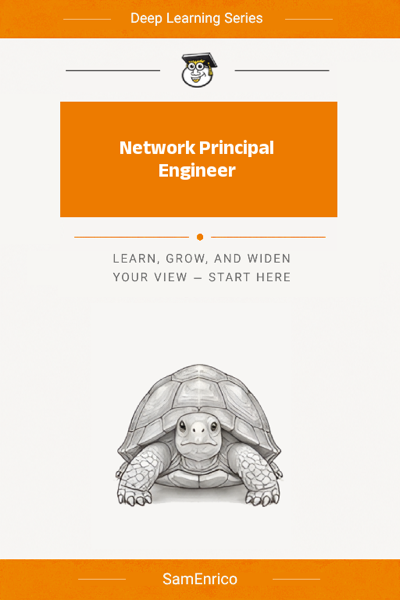
Non-FictionInformativeEducational
Network Principal Engineer eBook
A Coursebook on Network Principal Engineer
by Rea Delcie
A Coursebook on Network Principal Engineer
Formats
Free sample
Chapter 1: Beyond the CLI...--–- The first time I watched a senior engineer troubleshoot a BGP route leak by typing “show ip bgp” into twelve different routers in rapid succession, I thought I was witnessing mastery. The speed, the fluency, the arcane incantations—it all looked like wizardry. It took me another five years to realize that wizardry is not leadership. The fastest typist in the network operations center is rarely the person who should be designing the network. This chapter is not about teaching you a new protocol or a new automation framework.
It is about unlearning something far more difficult: the belief that technical depth alone qualifies you for the principal seat.The transition from Senior Network Engineer to Principal Network Engineer is not a promotion. It is an identity shift. Senior engineers are measured by their ability to solve problems inside a domain. Principal engineers are measured by their ability to prevent problems across domains, often without touching a single device. This distinction is uncomfortable because it demands that you become less useful in the short term to become more valuable in the long term.
A senior engineer who stops troubleshooting to write an Architectural Decision Record or to mentor a junior colleague on failure modes feels unproductive. A principal engineer who spends a week building a chaos engineering harness feels irresponsible. Both are wrong.This chapter dismantles the myth that the Principal Network Engineer is simply a more experienced version of a Senior Network Engineer. We will explore the T-shaped skillset, the strategic management of technical debt, and perhaps most importantly, a distinction that will echo through every subsequent chapter: the CLI is for debugging, not for configuration. This single sentence resolves more career stagnation than any certification ever written.
Let us begin the unlearning.The Great Misunderstanding: Senior vs. Principal Every engineering organization has a implicit ladder. At the bottom, individual contributors solve tickets. Mid-level engineers design features. Senior engineers own systems.
But the Principal role breaks this linear progression because it is not about owning more systems. It is about owning the relationships between systems.Consider two engineers facing a network outage. The Senior Engineer grabs a console cable, opens five terminal windows, and begins issuing show commands. They identify a spanning tree loop on a specific VLAN, shut down the offending port, and restore service within twelve minutes. Heroic.
Effective. Necessary.The Principal Engineer does not touch a console. Instead, they ask: Why did spanning tree reconverge so slowly? Why was the loop detection not caught in the staging environment? Which architectural decision—made three years ago—allowed this VLAN to span too many switches?
What change in the change management process allowed this configuration to be deployed without a peer review? The Principal Engineer returns service zero minutes faster, but they ensure that this exact failure never happens again across all twelve data centers.This is not a difference in skill. It is a difference in abstraction. The Senior Engineer operates at the level of packets and ports. The Principal Engineer operates at the level of policies, patterns, and people.
Both are necessary. But only one scales.The T-Shaped Skillset The metaphor of the T-shaped professional has been overused, but for the Principal Network Engineer, it has a precise meaning. The vertical bar of the T represents deep expertise in at least two technical domains. Not one. Two.
A Principal who knows BGP inside and out but cannot write a Python script is incomplete. A Principal who automates everything but cannot debug a BGP path selection issue is dangerous. The two domains must be complementary: typically one traditional networking protocol (BGP, OSPF, EVPN, MPLS) and one automation discipline (Python, Go, data modeling, CI/CD).The horizontal bar of the T represents breadth across four essential pillars: networking, automation, security, and business. Notice that "business" is the final pillar. Most engineers stop at the third.
A Principal Engineer understands that a network design that meets all technical requirements but costs thirty percent more than the budget allows is a failed design. They understand that a security control that blocks a legitimate revenue-generating application is a negative outcome, not a win for the security team.The T-shaped model has a critical implication: you must deliberately cultivate shallowness in some areas. You cannot know everything. The Principal Engineer is comfortable saying, "I do not know the answer, but I know which three people to ask and how to synthesize their answers into a decision." This is not impostor syndrome. It is intellectual honesty.The CLI Paradox: Debugging Tool, Not Configuration Interface No inconsistency has derailed more aspiring Principal Engineers than the confused relationship with the command-line interface.
Early career success is built on CLI mastery. Certifications test CLI speed. Interview loops often include live CLI troubleshooting. It is understandable, then, that many engineers believe CLI proficiency is the mark of seniority. It is not.
It is the mark of a skilled operator.The Principal Network Engineer must internalize a sharp distinction: the CLI is for debugging and exploration. APIs and infrastructure-as-code are for configuration.Let me be explicit about what this means. When a Principal Engineer receives a Sev-2 alert at 2 AM, they will SSH into a device. They will use show ip bgp, show interface counters, show log, show tech-support. They will pipe output to grep, count errors with wc -l, and perhaps even write a quick bash loop to check consistency across a dozen routers.
This is debugging. It is forensic. It is exploratory. It is entirely appropriate.But when that same Principal Engineer needs to add a new VLAN to one hundred switches, they will not type conf t, interface vlan 200, ip address 10.2.200.1/24, no shut one hundred times. They will not even do it with a script that emulates typing.
They will write a YAML file describing the desired VLAN state, commit it to a Git repository, and let a CI/CD pipeline push it to the network via RESTCONF, g NMI, or NETCONF. This is configuration. It is declarative. It is version-controlled. It is auditable.Why the Distinction Matters The industry has spent two decades conflating debugging and configuration because the CLI was the only interface available.
That era is ending. Modern network operating systems—SONi C, Arista EOS, Cisco NX-OS in its modern incarnation—expose rich programmatic interfaces. Cloud networking has never had a CLI at all; you configure AWS Transit Gateways with Terraform or the AWS console (which is itself a graphical wrapper around an API).The Principal Engineer who fails to internalize this distinction will fall into two traps. First, they will remain vendor-locked, because every vendor’s CLI is different but every vendor’s YANG models and Open Config paths are increasingly convergent. Second, they will remain operationally fragile, because CLI changes are rarely tested, rarely reviewed, and often undocumented.This chapter explicitly resolves the tension that plagues many senior engineers: Do I need to abandon the CLI entirely?
No. You need to abandon the CLI for configuration. Keep it sharp for debugging. Keep it in your toolbox for emergency forensic work. But move every repeatable, planned, or auditable change into a programmatic, version-controlled workflow.
The rest of this book assumes you have made this mental shift. Chapters 4 through 7 will teach you the…
This is the end of the free sample. Get the eBook to keep going. Buy now
About this book
Details
- Author
- Rea Delcie
- Publisher
- SamEnrico
- Language
- English
- Genre
- Non-Fiction, Informative, Educational
- Released
- 2026-05-08
- Pages (approx.)
- 159
- Available as
- eBook, Audiobook

Read better in the ZLOADR app
Your eBooks on your phone or tablet. Sign in with your SamEnrico account and start reading.
More by Rea Delcie
 ED Success StoriesRea Delcie$11.99
 MDD Symptoms Recognition GuideRea Delcie$11.99
 The Connected Parent GuideRea Delcie$11.99
 The Working Memory for Seniors GuideRea Delcie$11.99
 Debtors Anonymous Step WorkbookRea Delcie$11.99
 The Pianist and the Spy: A Love Story Written in Beethoven’s ShadowRea Delcie$11.99
 The Breeder's Guide to Plymouth Rock ChickensRea Delcie$11.99
 PR for Minority FoundersRea Delcie$12.99
 Minority Firm Contract FinanceRea Delcie$12.99
 How to Become a Log CookerRea Delcie$11.99
You may also like
 Hong Kong Handover 1997Dunn Johnnie$11.99
 Zumba For Postnatal Recovery CourseNeal Christian$11.99
 Zumba for BeginnersLadner Nikia$11.99
 YouTube Comment Mining GuideHumes Pandora$12.99
 Worry Box MeditationCarlin Rudy$11.99
 Workplace Stress MeditationNguyen Lynn$11.99
 Workplace Stress and Sleep RepairHawley Ivory$11.99
 Workplace Perfectionism CureDelaney Jeffry$11.99
 Workplace Injustice Anger GuideWallen Isabelle$11.99
 Work Addiction and Burnout LinkGreenwood Ester$11.99
 Women in Yoga and WellnessBeattie Galina$11.99
 Women in Stand Up ComedyChun Evangeline$11.99