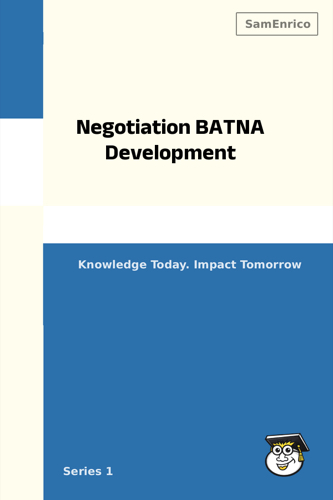
Negotiation BATNA Development eBook
Teaches calculating and strengthening your best al
Teaches calculating and strengthening your best alternative before bargaining.
Formats
Free sample
Chapter 1: The Leverage Lie--–- Most people walk into a negotiation believing a lie. The lie whispers that success belongs to the quick-witted, the smooth-talking, the naturally confident. It tells you that if you are not born with the gift of gab, you will always be outmaneuvered by those who are. This lie has cost ordinary people billions of dollars in bad deals, unnecessary compromises, and quiet resentments. And it is time to expose it for what it is: a comfortable fiction that keeps the unprepared exactly where they belong—at the mercy of those who know better.The truth is far more liberating.
After analyzing thousands of negotiations across forty years of research, the data points to a single, undeniable conclusion. Your success at the bargaining table has almost nothing to do with your personality, your charisma, or your ability to think on your feet. The single greatest predictor of whether you will walk away satisfied or defeated is something you can control completely, something you can build in the quiet hours before you ever shake hands or make eye contact. That something is your Best Alternative to a Negotiated Agreement—your BATNA.This book is not about becoming a different person. It is not about learning to stare down opponents or mastering psychological tricks.
It is about building a foundation so solid that you never need to rely on charm, bluffing, or luck. It is about transforming negotiation from an anxiety-inducing performance into a simple calculation. And it begins with dismantling the most persistent and damaging myth in the history of bargaining: the myth of the natural negotiator.The Case of the Quiet Procurement Officer Let me introduce you to two people. The first is Marcus. Marcus is a regional sales director for a mid-sized software company.
He is six-foot-three, has a voice that fills conference rooms without a microphone, and possesses the kind of effortless charm that makes people want to agree with him. He tells stories that make clients laugh. He remembers names, birthdays, and the names of clients' children. In every observable measure of social grace, Marcus is a nine out of ten. He has never read a negotiation book in his life because, in his words, "negotiation is just talking to people, and I am good at talking to people."The second person is Priya.
Priya is a procurement manager for a manufacturing firm. She is soft-spoken, prefers email to phone calls, and describes herself as "terrible at small talk." In meetings, she listens more than she speaks. When she does speak, she often looks down at her notes rather than making eye contact. Her colleagues respect her but would never describe her as charismatic. By conventional wisdom, Marcus should destroy Priya in any negotiation.
He has the personality. He has the confidence. He has the room.But here is what actually happens when Marcus and Priya sit across from each other. Marcus represents a software vendor trying to sell a license to Priya's company. The list price is one hundred thousand dollars.
Marcus is prepared to go as low as eighty thousand, but he hopes to land at ninety. He walks into the room radiating warmth, tells a few jokes, and assumes his natural charm will carry the day.Priya, meanwhile, has spent the previous week preparing. She has identified three alternative software vendors and requested quotes from all of them. She has calculated the total cost of ownership for each option, including implementation, training, and maintenance fees. She has determined that her best alternative—switching to Vendor B—would cost her company ninety-two thousand dollars for an equivalent product, but would require an additional twenty hours of staff time to migrate data.
She has converted that staff time into a dollar figure: eight thousand dollars. Her reservation price, the number at which she is indifferent between accepting Marcus's deal and walking away to Vendor B, is exactly eighty-four thousand dollars. Any deal below eighty-four thousand is a win. Any deal above that number means she should walk.The negotiation lasts eighteen minutes. Marcus opens at one hundred ten thousand, expecting Priya to counter around ninety-five.
Instead, Priya thanks him for the proposal and says, "Based on our analysis of three other vendors offering equivalent products, we believe a fair price for this license is seventy-eight thousand dollars. We are prepared to sign today at that price, and we are also prepared to move forward with Vendor B by end of week if we cannot reach agreement."Marcus laughs, tries to build rapport, mentions the superior features of his product, and asks for ninety-five. Priya does not argue. She does not charm. She simply says, "I understand.
Please let me know by Friday if seventy-eight becomes workable for you." Then she stands up, shakes his hand, and leaves.Marcus calls her back the next day and accepts seventy-eight thousand dollars. He walks away feeling outmaneuvered but unable to explain why. Priya walks away having saved her company fourteen thousand dollars relative to her best alternative. She did not outtalk Marcus. She did not outcharm him.
She out-prepared him. And preparation, not personality, is the true engine of negotiation power.The Data Behind the Myth This is not an isolated anecdote. The research is overwhelming and consistent. In a landmark study conducted by Northwestern University's Kellogg School of Management, researchers analyzed over fifteen hundred simulated negotiations involving more than three thousand participants. They measured two variables: the objective strength of each participant's BATNA (measured by researchers before the negotiation) and each participant's self-reported "negotiation self-efficacy" (a measure of how confident and skilled they believed themselves to be).
The results were stark. Participants with strong BATNAs achieved better outcomes than those with weak BATNAs in ninety-four percent of cases, regardless of their self-efficacy scores. In other words, a nervous, inexperienced negotiator with a strong backup plan consistently outperformed a confident, experienced negotiator with no backup plan.Another study, published in the Journal of Applied Psychology, looked at real-world salary negotiations among MBA graduates. Researchers tracked both the students' negotiation training (including courses taken, books read, and workshops attended) and the number of alternative job offers each student had received before negotiating. The single best predictor of final salary was not training or personality—it was the number of alternative offers.
Students with three or more offers earned an average of fourteen percent more than students with only one offer, even when the students with one offer had significantly more formal negotiation training.The implication is uncomfortable for those who have built careers on the idea that negotiation is an art form requiring innate talent. But for everyone else, it is extraordinarily liberating. You do not need to become a different person to negotiate effectively. You do not need to master psychological tricks or learn to enjoy conflict. You need to build better alternatives.
That is it. That is the secret that the "natural negotiators" have been accidentally hiding from you for decades.Why the Myth Persists If the data is so clear, why does the myth of the natural negotiator persist? Three reasons. First, confirmation bias. When we see a charismatic person succeed in a negotiation…
This is the end of the free sample. Get the eBook to keep going. Buy now
About this book
Details
- Author
- Goforth Mathilde
- Publisher
- SamEnrico
- Language
- English
- Genre
- Non-Fiction, Business Brief, Preparation
- Released
- 2026-06-08
- Pages (approx.)
- 136
- Available as
- eBook, Audiobook

Read better in the ZLOADR app
Your eBooks on your phone or tablet. Sign in with your SamEnrico account and start reading.
More by Goforth Mathilde
 Notion Formula Field ReferenceGoforth Mathilde$11.99
 Gambling Addiction Sleep RecoveryGoforth Mathilde$11.99
 Tuberculosis DetoxGoforth Mathilde$11.99
 Interruption Prevention PlanGoforth Mathilde$11.99
 Legacy Letter Writing GuideGoforth Mathilde$11.99
 Child Loss and DepressionGoforth Mathilde$11.99
 Divorce Grief JournalGoforth Mathilde$11.99
 The Iron Admiral: Nelson and the Tide of EmpireGoforth Mathilde$11.99
 Patrick White's Noble Quest: The Australian Novelist Who Conquered the WorldGoforth Mathilde$11.99
 How to Produce Gas CylindersGoforth Mathilde$11.99
 A Collector's Handbook to the Renault MonasixGoforth Mathilde$11.99
 Student Job Search WebsitesGoforth Mathilde$12.99