
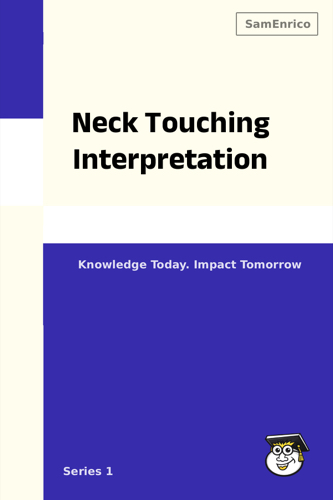
Non-FictionSelf-HelpNeckComfort
Neck Touching Interpretation eBook
Recognize neck rubs and collar pulls as comfort or
Recognize neck rubs and collar pulls as comfort or stress signals.
Formats
Free sample
Chapter 1: The Honest Compass--–- Every person you meet carries a hidden broadcast of their inner state—a continuous stream of signals that reveals comfort, stress, uncertainty, and fear. Most people never learn to tune into this broadcast. They hear the words, they see the face, but they miss the quiet conversation happening just below the chin. That conversation happens at the neck.Think about the last time you felt truly anxious. Perhaps it was before a job interview, during a difficult conversation with a partner, or while waiting for important news.
Did you touch your neck? Probably. Most people do. They rub the back of their neck, pull at their collar, scratch the side of their throat, or cover the soft hollow at the base of their throat. These gestures feel natural and involuntary because they are.
Your body knows something your mind hasn't yet processed: the neck is the most honest part of the human body.This book will teach you to read that honesty. Over the next twelve chapters, you will learn to recognize, interpret, and respond to the full vocabulary of neck-touching behaviors. You will discover why a light scratch behind the ear means something different from a full-palm neck rub. You will understand why men and women touch their necks differently, and why a collar pull in July might mean nothing while the same gesture in an air-conditioned boardroom means everything. You will learn to distinguish the stress signals that deserve your attention from the nervous habits that deserve your patience.But before we can interpret specific gestures, we must understand the deeper truth: the neck is not just another body part.
It is a biological and psychological crossroads, uniquely vulnerable and uniquely expressive. This first chapter lays the foundation for everything that follows. We will explore the anatomy that makes the neck so sensitive. We will trace the evolutionary roots of neck-protection behaviors from our primate ancestors to modern life. We will distinguish between conscious and subconscious touching, between stress signals and comfort behaviors, between meaningful gestures and meaningless noise.By the end of this chapter, you will never look at someone touching their neck the same way again.
More importantly, you will begin to see what you have been missing all along.Why the Neck Is Different The neck is not like the arm, the leg, or even the face. Those body parts communicate, certainly, but they lack the neck's unique combination of vulnerability, sensitivity, and expressive power. To understand why neck touching is so revealing, we must first understand what the neck contains and what it represents.The Carotid Arteries. Running up both sides of the neck, these major blood vessels carry oxygenated blood from the heart to the brain. They are essential and exposed.
A serious threat to the carotid arteries can cause unconsciousness in seconds and death in minutes. The body knows this. The brain monitors the neck region with heightened vigilance, and any perceived threat triggers an immediate protective response. When you feel stressed, your blood pressure rises. That increased pressure is felt most acutely in the carotid arteries, creating a sensation of fullness, heat, or throbbing.
The subconscious response is to touch the neck—to check, to soothe, to protect.The Vagus Nerve. This is perhaps the most important structure for understanding neck touching. The vagus nerve is the body's primary parasympathetic highway—the system responsible for calming you down after stress. It runs from the brainstem down through the neck into the chest and abdomen. When you touch your neck, especially the front and sides, you are physically stimulating the vagus nerve.
This is not accidental. The body has learned that gentle pressure on the neck can activate the vagal response, slowing heart rate and reducing cortisol. In other words, neck touching is not just a signal of stress—it is also a solution the body attempts. Psychologists call this "pacifying behavior." The body is literally trying to calm itself down.The Thyroid Gland. Located in the front of the neck, the thyroid regulates metabolism, energy, and temperature sensitivity.
When stress hormones surge, thyroid function can be temporarily affected, leading to sensations of heat or tightness in the throat. Many people who pull at their collars are responding to a very real, physiologically driven increase in neck temperature. They are not imagining the heat, and they are not necessarily lying. Their body is simply running hot under pressure.The Trachea. The airway is the most immediately vulnerable structure in the neck.
A blow to the trachea can be fatal. Evolution has hardwired us to protect this area at all costs. When you see someone cover their throat with a whole hand, you are witnessing a primal survival response being activated by a social or emotional threat. The brain does not fully distinguish between a physical threat to the trachea and a psychological threat to the self. Both produce the same protective gesture.Beyond these structures, the neck is densely packed with nerve endings and has relatively little fat or muscle cushioning.
This means that even light contact is highly perceptible, and the brain devotes significant processing resources to monitoring the neck area. Some neurological research suggests that the cortical homunculus—the brain's map of the body—allocates disproportionately large space to the neck and throat given their actual size, precisely because of their survival importance.Taken together, these anatomical facts lead to an inescapable conclusion: the neck is a physiological hotspot for stress detection and regulation. When a person experiences emotional discomfort, cognitive load, social anxiety, or perceived threat, their neck will respond. And because the neck is visible in most social interactions—unlike legs under a table or hands in pockets—it becomes one of the most accessible windows into internal states.The Evolutionary Legacy Why would evolution wire the neck to be so expressive? The answer lies in our primate heritage and the survival pressures that shaped the human nervous system over millions of years.Imagine an early hominid walking across the savannah.
A predator approaches from the tall grass. What happens? The hominid's sympathetic nervous system activates—heart rate increases, blood vessels dilate, muscles tense. But critically, the hominid also experiences a powerful urge to protect the neck. Why?
Because predators target the throat. A bite to the neck is quickly fatal. Over evolutionary time, individuals who were more vigilant about neck protection were more likely to survive and reproduce.That vigilance manifests as a set of automatic behaviors: pulling the chin down, raising the shoulders, and—most relevant for our purposes—touching the neck with the hand. The hand serves as a shield, a check for injury, and a calming mechanism all at once.Now fast forward to the modern world. You are sitting in a performance review with your manager.
She asks, "How do you explain the discrepancy in last quarter's numbers?" You are not in physical danger. There is no predator in the room. But your brain does not know the difference. The social threat activates the same ancient circuits. Your blood pressure rises.
Your neck feels hot. And without thinking, your hand moves to your neck—perhaps rubbing the back, perhaps pulling at your…
This is the end of the free sample. Get the eBook to keep going. Buy now
About this book
Details
- Author
- Donnell Aleida
- Publisher
- SamEnrico
- Language
- English
- Genre
- Non-Fiction, Self-Help, Neck, Comfort
- Released
- 2026-06-08
- Pages (approx.)
- 160
- Available as
- eBook, Audiobook

Read better in the ZLOADR app
Your eBooks on your phone or tablet. Sign in with your SamEnrico account and start reading.
More by Donnell Aleida
 Canva Brand Identity for Tech StartupsDonnell Aleida$11.99
 Umbrella Logo DistributionDonnell Aleida$11.99
 Skin Recovery After SmokingDonnell Aleida$11.99
 The Golden Generation: How Spain's 2010 World Cup Team Redefined Football as ArtDonnell Aleida$11.99
 Learn to Play the HaidiDonnell Aleida$11.99
 How to Start a Barbed Wire Made of Steel Business (Beginners Guide)Donnell Aleida$11.99
 AI for Skills ExtractionDonnell Aleida$12.99
 Family Law ClerkDonnell Aleida$11.99
You may also like
 Hong Kong Handover 1997Dunn Johnnie$11.99
 Zumba For Postnatal Recovery CourseNeal Christian$11.99
 Zumba for BeginnersLadner Nikia$11.99
 YouTube Comment Mining GuideHumes Pandora$12.99
 Worry Box MeditationCarlin Rudy$11.99
 Workplace Stress MeditationNguyen Lynn$11.99
 Workplace Stress and Sleep RepairHawley Ivory$11.99
 Workplace Perfectionism CureDelaney Jeffry$11.99
 Workplace Injustice Anger GuideWallen Isabelle$11.99
 Work Addiction and Burnout LinkGreenwood Ester$11.99
 Women in Yoga and WellnessBeattie Galina$11.99
 Women in Stand Up ComedyChun Evangeline$11.99