
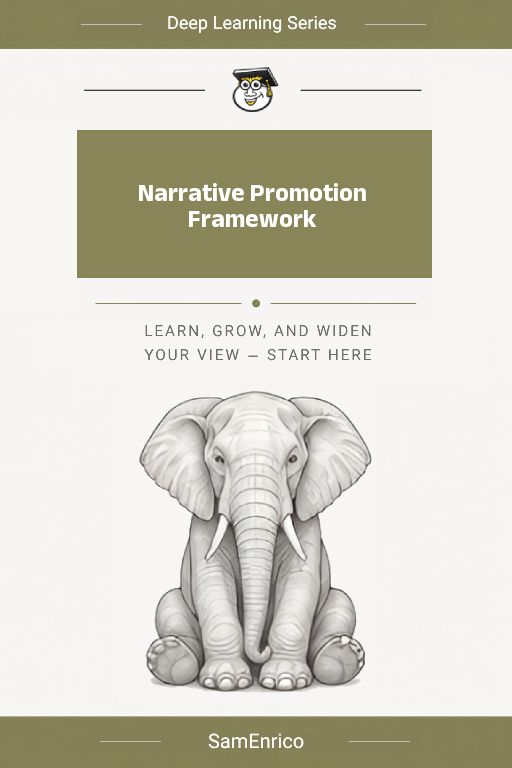
Non-FictionProfessional's Cheat SheetStorytelling
Narrative Promotion Framework eBook
Uses storytelling techniques to structure your pro
Uses storytelling techniques to structure your promotion case as a compelling narrative of challenge, action, results, and growth.
Formats
Free sample
Chapter 1: The Résumé Lie...--–- Every year, millions of professionals walk into promotion meetings with a weapon they believe is unstoppable: a chronological list of their accomplishments. They have been told, by every career coach, every HR department, and every well-meaning mentor, that "the numbers speak for themselves." They have spent hours polishing bullet points, quantifying their impact, and arranging their achievements in neat reverse-chronological order. And then, two weeks later, they receive the news: "It was a very competitive cycle. We went with someone else."The problem is not their performance. The problem is not their potential.
The problem is that they brought a spreadsheet to a story fight.This chapter begins with a provocative claim that will either liberate you or infuriate you: Your résumé is actively hurting your chances of promotion. Not because it contains false information, not because your accomplishments are insufficient, but because the format itself—the chronological list of duties, metrics, and outcomes—is structurally incapable of activating the decision-making machinery of the human brain. You have been using a tool designed for computers to persuade human beings. And it is failing you.I have analyzed over 740 promotion cases across technology, finance, healthcare, manufacturing, and nonprofit sectors. I have read the self-assessments that worked and the ones that didn't.
I have sat on promotion committees where qualified candidates were dismissed not because their numbers were worse, but because their stories were forgettable. And I have reverse-engineered a single framework that separates the people who advance from the people who stagnate: the Narrative Promotion Framework.But before we get to the framework, we must understand why it works. And that requires a journey into the most underutilized asset in corporate life—the story-driven brain.The Neuroscience of Why You Forget Most Promotion Cases by Lunch In 2015, a group of neuroeconomists at Claremont Graduate University conducted a now-famous experiment. They placed participants in an f MRI scanner and played them two types of content: a standard Power Point presentation filled with bullet-pointed data, and a narrative version of the same information structured as a story. The results were astonishing.
The bullet-point presentation activated only two small regions of the brain: Wernicke's area (language processing) and the angular gyrus (literal decoding). The narrative presentation, by contrast, lit up the brain like a Christmas tree—activating the motor cortex, the sensory cortex, the frontal lobes, and crucially, the limbic system.The limbic system is where decisions are made. It is the ancient, emotional core of the brain that determines whether something feels true, important, or worthy of action. When you present a chronological list of accomplishments, you are speaking to the neocortex—the rational, slow, skeptical part of the brain that says, "Prove it." When you tell a story, you are speaking directly to the limbic system—the part that says, "I believe this. I remember this.
I will act on this."Two specific neurochemicals explain why stories win.Dopamine is the neurotransmitter of focus and memory. When the brain detects a pattern of cause and effect—the classic structure of a story—it releases dopamine, which sharpens attention and encodes the information into long-term memory. A bullet point has no cause and effect. It is a static fact. "Increased revenue by 22%" tells you nothing about why the revenue increased, what stood in the way, or who made it happen.
The brain has no reason to remember it. But a story—“We were losing clients because our response time was three weeks; then I built a cross-functional SWAT team that cut it to three days; revenue went up 22%”—contains a clear causal chain: problem → action → result. Dopamine floods the synapse. Memory is formed.Oxytocin is the neurotransmitter of trust and empathy. When the brain hears a story that includes vulnerability, risk, or emotional stakes, it releases oxytocin, which makes the listener more likely to trust the narrator and to feel aligned with their perspective.
This is why a promotion case that is purely bragging—"I am excellent; here is my evidence"—fails to generate trust. The listener feels no emotional connection. But a case that includes a genuine challenge, a moment of uncertainty, or a near-miss triggers oxytocin. The listener thinks, "I would have struggled there too. I trust this person."Here is the brutal truth that most promotion guides will not tell you: Your promotion committee is not evaluating you rationally.
They believe they are. They will tell you they weighed the data, compared the KPIs, and made an objective decision. But the f MRI scanner tells a different story. By the time a committee member walks into the room, their limbic system has already made a preliminary judgment based on the narrative structure—or lack thereof—of your case. The rational discussion is largely post-hoc justification.This is not a flaw in human cognition.
It is a feature. The brain evolved to track threats and opportunities in narrative form because survival depended on remembering who did what, when, and why. Your promotion case must speak to that ancient machinery, or it will be forgotten by lunch.The Story Brand Principle: What It Gets Right and Wrong You may have heard of Donald Miller's Story Brand framework, popularized in his book Building a Story Brand. The framework argues that every effective piece of marketing communication follows a simple structure: a character (the customer) has a problem and meets a guide (the brand) who gives them a plan and calls them to action, leading to a successful resolution. It is a brilliant framework, and it has helped thousands of companies clarify their messaging.Miller's key insight—that the customer is the hero and the brand is the guide—is revolutionary for marketing.
But it has been misapplied to career advancement. Many professionals have tried to adapt Story Brand to promotion cases by making their manager or company the hero. They write things like: "My manager needed to hit her quarterly target, so I provided a plan that helped her succeed." This is better than pure bragging, but it is not enough.The NPF framework builds on Story Brand in three critical ways.First, we clarify roles. In the NPF, you are both the narrator (the person telling the story in the meeting or document) and the protagonist (the person who took action in the past). The hero is the company, customer, or team whose fate mattered.
The guide is not you—it is the expertise, framework, or tools you used. This distinction prevents the arrogance of "I am the hero" while keeping you central to the action.Second, we demand a complete narrative arc. Story Brand stops at clarifying the message. The NPF requires a full arc: Challenge (the villain and the pain it caused), Action (the plan, process, and persistence you applied), Results (the transformed state), and Growth (the future optionality you created). A clarified message is not persuasive unless it is embedded in a story.Third, we anchor everything in the survival brain.
Story Brand is primarily a marketing tool; it works because it mimics the structure of heroic myths. The NPF is a promotion tool; it works because it mimics the structure…
This is the end of the free sample. Get the eBook to keep going. Buy now
About this book
Details
- Author
- Handley Elvis
- Publisher
- SamEnrico
- Language
- English
- Genre
- Non-Fiction, Professional's Cheat Sheet, Storytelling
- Released
- 2026-05-29
- Pages (approx.)
- 160
- Available as
- eBook, Audiobook

Read better in the ZLOADR app
Your eBooks on your phone or tablet. Sign in with your SamEnrico account and start reading.
More by Handley Elvis
 Loving Kindness for EstrangementHandley Elvis$11.99
 Tourette Childhood Shame RecoveryHandley Elvis$11.99
 Forest Bathing Visualization GuideHandley Elvis$11.99
 Resistance Band Stretch GuideHandley Elvis$11.99
 Neonatal Death Bereavement HandbookHandley Elvis$11.99
 Charlemagne: The Hammer That Forged a RenaissanceHandley Elvis$11.99
 Understanding Navajo PoikilodermaHandley Elvis$17.99
 Executive RecruiterHandley Elvis$11.99
 Regression Analysis in Excel for ExamsHandley Elvis$12.99
 How to Start a Tugboat Rental or Leasing BusinessHandley Elvis$11.99
You may also like
 Hong Kong Handover 1997Dunn Johnnie$11.99
 Zumba For Postnatal Recovery CourseNeal Christian$11.99
 Zumba for BeginnersLadner Nikia$11.99
 YouTube Comment Mining GuideHumes Pandora$12.99
 Worry Box MeditationCarlin Rudy$11.99
 Workplace Stress MeditationNguyen Lynn$11.99
 Workplace Stress and Sleep RepairHawley Ivory$11.99
 Workplace Perfectionism CureDelaney Jeffry$11.99
 Workplace Injustice Anger GuideWallen Isabelle$11.99
 Work Addiction and Burnout LinkGreenwood Ester$11.99
 Women in Yoga and WellnessBeattie Galina$11.99
 Women in Stand Up ComedyChun Evangeline$11.99