
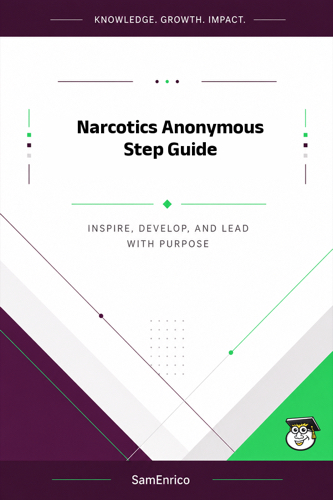
Non-FictionSelf-HelpNarcotics Recovery
Narcotics Anonymous Step Guide eBook
Recover from any drug addiction using the NA twelv
by Henry Jesus
Recover from any drug addiction using the NA twelve step program and basic text guide.
Formats
Free sample
Chapter 1: The Last Lie...--–- You are reading this because some part of you already knows the truth. The truth is not that you have a drug problem. You have known that for years. The truth is not that you need to stop. You have tried that, perhaps dozens of times, and each attempt ended the same way: with you back in the chaos, promising yourself that this time would be different, knowing even as you promised that it would not be.
The real truth—the one you have been running from—is that you have lost the ability to choose whether you use drugs. That choice was surrendered a long time ago, probably before you noticed it was gone. You are not reading this because you are weak. You are reading this because you are finally tired enough to stop lying to yourself.This book is not a collection of suggestions. It is a precise outline for living, drawn from the accumulated experience of hundreds of thousands of addicts who have found a way out of the nightmare you are currently trapped in.
The path is called the Twelve Steps of Narcotics Anonymous, and it has worked for people who were worse off than you, people who had less money, less support, less intelligence, and less willpower. It worked for them because they stopped relying on the one thing that had never worked: their own best thinking. This chapter is about the first step, but before you can take that step, you need to understand what you are actually facing.The Difference Between Stopping and Recovering Let us be brutally honest about something most recovery books dance around. There is a vast difference between abstinence and recovery. Abstinence is simply not using drugs.
You can achieve abstinence through jail, a hospital bed, a locked treatment center, or sheer terror after a near-fatal overdose. Abstinence is a condition. Recovery is a transformation. You have likely been abstinent before. Maybe you lasted a week.
Maybe a month. Maybe even a year. But at some point, the obsession returned, the craving became unbearable, and you used again. That is because abstinence without recovery is just a waiting room for relapse.The NA program defines recovery as a fundamental shift in how you think, feel, and relate to the world. It is not about white-knuckling your way through life, fighting the urge to use every minute of every day.
Recovery is the gradual erosion of that urge until it becomes a faint whisper, then a memory, then nothing at all. But to get there, you must stop believing in the single most dangerous lie that addiction tells you: the lie that you can eventually learn to use like a normal person.The Phenomenon of Craving Every addict has experienced what NA calls the "phenomenon of craving." This is not a metaphor. It is a biological reality. When you take a drug that your brain has become dependent on, something happens in your neural circuitry that does not happen to non-addicts. A non-addict can take a prescription opioid for a week after surgery and stop without a second thought.
They might feel mild discomfort, but they do not wake up in a cold sweat at three in the morning, convinced that they will die without another pill. You do. That is the difference.The phenomenon of craving means that once you take the first drug, the compulsion to take the second, the third, and the hundredth is no longer under your control. Your brain’s reward system has been hijacked. The part of your brain that makes decisions—the prefrontal cortex—has been overridden by the part that seeks survival-level rewards.
To your addicted brain, drugs are not a pleasure. They are oxygen. They are water. They are the difference between living and dying. This is not a moral failure.
It is a disease. But like any disease, it requires treatment, not excuses.The Three Types of Unmanageability Step One says: "We admitted that we were powerless over our addiction, that our lives had become unmanageable." Most addicts can admit powerlessness relatively quickly. They know they cannot control their using. The harder admission is unmanageability. You might look at your life and say, "It's not that bad.
I still have a job. I still have a roof over my head." But unmanageability is not about how much you have lost. It is about how much you have surrendered control over your own decisions. There are three areas where unmanageability shows up first.Financial Unmanageability Before you started using heavily, you had a relationship with money. You planned.
You saved. You paid bills. Addiction destroys that relationship. Now, money flows through your hands like water, and you cannot explain where it went. You have stolen from family members, borrowed from friends with no intention of repaying, sold possessions that mattered to you, and likely committed crimes to fund your using.
The unmanageability is not the amount of debt. It is the fact that you no longer have a choice about where your money goes. The drugs take it. You are just a passenger.Relational Unmanageability Addiction is a disease of isolation. You have lied to people who love you.
You have broken promises so many times that your words mean nothing. You have manipulated, gaslit, and emotionally blackmailed the people closest to you. You have likely ended relationships because the other person interfered with your using, or you have stayed in toxic relationships because they enabled it. The unmanageability here is not that you have hurt people. It is that you have lost the ability to tell the truth about your own behavior.
You believe your own lies now.Emotional Unmanageability This is the deepest and most painful form of unmanageability. Your emotions are no longer your own. They are dictated by your using cycle. When you are high, you feel invincible, loving, generous, and creative. When you are coming down, you feel rage, self-pity, terror, and despair.
When you are sick, you feel nothing except the urgent need to get well. You cannot remember the last time you felt a genuine, unforced emotion that was not tied to your drug use. You have lost the ability to regulate your own inner life. That is unmanageability at its core.The Pink Cloud Warning Because this book is honest with you, I must warn you about something that will happen soon. In the first few weeks of abstinence, you will likely experience a period of euphoria.
Everything will feel new. You will sleep better. You will wake up without the shakes. You will laugh at something genuinely funny. You will feel hope.
This is called the "Pink Cloud," and it is dangerous.The Pink Cloud is not recovery. It is a neurological rebound. Your brain, starved of the artificial dopamine floods it has been receiving, is temporarily overproducing natural feel-good chemicals. This will not last. Within thirty to ninety days, the Pink Cloud will fade.
You will crash. You will feel bored, irritable, depressed, and convinced that recovery was a lie. Most relapses happen not during the acute withdrawal phase, but during the Pink Cloud…
This is the end of the free sample. Get the eBook to keep going. Buy now
About this book
Details
- Author
- Henry Jesus
- Publisher
- SamEnrico
- Language
- English
- Genre
- Non-Fiction, Self-Help, Narcotics Recovery
- Released
- 2026-06-06
- Pages (approx.)
- 143
- Available as
- eBook, Audiobook

Read better in the ZLOADR app
Your eBooks on your phone or tablet. Sign in with your SamEnrico account and start reading.
More by Henry Jesus
 Podcast Interview Nerves GuideHenry Jesus$11.99
 Cocaine Recovery Exercise GuideHenry Jesus$11.99
 Disabled Hostage SurvivorHenry Jesus$11.99
 Panic Disorder Nocturnal Attacks HandbookHenry Jesus$11.99
 The Vanishing Billion: The Heist That Shook Wall StreetHenry Jesus$11.99
 The Great Gathering: How 2 Million People Converged for Woodstock 94Henry Jesus$11.99
 How to Start a Hobby in Insect collectingHenry Jesus$11.99
 Understanding Brachydactyly HypertensionHenry Jesus$17.99
 Sony Remote Entertainment InternHenry Jesus$12.99
 Executive Summary Headline Writing GuideHenry Jesus$12.99
 Dialysis NurseHenry Jesus$11.99Dialysis NurseHenry Jesus$11.99
You may also like
 Hong Kong Handover 1997Dunn Johnnie$11.99
 Zumba For Postnatal Recovery CourseNeal Christian$11.99
 Zumba for BeginnersLadner Nikia$11.99
 YouTube Comment Mining GuideHumes Pandora$12.99
 Worry Box MeditationCarlin Rudy$11.99
 Workplace Stress MeditationNguyen Lynn$11.99
 Workplace Stress and Sleep RepairHawley Ivory$11.99
 Workplace Perfectionism CureDelaney Jeffry$11.99
 Workplace Injustice Anger GuideWallen Isabelle$11.99
 Work Addiction and Burnout LinkGreenwood Ester$11.99
 Women in Yoga and WellnessBeattie Galina$11.99
 Women in Stand Up ComedyChun Evangeline$11.99