
Non-FictionHealth & WellnessSleep Disorders
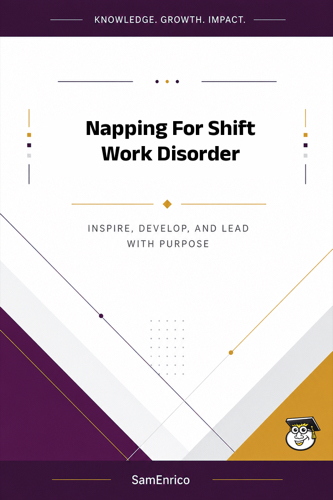
Napping For Shift Work Disorder eBook
Strategies for irregular sleep schedules.
Strategies for irregular sleep schedules.
Formats
Free sample
Chapter 1: The 4 AM Killer--–- At 4:47 AM on a cold Tuesday in March, Danielle Michaels blinked. That was her crime. One blink that lasted four seconds too long. When her eyes reopened, the headlights of a semi-trailer filled her entire windshield. She had no memory of crossing the median.
No memory of leaving her lane. No memory of the last 400 feet of Interstate 94 at all. The steering wheel jerked left as her right tire caught the rumble strip, then the gravel shoulder, then nothing but air. The Toyota Corolla rolled twice. Danielle woke up again, this time upside down, hanging from her seatbelt, windshield spiderwebbed into opaque white glass, and the smell of gasoline so thick she could taste it.
A truck driver was already at her window, shouting something she couldn't hear over the ringing in her ears. Later, at the hospital—the same hospital where she had just finished her twelfth straight twelve-hour night shift as an emergency room nurse—a doctor would tell her she had a concussion, three cracked ribs, and a blood alcohol level of exactly zero. "You fell asleep at the wheel," the doctor said. Not a question. A statement.
Danielle stared at the fluorescent lights of the trauma bay, the same lights she had stood under for a decade, and said nothing. She had been a nurse for ten years. She had told patients not to drive tired. She had signed discharge papers warning about fatigue. And no one—not her nursing program, not her hospital, not her union, not the twenty-three books on sleep she had skimmed over the years—had ever taught her how to take a nap.The Mathematics of Survival Shift work is not a lifestyle choice.
For approximately fifteen million Americans—nurses, truck drivers, police officers, firefighters, factory workers, power plant operators, airline pilots, air traffic controllers, call center employees, warehouse pickers, emergency dispatchers, and overnight pharmacists—shift work is the architecture of survival. You work when the world sleeps because someone has to keep the lights on, the ambulances running, the inventory moving, and the patients breathing. But here is the mathematics that no employer prints on the break room bulletin board: a human being forced to work during their biological night (approximately 11:00 PM to 7:00 AM by the body's internal clock, regardless of when they actually go to bed) experiences cognitive impairment equivalent to a blood alcohol concentration of 0.05% to 0.10%. That is legally drunk in every state in America. A night shift worker who has been awake for eighteen hours drives with the same reaction time as someone with a blood alcohol level of 0.08%.
After twenty hours of wakefulness, the impairment matches 0.10%. After twenty-four hours—a common stretch for a double shift plus commute—the impairment matches 0.12%, well above the legal limit for driving. Yet no one breathalyzes a nurse leaving the hospital at 8:00 AM. No one pulls over a truck driver at 5:00 AM and says, "Sir, you smell like adenosine."This is not a metaphor. This is neurochemistry.The Tyranny of the Master Clock Deep inside your brain, buried beneath the cerebral cortex, tucked behind the optic chiasm where the nerves from your eyes cross, sits a cluster of approximately twenty thousand neurons called the suprachiasmatic nucleus, or SCN.
It is smaller than a grain of rice. It weighs less than a paperclip. And it is the absolute, undisputed dictator of every cell in your body. The SCN generates an endogenously driven rhythm that lasts approximately twenty-four hours and fifteen minutes in humans, a cycle that must be reset daily by external cues—primarily sunlight—to lock onto the actual twenty-four-hour day. This process of entrainment is why you feel awake when the sun rises and sleepy when it sets.
But here is the cruel biological joke played on shift workers: the SCN does not care about your work schedule. It does not care about your paycheck. It does not care that the factory needs you at 2:00 AM. The SCN continues to generate its twenty-four-hour rhythm based on the evolutionary assumption that you are a hunter-gatherer who wakes at dawn, rests at noon, and sleeps at dusk. When you force yourself to be awake at 3:00 AM, you are not fighting sleepiness.
You are fighting the SCN. And the SCN has been perfecting its rhythm for five hundred million years of vertebrate evolution. You will lose.The Rebellion of the Peripheral Clocks The SCN is only the beginning of your problem. In addition to the master clock in your brain, every major organ in your body—your liver, your pancreas, your heart, your kidneys, your gut, even your skin—contains its own peripheral clock. These clocks are genetically encoded, operating through a feedback loop of clock genes (CLOCK, BMAL1, PER, CRY) that rise and fall in concentration over approximately twenty-four hours.
Under ideal conditions, the SCN synchronizes all these peripheral clocks through neural signals and hormonal pulses, primarily melatonin and cortisol. The result is beautiful biological harmony: your liver produces digestive enzymes when you eat, your pancreas releases insulin when glucose rises, your heart rate increases when you move, and your core body temperature drops when you sleep.Shift work destroys this harmony. Consider what happens when a night shift worker sleeps from 8:00 AM to 4:00 PM. The SCN, receiving sunlight through the eyelids (even closed eyelids transmit enough light to reset the clock), interprets 8:00 AM as "morning, time to be awake." The SCN sends wake-up signals to the rest of the brain. Cortisol rises.
Body temperature begins its daily ascent. But the worker's liver, still operating on the old schedule, is expecting dinner. The stomach is producing acid for a meal that will not come. The pancreas is releasing insulin in anticipation of glucose that has not been consumed. The gut's peristaltic rhythm—the wave-like contractions that move food through the intestines—is timed for daytime digestion, not midnight snacks.
Every organ is shouting different instructions. The result is not simply "feeling tired." The result is systemic chaos: metabolic dysregulation, insulin resistance, gastrointestinal distress, cardiovascular strain, and the bone-deep exhaustion that shift workers describe as "a flu that never starts and never ends."The Circadian Trough: Your Personal Danger Zone Every human being, regardless of chronotype, experiences a period of maximum sleepiness called the circadian trough. In a person following a traditional daytime schedule, this trough occurs between approximately 3:00 AM and 5:00 AM. Core body temperature reaches its daily minimum. Melatonin peaks.
Alertness bottoms out. Reaction times double. Memory encoding fails. Judgment evaporates. This is not subjective tiredness.
This is a measurable, quantifiable, ironclad biological reality. The majority of industrial accidents, medical errors, and single-vehicle crashes occur between 3:00 AM and 5:00 AM. The Chernobyl nuclear disaster began with a safety test at 1:23 AM. The Three Mile Island partial meltdown occurred at 4:00 AM. The Exxon Valdez ran aground at 12:04 AM.
The Challenger space shuttle disaster was preceded by a teleconference at 1:00 AM in which engineers, suffering from sleep deprivation, failed to communicate critical safety data. These are not coincidences. These are the circadian trough, written in disasters across human history.For shift workers, the trough does not disappear. It shifts, partially, inconsistently, but it never vanishes. A night shift worker…
This is the end of the free sample. Get the eBook to keep going. Buy now
About this book
Details
- Author
- Oldham Mallory
- Publisher
- SamEnrico
- Language
- English
- Genre
- Non-Fiction, Health & Wellness, Sleep Disorders
- Released
- 2026-06-10
- Pages (approx.)
- 139
- Available as
- eBook, Audiobook

Read better in the ZLOADR app
Your eBooks on your phone or tablet. Sign in with your SamEnrico account and start reading.
More by Oldham Mallory
 Property Manager LiabilityOldham Mallory$11.99
 Biotech Deal TermsOldham Mallory$11.99
 The IBS Second Opinion GuideOldham Mallory$11.99
 Micronutrients For Liver Health GuideOldham Mallory$11.99
 Pet Loss For Boarding StaffOldham Mallory$11.99
 Caregiver for Spinal Cord InjuryOldham Mallory$11.99
 The Barbi Twins StoryOldham Mallory$11.99
 Fibromyalgia Medication GuideOldham Mallory$11.99
 The Iron Monks: How the Teutonic Knights Forged a Baltic EmpireOldham Mallory$11.99
 Into the Heart of Darkness: La Loubère’s Forgotten Congo Expedition (1687-1688)Oldham Mallory$11.99
 Real Estate Deal Structuring with AI PromptsOldham Mallory$11.99
 The Complete Guide to the 10 Day Detox DietOldham Mallory$11.99
You may also like
 Hong Kong Handover 1997Dunn Johnnie$11.99
 Zumba For Postnatal Recovery CourseNeal Christian$11.99
 Zumba for BeginnersLadner Nikia$11.99
 YouTube Comment Mining GuideHumes Pandora$12.99
 Worry Box MeditationCarlin Rudy$11.99
 Workplace Stress MeditationNguyen Lynn$11.99
 Workplace Stress and Sleep RepairHawley Ivory$11.99
 Workplace Perfectionism CureDelaney Jeffry$11.99
 Workplace Injustice Anger GuideWallen Isabelle$11.99
 Work Addiction and Burnout LinkGreenwood Ester$11.99
 Women in Yoga and WellnessBeattie Galina$11.99
 Women in Stand Up ComedyChun Evangeline$11.99