
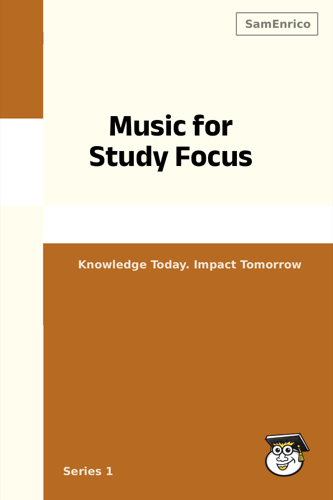
Non-FictionSelf-HelpAuditory Learning
Music for Study Focus
Explains which types of music improve concentratio
Explains which types of music improve concentration and which distract.
Formats
About this book
Free sample
Chapter 1: The Mozart Trap--–- On a rainy Tuesday afternoon in 1993, a small research team at the University of California, Irvine, published a paper that would accidentally mislead an entire generation of students, parents, and educators. The study was modest in scope: thirty-six college students listened to ten minutes of a Mozart sonata, then performed a paper-folding and paper-cutting task that measured spatial-temporal reasoning. Their scores were temporarily higher than after ten minutes of silence or relaxation instructions. The researchers called this a "small and transitory" effect. The media called it something else entirely.Within months, headlines around the world declared that listening to Mozart made you smarter.
Georgia's governor requested classical music CDs for every newborn in the state. Preschools began piping Mozart into classrooms. A booming industry of "Baby Mozart" videos and "genius playlists" emerged, generating hundreds of millions of dollars. Parents played classical music to sleeping infants. College students built study playlists exclusively of Baroque concertos.
The idea was seductive in its simplicity: passive listening, no effort required, and intelligence flows in through the ears like water into a cup.The problem is that none of this was ever true. And worse, the widespread belief in the "Mozart Effect" has led millions of students to study with the wrong music for the wrong reasons, wasting countless hours and actually harming their concentration. This chapter dismantles one of the most persistent myths in cognitive science and establishes the foundational truth of this book: there is no single "focus music" genre, and no music can passively increase your intelligence. Instead, effective study music is an active, personalized, task-dependent tool. You are not a passive receiver of sound.
You are an architect of your own auditory environment.The Birth of a Myth: What the 1993 Study Actually Found Let us examine the original study with the precision it deserves but rarely receives. Frances Rauscher, Gordon Shaw, and Catherine Ky published "Music and Spatial Task Performance" in the journal Nature. The experiment was straightforward. Thirty-six college students participated in three listening conditions: ten minutes of Mozart's Sonata for Two Pianos in D…
This is the end of the free sample. Get the eBook to keep going. Buy now
Contents
- Chapter 1
- Chapter 2
- Chapter 3
- Chapter 4
- Chapter 5
- Chapter 6
- Chapter 7
- Chapter 8
- Chapter 9
- Chapter 10
- Chapter 11
- Chapter 12
Details
- Author
- Mccurdy Ailene
- Publisher
- SamEnrico
- Language
- English
- Genre
- Non-Fiction, Self-Help, Auditory Learning
- Released
- 2026-06-06
- Pages (approx.)
- 146
- Available as
- eBook, Audiobook

Read better in the ZLOADR app
Your eBooks on your phone or tablet. Sign in with your SamEnrico account and start reading.
More by Mccurdy Ailene
 The Senior Technology Confidence CourseMccurdy Ailene$11.99
 Sexual Addiction Relapse DrillsMccurdy Ailene$11.99
 Gaming and Physical HealthMccurdy Ailene$11.99
 Bird Phobia Park ToleranceMccurdy Ailene$11.99
 The Anxiety Sound MeditationMccurdy Ailene$11.99
 The School Hostage CrisisMccurdy Ailene$11.99
 The Silk Road's Shadow Brokers: How Spices Shaped EmpiresMccurdy Ailene$11.99
 Bankruptcy Mediation ParticipationMccurdy Ailene$11.99
 Dino Detectives: The Secret of the Crystal TeethMccurdy Ailene$11.99
 The Mineral Guide to Anyolite (Metamorphic Rock Zoisite, Ruby, and Hornblende)Mccurdy Ailene$11.99
 Capital Allocation for TradersMccurdy Ailene$11.99
 Growing Darwinia (Scent Myrtle)Mccurdy Ailene$11.99
You may also like
 Hong Kong Handover 1997Dunn Johnnie$11.99
 Zumba For Postnatal Recovery CourseNeal Christian$11.99
 Zumba for BeginnersLadner Nikia$11.99
 YouTube Comment Mining GuideHumes Pandora$12.99
 Worry Box MeditationCarlin Rudy$11.99
 Workplace Stress MeditationNguyen Lynn$11.99
 Workplace Stress and Sleep RepairHawley Ivory$11.99
 Workplace Perfectionism CureDelaney Jeffry$11.99
 Workplace Injustice Anger GuideWallen Isabelle$11.99
 Work Addiction and Burnout LinkGreenwood Ester$11.99
 Women in Yoga and WellnessBeattie Galina$11.99
 Women in Stand Up ComedyChun Evangeline$11.99