
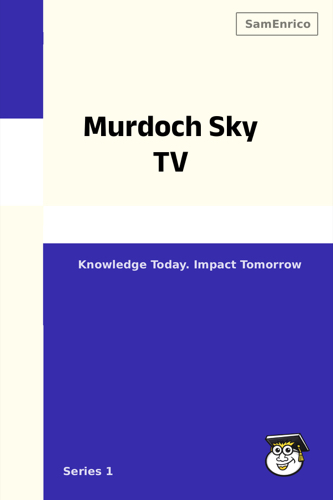
Murdoch Sky TV eBook
Chronicles the satellite broadcaster that dominate
Chronicles the satellite broadcaster that dominated UK TV.
Formats
Free sample
Chapter 1: The £1 Gamble...--–- The rain was falling hard on Slough that November morning, and Rupert Murdoch, the most feared newspaper proprietor in the English-speaking world, stood in a puddle staring up at a ten-foot satellite dish. He was sixty-two years old, worth approximately $2 billion on paper, and utterly incapable of understanding why anyone would willingly stand in a puddle in Slough. Yet here he was. The dish was ugly. It was gray, industrial, and speckled with bird droppings.
A thin cable ran from it into a nearby portable building where a technician in a stained jumper was trying to tune a signal from a satellite called Astra. Murdoch did not understand the technology. He did not care to understand it. What he understood was power. And the dish, he had become convinced, was the future of power.The Man Who Wanted to Own the Sky Rupert Murdoch was not born into poverty.
His father, Sir Keith Murdoch, was a celebrated war correspondent and later a powerful newspaper executive in Australia. But Rupert carried something that his father did not: a burning, almost pathological hunger to be decisive. Sir Keith was respected; Rupert wanted to be feared. In 1952, when his father died unexpectedly, the young Murdoch inherited a single struggling newspaper in Adelaide, The News. He was twenty-one years old.
Within a decade, he had turned that inheritance into a small Australian empire. Within two decades, he had conquered Fleet Street, buying The Sun in 1969 and transforming it from a struggling broadsheet into a brash, confrontational tabloid that would come to dominate British journalism. By 1981, he had added The Times and The Sunday Times to his stable. In the United States, he had purchased the 20th Century Fox film studio and launched the Fox Broadcasting Company. He was, by any measure, a titan.But Murdoch saw something that his rivals did not.
He saw the limits of print. The Sun, for all its four million daily readers, was dying. Not quickly—circulation was still strong—but inevitably. Young people were watching television, not reading newspapers. The BBC and ITV held a duopoly over British screens, deciding what the nation watched, when it watched it, and how much it cost (which, thanks to the license fee, was nothing at the point of consumption).
Murdoch hated the BBC with a particular ferocity. He saw it not as a public service but as a state-subsidized monopoly that devalued the content he paid to produce. "The BBC is a socialist enterprise," he once told an aide. "They take money from people who have no choice and use it to produce programs that no one wants to watch. That is not competition.
That is theft."His solution was radical, expensive, and, by most sane assessments, insane: he would bypass the BBC and ITV entirely by beaming television directly into British homes from space. No transmitters. No licenses. No regulators. Just a dish, a decoder, and a subscription fee.
The model was American—HBO and Showtime had proven that people would pay for premium content—but the scale was European. And the obstacles were formidable.The £1 Purchase That Changed Everything In 1983, Murdoch discovered a failing enterprise called Satellite Television Ltd, or SATV. SATV was a pan-European service launched by a consortium of investors who had believed, briefly and incorrectly, that there was a mass market for a general entertainment channel broadcast from a satellite called Orion. There was not. SATV had lost approximately £10 million in its first year, and by the time Murdoch heard of it, the company was being kept alive by a single, increasingly impatient banker at Barclays.
The banker wanted out. SATV's management wanted a savior. Murdoch wanted a beachhead.The negotiations were conducted in secret, in the sorts of hotel rooms where deals are made without paper trails. Murdoch's negotiator was a young, sharp-elbowed Australian named Bruce Gyngell, who would later become the first face on British satellite television. The final terms were astonishing.
Murdoch paid exactly £1 for the entire operation—the broadcasting license, the satellite transponder lease, the subscriber list, and the debts, which totaled over £2 million. He assumed the liabilities, but he also acquired something more valuable: a legal right to broadcast into Britain via satellite. The British government had not yet decided how to regulate the medium, and Murdoch intended to exploit that regulatory vacuum ruthlessly.When the deal was announced, Fleet Street laughed. The Financial Times called it "a vanity project for a bored millionaire." The Guardian suggested that Murdoch had "finally lost his touch." Even his own executives were skeptical. One senior News International manager later recalled a board meeting where Murdoch presented the plan.
"He drew a diagram of a dish, a satellite, and a television," the executive said. "Then he said, 'This is the future.' And we all nodded because he was the boss, but inside we thought he was mad." Murdoch was not mad. He was patient. For the next five years, SATV limped along, broadcasting sporadically to a tiny, scattered audience of European dish owners. Murdoch bled cash, but he did not flinch.
He was waiting.The Missing Five Years: 1983 to 1988Between 1983 and 1988, SATV did not die, but it did not thrive. It broadcast a hodgepodge of content—old movies, European sports, American sitcoms licensed cheaply from studios that did not yet understand satellite rights. The audience never exceeded a few hundred thousand households scattered across the continent. But Murdoch was not building an audience. He was building infrastructure.
He was learning the technology, the regulatory landscape, and, most importantly, the weaknesses of his future competitors.The most significant development during this period was not technical but political. In 1986, the British government, under Prime Minister Margaret Thatcher, began the process of awarding a formal license for a domestic satellite broadcasting service. Unlike SATV's pan-European, unregulated model, this would be a properly authorized British service, with public service obligations, content quotas, and a regulator. A consortium called British Satellite Broadcasting (BSB) won the license. BSB was everything Murdoch was not: establishment, well-funded, and slow.
Its backers included the major ITV companies, the BBC, and a collection of City banks. BSB planned to launch a service called "The Marco Polo" using advanced, expensive technology known as the Marcopolo satellite. The picture quality would be superior to anything Murdoch could offer. The set-top boxes would be sleek, British-designed marvels. The launch date, however, kept slipping.
And slipping. And slipping.Murdoch watched from the sidelines, feeding losses into SATV, waiting for the moment when the establishment would stumble. He did not have to wait long.The Cowboy Strategy: Why Speed Beat Quality By 1988, Murdoch had had enough. SATV was burning approximately £5 million per month, and BSB was still years from launch. He called a meeting at his London headquarters and issued an ultimatum: "We launch in six months or we close the whole thing." His lieutenants protested.
They had no proper uplink facility, no reliable encryption system, no distribution network for dishes, and no programming deals. Murdoch did not care. "Perfection is the enemy of the good," he told them. "And good is the enemy of done. We launch."The solution came from an unexpected direction.…
This is the end of the free sample. Get the eBook to keep going. Buy now
About this book
Details
- Author
- Stubblefield Verena
- Publisher
- SamEnrico
- Language
- English
- Genre
- Non-Fiction, Biography, Media
- Released
- 2026-06-08
- Pages (approx.)
- 116
- Available as
- eBook, Audiobook

Read better in the ZLOADR app
Your eBooks on your phone or tablet. Sign in with your SamEnrico account and start reading.
More by Stubblefield Verena
 The Plagiarism Fear GuideStubblefield Verena$11.99
 Anticipatory Grief and Palliative CareStubblefield Verena$11.99
 Curie Daughter IreneStubblefield Verena$11.99
 Step Two Open Mindedness ExercisesStubblefield Verena$11.99
 Upwork Portfolio OptimizationStubblefield Verena$11.99
 Remote Project Management CommunicationStubblefield Verena$11.99
 Gaslighted Childhood RecoveryStubblefield Verena$11.99
 Pharmaceutical GH vs Natural BoostStubblefield Verena$11.99
 The Vanishing Highway: The Phantom of I-70Stubblefield Verena$11.99
 The Midnight Swap: The Untold Story of the 1996 NBA Blockbuster That Changed Two DynastiesStubblefield Verena$11.99
 Rum Runners & Royalty: The Untold Story of Queen Elizabeth’s Secret Caribbean EspionageStubblefield Verena$11.99
 The Complete Guide to the Three Day DietStubblefield Verena$11.99
You may also like
 Hong Kong Handover 1997Dunn Johnnie$11.99
 Zumba For Postnatal Recovery CourseNeal Christian$11.99
 Zumba for BeginnersLadner Nikia$11.99
 YouTube Comment Mining GuideHumes Pandora$12.99
 Worry Box MeditationCarlin Rudy$11.99
 Workplace Stress MeditationNguyen Lynn$11.99
 Workplace Stress and Sleep RepairHawley Ivory$11.99
 Workplace Perfectionism CureDelaney Jeffry$11.99
 Workplace Injustice Anger GuideWallen Isabelle$11.99
 Work Addiction and Burnout LinkGreenwood Ester$11.99
 Women in Yoga and WellnessBeattie Galina$11.99
 Women in Stand Up ComedyChun Evangeline$11.99