
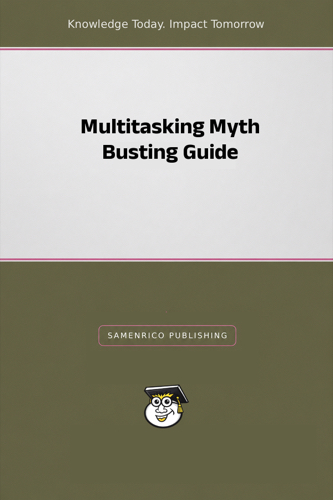
Multitasking Myth Busting Guide eBook
Understand why multitasking fails and how to handl
by Savage Marge
Understand why multitasking fails and how to handle interruptions with this practical productivity primer.
Formats
Free sample
Chapter 1: The $15,000 Email--–- The conference room smelled of stale coffee and desperation. Sarah Chen, a senior analyst at a mid-sized marketing firm, had been up since 5:00 AM. Her morning had been a blur of breakfast for two toddlers, a spilled sippy cup, a rushed shower, and a frantic scroll through 47 Slack messages before she even reached the office. By 9:15 AM, she was already exhausted.At 9:30 AM, she joined a critical client call. The client, a regional retail chain, was considering renewing a $15,000 monthly contract.
Sarah’s boss had made it clear: “Don’t screw this up.”During the call, Sarah did what she always did. She kept her email open in one tab and Slack in another. While the client’s CFO asked about quarterly projections, Sarah answered a Slack message from her boss about a different project. Then she replied to an email from a colleague. Then she checked her calendar for the afternoon.
Then she typed a quick response to a vendor. All while nodding along to the client’s questions.When the CFO asked, “So just to confirm—your Q3 retention numbers are holding steady at 87 percent?” Sarah, who had only heard the last four words, replied, “Yes, 87 percent sounds right.”The correct number was 72 percent.The client pulled the contract within an hour. $15,000. Gone. Sarah’s boss called her into his office and said three words she would never forget: “What happened?”She didn’t have a good answer.
She had been working hard. She had been responsive. She had been doing everything she thought a good employee was supposed to do. She had been multitasking.And that was the problem.The Lie You’ve Been Sold Every day, millions of professionals like Sarah proudly describe themselves as “great multitaskers.” It is treated as a badge of honor, a résumé buzzword, a skill to be cultivated. Parents multitask through dinner.
Executives multitask through board meetings. Students multitask through lectures. We have built an entire culture around the belief that doing more things at once is the same as doing more things well.It is a lie.Not an exaggeration. Not a slight misstatement. A complete, demonstrable, scientifically falsifiable lie.The human brain cannot perform two cognitive tasks simultaneously.
It never has. It never will. What we call “multitasking” is actually something far more insidious and expensive: switchtasking—the rapid, often unconscious toggling of attention between two or more activities. Each toggle carries a hidden tax. And over the course of a day, a week, a career, those taxes compound into a fortune of lost time, degraded quality, chronic stress, and fractured relationships.This chapter will introduce you to The 4 Toxins of Fragmentation—a unifying framework that will guide the entire book.
These four toxins are the hidden drivers of your exhaustion, your errors, and your feeling of never quite catching up. They are:Switchtasking – The cognitive impossibility of doing two things at once, and the hidden costs of rapid toggling.Interruptions – The external and internal forces that hijack your attention, from chatty colleagues to the dopamine slot machine in your pocket.Overcommitment – The habit of saying “yes” to everything, which fragments your focus across too many priorities.Context Chaos – The structural disorganization of your work, where projects and tasks are mixed randomly instead of batched logically.By the end of this book, you will understand each toxin, measure its impact on your life, and eliminate it using practical, neuroscience-backed tools. But first, we must fully dismantle the myth that started all of this: the myth of multitasking.Why “Multitasking” Is a Scientific Impossibility Let us begin with a simple experiment. Try the following right now, while you are reading this sentence: Hum the chorus of a song you know well—any song. At the same time, write down the sentence “The brain cannot multitask.”You cannot do it.
Not really. You can hum a few notes and then write a few letters, switching back and forth so rapidly that it feels simultaneous. But if you record yourself, you will hear the hum stop when you write and the writing stop when you hum. Your attention is a spotlight, not a floodlight. It can illuminate only one object at a time.This is not a personal failing.
It is a biological constraint. The prefrontal cortex—the brain’s executive center responsible for goal-directed behavior, decision-making, and attention—operates as a single-channel processor. It can hold one conscious goal at a time. When you attempt to “multitask,” you are not splitting your attention. You are switching it.
Rapidly. Expensively.The term “multitasking” was borrowed from computing. Early computer operating systems could pause one task, save its state, load another task, and resume later. This worked for machines because they have no emotional or cognitive cost associated with context switching. Humans do not work that way.
When a human brain switches tasks, it does not simply “save state” cleanly. It leaves behind a residue of distraction, a cognitive echo that interferes with the new task.This is why you can walk into a room and forget why you entered. You switched tasks—from walking to locating an object—and the previous task’s context was not fully cleared. The same phenomenon happens dozens of times per hour in an open office, a busy home, or a phone-filled pocket.Micro-Switches vs. Macro-Interruptions: A Critical Distinction Before we go further, we need to clarify two terms that will appear throughout this book.
Understanding the difference between them is essential to diagnosing your own fragmentation.Micro-switch costs are the tiny, sub-second delays that occur when you toggle between two tasks you are already actively engaged in. For example, switching between writing a report and checking a spreadsheet. Each micro-switch costs approximately 0.5 to 2 seconds of mental reorientation time. That does not sound like much. But if you micro-switch 50 times in an hour—common in open offices—you lose two to three minutes of productive capacity to reorientation alone.
Over a 40-hour workweek, that is nearly two hours of pure switching overhead. Over a year, that is more than 100 hours—or two and a half workweeks—spent doing nothing but reorienting.Macro-resumption lags are the much larger delays that occur after a complete interruption—something that pulls you entirely out of a task. Answering a phone call, leaving your desk to help a colleague, or (most commonly) checking your email. Gloria Mark’s research at the University of California, Irvine, found that after a macro-interruption like an email check, it takes an average of 23 minutes to return to the original task with full focus. Not 23 seconds.
Twenty-three minutes.Why so long? Because your brain does not simply resume where it left off. It must remember what you were doing, recall the context, suppress the distraction, and rebuild the neural activation patterns that support deep focus. Each macro-interruption is like a cold start for your brain’s engine.Throughout this book, we will use these two terms precisely:Micro-switch costs (seconds) – The friction of rapid toggling.Macro-resumption lags (minutes) – The wreckage of full interruptions.Both are harmful. Both are avoidable.
And both are invisible to the person experiencing them—which is why most people have no idea how much they are…
This is the end of the free sample. Get the eBook to keep going. Buy now
About this book
Details
- Author
- Savage Marge
- Publisher
- SamEnrico
- Language
- English
- Genre
- Non-Fiction, Self-Help, Cognitive Science
- Released
- 2026-06-06
- Pages (approx.)
- 130
- Available as
- eBook, Audiobook

Read better in the ZLOADR app
Your eBooks on your phone or tablet. Sign in with your SamEnrico account and start reading.
More by Savage Marge
 Tears Are AllowedSavage Marge$11.99
 Networking at Conferences GuideSavage Marge$11.99
 NSAID Timing for CrampsSavage Marge$11.99
 Food Addiction Withdrawal ManualSavage Marge$11.99
 The Last Anchor of AtlantisSavage Marge$11.99
 The Enigma of the Zodiac Killer: Cracking the Code of TerrorSavage Marge$11.99
 How to Become a Automobile-accessories InstallerSavage Marge$11.99
 Understanding Ectodermal Dysplasia Tricho Odonto Onychial TypeSavage Marge$17.99
 Directed Energy Deposition (Ded)Savage Marge$11.99
 Voiceover Noise ReductionSavage Marge$12.99
 Encryption Safe Harbor GuideSavage Marge$12.99
You may also like
 Cognitive Training HandbookSatterfield Tarra$11.99
 Chunking Information WorkbookChu Garth$11.99
 Attention Residue Reduction GuideTheriault Ngan$11.99
 NREM Sleep Learning GuideChu Garth$11.99
 Managing Cognitive Load HandbookBobo Sherlyn$11.99
 The Logical Creativity CourseRubio Debera$11.99
 Chunking Memory Mastery GuideCotter Micheline$11.99
 Evidence Based Affirmations GuideCobbs Keith$11.99
 Peg System Memory WorkbookMccullough Yetta$11.99
 Working Memory and IQ LinkParks Ian$11.99
 Multitasking Myth BusterElrod Portia$11.99
 Memory Palace Design PrimerHughes Derrick$11.99