
Non-FictionStudent's ShortcutTest Taking
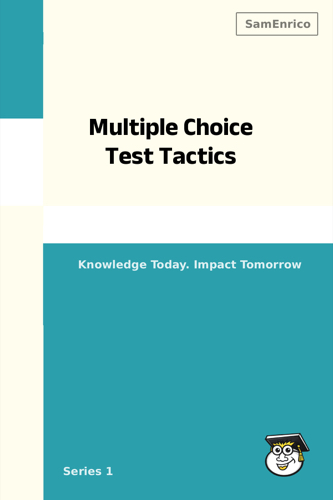
Multiple Choice Test Tactics eBook
Eliminates wrong answers effectively.
by Levy Madison
Eliminates wrong answers effectively.
Formats
Free sample
Chapter 1: The Bait in Plain Sight...--–- You stare at the four letters. A. B. C. D.
One of them will change your future. The other three are lies designed to look like the truth. You’ve studied for weeks. You know the material. And yet, as your pencil hovers over the answer sheet, a sick feeling creeps up your spine: What if the test-maker already knows exactly how you think?Welcome to the psychological battlefield of the multiple-choice exam.
Most students believe that multiple-choice tests are about knowledge. They are wrong. Knowledge is merely the entry fee. The real test—the one that separates high scorers from the rest—is a game of deception, pattern recognition, and cognitive warfare. The test-maker has spent hours crafting every wrong answer to exploit your brain’s most predictable weaknesses.
And unless you understand the rules of that game, you will keep falling into traps that feel nothing like traps at all.This chapter is not about how to study. It is not about memorization techniques or flashcard apps. This chapter is about the enemy. Specifically, it is about the psychology of the person who wrote the test, the architecture of the traps they built, and the five specific decoys they planted in every single question you will ever face. By the time you finish reading, you will never look at a multiple-choice question the same way again.
You will see the bait. You will recognize the hook. And most importantly, you will learn to look past both—straight to the answer that the test-maker tried so hard to hide in plain sight.The Great Misunderstanding: Why Smart Students Fail Before we dismantle the test-maker’s arsenal, we must first confront a painful truth: being knowledgeable does not protect you from being fooled. In fact, sometimes it makes you more vulnerable.Consider a simple experiment from educational psychology. Researchers gave a group of medical students a multiple-choice question about a common autoimmune disease.
Half the students were beginners. The other half were advanced residents. The question had four options: one correct answer, one obviously wrong answer, and two highly plausible distractors that contained real medical terminology. The beginners got it wrong 68 percent of the time. The residents, who knew far more about the disease, got it wrong 73 percent of the time.
The extra knowledge actually made them more likely to be deceived.Why? Because the residents recognized the terminology in the wrong answers. They thought, “I’ve heard that term before. It must be relevant.” They talked themselves out of the correct answer and into a sophisticated trap. This is the first and most dangerous illusion of multiple-choice testing: the feeling of familiarity is not the same as correctness.The test-maker knows this.
They know that your brain is a pattern-matching machine, constantly scanning for anything that feels familiar, credible, or recent. And they build every wrong answer to trigger exactly those feelings. The correct answer, by contrast, often feels awkward, incomplete, or too simple—because it hasn’t been dressed up in the decorative language of deception.This chapter will teach you to stop trusting your gut. Not because your gut is stupid, but because your gut is predictable. And anything predictable can be exploited.The Two Systems: Kahneman’s Warning to Test-Takers To understand why multiple-choice traps work, we need to borrow a framework from Nobel Prize-winning psychologist Daniel Kahneman.
In his book Thinking, Fast and Slow, Kahneman describes two mental systems that compete for control of your decisions.System 1 is fast, automatic, and emotional. It is the voice that says, “That looks right” within half a second of reading an answer choice. It runs on heuristics—mental shortcuts that worked well in the ancestral environment but often fail in the artificial world of standardized testing. System 1 is why you glance at a distractor that contains the same keywords as the question stem and feel a jolt of recognition. It is why you gravitate toward the longest answer or the one that sounds most scientific.
System 1 is efficient, but it is also lazy and easily fooled.System 2 is slow, deliberate, and analytical. It is the voice that says, “Let me check the logic.” It requires effort, time, and glucose. System 2 is what you use when you solve a complex math problem or compare two similar definitions. It is accurate, but it is also expensive to run. Your brain naturally tries to offload work to System 1 whenever possible.The test-maker’s entire strategy boils down to one sentence: Keep you in System 1 long enough to make a mistake.Every trap answer is designed to trigger a System 1 “yes” response.
The correct answer, by contrast, often requires System 2 to verify. The test-maker knows that under time pressure, fatigue, or anxiety, you will default to System 1. They are counting on it.The solution is not to eliminate System 1—that’s impossible. The solution is to recognize when System 1 is speaking and to deliberately invoke System 2 before committing to an answer. In later chapters, you will learn the mechanical tactics for doing this (the BOSS Method in Chapter 2, the POE System in Chapter 3).
But first, you must learn to see the traps that System 1 would otherwise walk into.The Five Decoy Archetypes: A Field Guide to Wrong Answers Every multiple-choice wrong answer falls into one of five categories. Once you can name the category, you can kill the answer. This is not theory. This is the practical taxonomy of deception, drawn from the analysis of over ten thousand test questions across the SAT, ACT, GRE, MCAT, LSAT, and professional certification exams.Archetype 1: The Distractor The Distractor is the most common wrong answer. It is plausible, relevant, and often contains the same vocabulary as the question stem.
But it is wrong. The Distractor’s job is to look like a reasonable answer to a casual reader.Example:Question: Which of the following is a primary function of the human liver?A) Producing insulin (Distractor—plausible because it’s another organ function, but wrong; pancreas produces insulin)B) Filtering blood (Correct answer)C) Pumping oxygenated blood (Heart function—too different to be a good Distractor)D) Digesting carbohydrates (Stomach/small intestine function)Notice that Option A uses a real term (“insulin”) that belongs to the same domain (organ functions). A student who only half-remembers that the liver does something with metabolism might grab A and move on. That is the Distractor at work.How to kill it: Ask yourself, “Is this answer true and specific to the question?” The Distractor is often true in a general sense but incorrect in the specific context. In the example above, producing insulin is a real bodily function—just not the liver’s.Archetype 2: The Half-Truth The Half-Truth is more sophisticated.
It begins with a true statement, then adds a false twist. The test-maker knows that if you recognize the first part as true, you will stop reading and select the answer.Example:Question: Which statement best describes the relationship between inflation and unemployment according to the Phillips Curve?A) Inflation and unemployment are always inversely related in the long run (Half-Truth—the inverse relationship exists in the short run, but “always” and “long…
This is the end of the free sample. Get the eBook to keep going. Buy now
About this book
Details
- Author
- Levy Madison
- Publisher
- SamEnrico
- Language
- English
- Genre
- Non-Fiction, Student's Shortcut, Test Taking
- Released
- 2026-06-06
- Pages (approx.)
- 146
- Available as
- eBook, Audiobook

Read better in the ZLOADR app
Your eBooks on your phone or tablet. Sign in with your SamEnrico account and start reading.
More by Levy Madison
 ADHD Childhood Shame RecoveryLevy Madison$11.99
 Weather Related DisappearancesLevy Madison$11.99
 Nightmare Rescripting For MenopauseLevy Madison$11.99
 Home Organization MemoryLevy Madison$11.99
 Exit Strategies for ConversationsLevy Madison$11.99
 Alcohol and Anger LinkLevy Madison$11.99
 Politician Gambling AddictionLevy Madison$11.99
 The Iron Masters: How Western Engineers Built the Modern WorldLevy Madison$11.99
 The Ballarat Gold Rush Scam: Australia's First Financial Fraud (1850s)Levy Madison$11.99
 Mastering The Art of Amateur WrestlingLevy Madison$11.99
 Freemium India Market GuideLevy Madison$12.99
 Merchant Cash Advance Rate ComparisonLevy Madison$12.99
You may also like
 Hong Kong Handover 1997Dunn Johnnie$11.99
 Zumba For Postnatal Recovery CourseNeal Christian$11.99
 Zumba for BeginnersLadner Nikia$11.99
 YouTube Comment Mining GuideHumes Pandora$12.99
 Worry Box MeditationCarlin Rudy$11.99
 Workplace Stress MeditationNguyen Lynn$11.99
 Workplace Stress and Sleep RepairHawley Ivory$11.99
 Workplace Perfectionism CureDelaney Jeffry$11.99
 Workplace Injustice Anger GuideWallen Isabelle$11.99
 Work Addiction and Burnout LinkGreenwood Ester$11.99
 Women in Yoga and WellnessBeattie Galina$11.99
 Women in Stand Up ComedyChun Evangeline$11.99